Agree to disagree but once again: be out there and then form your opinion, because I’ve seen it myself and loads are healthy.
I see it more as a pseudo-orbital route allowing the M1 to do its designed purpose: moving people to the city and back with extra capacity.
Not in a particularly efficient or convenient manner as all of the feeders are still woefully infrequent, which would also explain what @nathandavid88 said about newfound overcrowding on the 130, or the 150 in my case.
About the P88: do you know there’s already a way to get from Garden City to Indro and Toowong on a one-seat ride? Oh yeah, it’s the Great Circle LIne. If only TfB would reform the orbital to actually make it useful and frequent.
I think the argument would be the ability to transfer to local busses at Mount Gravatt, since many busses start and finish their routes there (allows a two seat journey interchanging at Mount Gravatt from a local bus to RBWH and Fortitude Valley - like taking the 545 then the 26).
I also think the routing might have been made (as you pointed out) as a peak service getting people from places of employment to houses, which the routing via Mount Gravatt does better than taking it to UQ (though there is of course housing in Fortitude Valley and near RBWH who would prefer a connection to uq)
However, if the patronage between Buranda and Mount Gravatt are low on the 26 and M1, you may have a point
See, peak loads would also be healthy on a route that started at UQ Lakes and not Upper Mt Gravatt. Again, there is little justification for duplicating the Brisbane Metro M1 service for 9 km. The new Brisbane Metro buses can fit 150 pax on them, so its not like space is lacking.
The whole purpose of bus network reform is to address these sort of issues that a peak-only focused network presents.
Good bus networks are built around all day service. There is no objection to the service being orbital; But we need a route that runs all day, not just in peak.
A service starting at UQ Lakes could do that. Patronage at UQ is all day, and is proven.
So the recommendation here is then that Route 26 should be considered for amalgamation with Route 29 and possibly 234 to form an all day service. That would close the timetable’s 7-hour service gap and provide a reliable all day orbital service that everyone - not just peak hour commuters - can use.
There might be other solutions or thoughts, that is fine too.
Dude, leave the metrobuses for that demand. These are not trains or trams so the “just make them transfer” idea isn’t going to work, and I have a lingering suspicion most people that got a route cut are doing the same thing and looking at options to avoid bus to bus transfers.
Anyways, I’m not gonna waste more bits taking to a wall.
Honestly there’s just too few bus connections going via the story bridge - you could have a few of the buses from the SEB go via the story bridge then go west into the city (like the 234, 232, 227)
Route 26 has a 7-hour service gap because the patronage is not there to support rocket buses to run during the day. So its usefulness isn’t going to really be comparable to say an all day BUZ or CityGlider route.
[HumanTransit Blog]
To complete your trip in a world-class transit system, you may have to make a connection, or “transfer” as Americans say. That is, you may have to get off one transit vehicle and onto another. You probably don’t like doing this, but if you demand no-transfer service, as many people do, you may be demanding a mediocre network for your city.
There are several reasons for this, but let’s start with the most selfish one: your travel time.
Well, when we stop spending money on wants, we’ll start having more money to spend on things like an upgraded GCL. Parts of Route 26 are useful, but not all of it.
In my opinion, it is definitely a duplication, but I’m not sure it’s a bad example of one - this is because, unlike a local route like the 203 (which ends at the PA), the 26 is a cross-town route, and so is busier (correct me if I am wrong), and hence moves more people faster. Therefore, keeping them on the bus allows the SEB to carry more people.
The reason it was probably chosen to extend southwards was because:
there is minimal link currently between Woolloongabba station and Buranda station right now (without transferring at Mater Hill)
Links between Buranda and UQ only occur north of Buranda station, making it more challenging (read:time consuming) to get the 26 to go via the Eastern Busway
Buranda and Mount Gravatt stations are major bus hubs, connecting both with Woolloongabba, Fortitude Valley and RBWH (at least better connect)
Buranda doesn’t seem to have a major area to turnaround/store buses (might be wrong on this)
I would like to also add: the connection to UQ lakes and the 26 bus does already exist without having to go via O’Keefe street - the 139,169,179, so an extension to UQ lakes would also be a duplication
Might explore the 26 route between Buranda and Mount Gravatt to check it out
I hear you, but it is a poor cross-town service because you cannot use it for the 7 hour gap period in the middle of the day. All-day service is a must have for a cross-town service.
Members should try and catch the service at 11 am from Upper Mt Gravatt Busway station - you can’t. The service does not exist then. This is why riding the bus during peak is not a good way to assess the utility of the route.
Other cross-town services, like the GCL or Route 369 run all day.
The connection between UMG and Woolloongabba stations is excellent, and something which used to require an irritating platform change transfer at Mater Hill. It’s also works as a kind of orbital, allowing ex-UMG passengers to get to the Valley quite quickly.
I believe it was also introduced to give CBD office workers who live on the southside another outbound option for those who work on the Northern end of the CBD (close to the Valley and Spring Hill) as with BNBN many of the southside rockets that used to start in that northern part of the city now no longer go there and instead start from Elizabeth or Mary streets.
Either way I’d rather see the service just made all day rather than removed. The 234 is a terrible service and something needs to be done about it yes, but it serves a very different purpose to the 26
That sounds like a good reason to extend it to being an all day service then, if it’s getting a reasonable number of passengers south of Buranda. Maybe that’s something to determine before getting rid of it altogether.
And regarding transfers, I agree it’s no big deal to get people to transfer once in their journey. But what if they have to transfer twice, or three times? Is that still a reasonable ask? Let’s remember Upper Mt Gravatt isn’t only a destination in itself, it’s also an interchange for suburban services. Some people are already transferring to or from there before the 26 comes into it. If a journey is cut from three services to two, I consider that to be a good change if enough people are benefiting.
The M1 Metro comes every few minutes. This means low patronage off peak on the 9 km duplicated section for this route, particularly if the bus is running 30 minutes or even 15 min daytime frequencies (likely case).
Route 77 is a similar service, low patronage in the off-peak saw its frequency cut back.
UQ Lakes is the better origin. Second largest destination after the Brisbane CBD.
Well, less duplication is desirable than more. So is connecting a more popular destination than a less popular one.
Responding to your main point: Route 29, a very short shuttle, exists due to the very high demand in this ‘duplicated’ section. Extending it (via merger with other routes) would allow it to continue this role and connect new northside destinations.
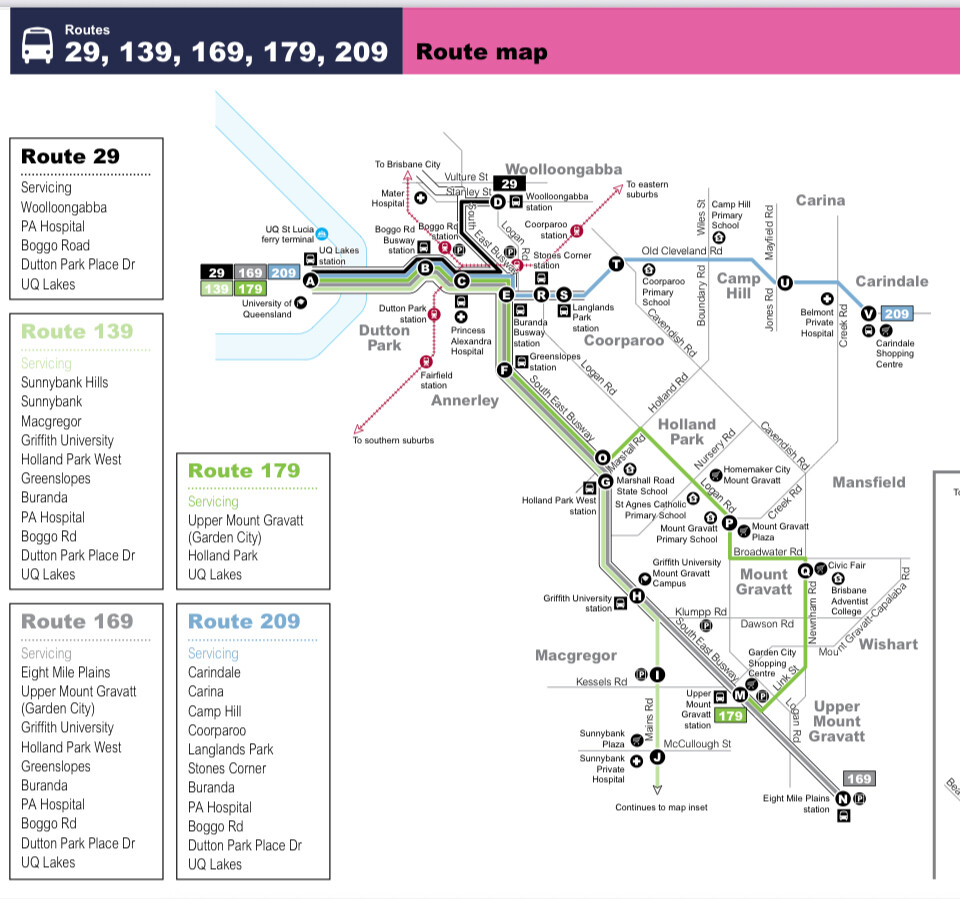
UQ Lakes already supports five non-CBD cross town bus routes, all running 15 min or better, all day (29, 139, 179, 169, 209). It’s a very good all-day terminus, and a valuable destination to add on a cross-town network.
You don’t want to deduplicate for the sake of it. If the loading is good from Buranda to Upper Mt Gravatt, then it’s fine to stay IMO. If we got rid of all duplication, the metros would be overloaded constantly.
On the back of reading the thread this morning, I decided to catch a 26 this morning (from Griffith University to Thornton Street to be precise) to see it for myself.
When I got on, the number of pax looked to be ~half the seated capacity of the bus (not bad for the second stop!) with that rising to between 2/3 to 3/4 seated capacity by the time we got to Woolloongabba. It wasn’t carrying air, but it wasn’t a sardine tin either.
What I will say is that while it may duplicate the M1 route, it wasn’t being used by passengers in that way. From when I got on, while we stopped at every busway station through to Woolloongabba to collect passengers (a steady 2-4 at every station, even HPW and Greenslopes), not one person got off the bus until we reached Woolloongabba (and even there, only a single person got off). Everyone else onboard was heading beyond the Gabba.
Going up Kangaroo Point, we picked up a couple of people at pretty well every stop, and lost one or two along the way (myself included), but there weren’t that many empty seats left by the time I got off at Thornton Street.
I think it’s quite a useful route, and I would certainly investigate making it an all day high frequency route. I’d catch it again to add some some variety to my morning walk to work.
If you went that route, I would push for it to extend to the SEB in some capacity rather than stopping at Woolloongabba, as doing that precludes direct interchanging from M1 services.
If you absolutely don’t want to run it to UMG because it duplicates the M1 route, and because running it to UQ Lakes duplicates the M2 route (and it requires the awkward dogleg manoeuvre onto/off of O’Keefe Street to service Buranda), I’d make such a route run RBWH to Langlands Park.