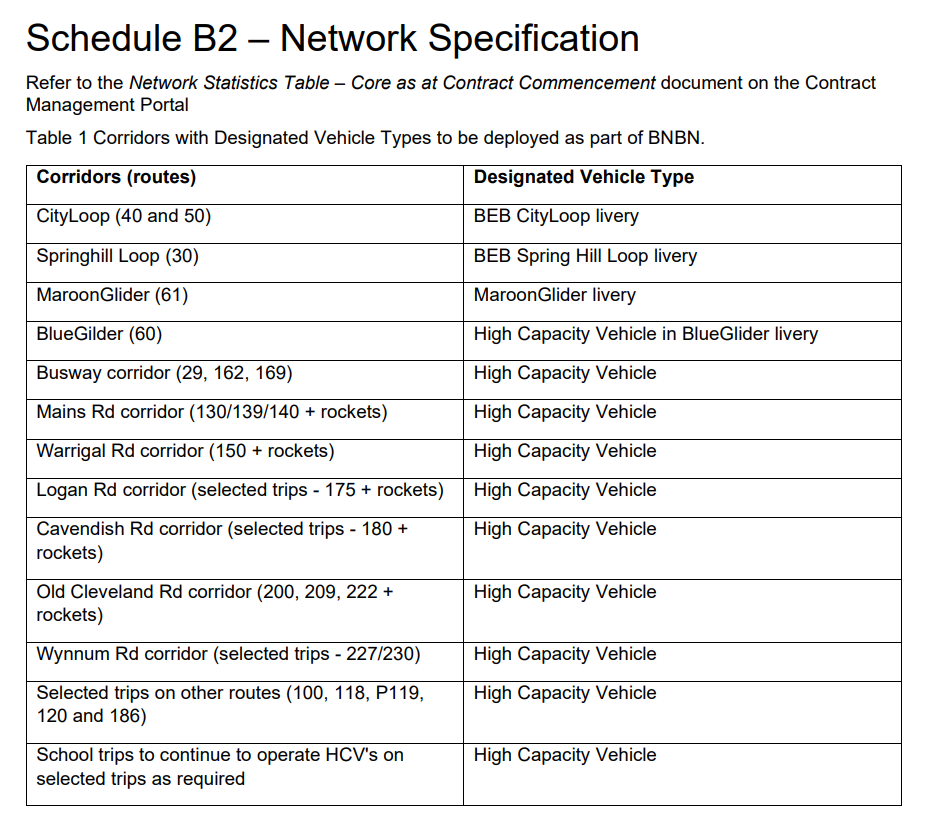
Below are a list of bus routes that TMR and Transport for Brisbane have agreed as per the BNBN that require high capacity vehicles - ie. a 14.5m TAG axle bus or an articulated bus:
Note: There is no mention of any high capacity vehicles set aside for high patronage northside routes (ie. 330, 333, 340, 345, 385, 412, 444), as Virginia, Toowong, and Eagle Farm depots’ neither have 14.5m TAG axle buses or artics with a non-glider livery.
Interestingly, the Old Cleveland Rd corridor warrants ‘high capacity vehicles’, yet on weekends Carina bus depot seems unwilling to deploy their 14.5m TAG axle vehicles. All you see are rigid buses doing the 200/204/222 out in the eastern suburbs on a Saturday
Maybe the thinking is that the high capacity vehicles are mainly required for the weekday runs? I don’t get out that way often, are the smaller buses getting swamped on the weekend runs?
The only northside routes that genuinely require a high capacity vehicle on the regular is the 60, 330, 333. Along with the 345 in peak hour only. All other routes would be better off having improved frequency on a 12m bus rather than longer vehicles.
Brisbane times article essentially confirming prior research that off-peak is where the patronage gains are, even though this may seem counter-intuitive.
To be fair, they do specifically point out that this was the case:
”During the first seven months of the new network, the route with the biggest surge in patronage – 190 per cent – was the 107, which was realigned to become an all-day service operating between Yeerongpilly and the city via the Boggo Road busway station and South Bank.”
For anyone who can’t see the article, the other routes were:
The 171, which has a new alignment travelling through Mount Gravatt with increased frequency and extra hours, had a 115 per cent patronage increase.
The 205 from Carindale Heights, which changed from a peak-only service to all day, had a 97 per cent increase in patronage.
The 131 from Parkinson, which merged with route P129, and the 185 from Upper Mount Gravatt, which merged with route 184, both had a 64 per cent increase in patronage.
The 116, which had its route changed and extended to Upper Mount Gravatt, had a 47 per cent increase.
It’s not just that it went to all day - it actually replaced the 105 for the Yeronga-City segment. You really need to compare the combined patronage for those two and the 108 to get a meaningful before/after comparison.
I’m a bit suss on this. Why wouldn’t the 10% “surge” in bus trips be best explained by passengers being moved from 1-seat journeys to 2-seat journeys? Have I missed something that suggests this is an increase in passengers journeys (i.e. home to CBD) rather than individual bus trip “segments” (i.e. home to Metro interchange, then interchange to CBD)?
There is still a lot of ill feeling in the part of the community that have lost their single seat journeys and are now forced to transfer, so I imagine that Council wouldn’t want to associate the patronage surge with forced transfers (although, in commentary on this article I’ve seen, people are already drawing that possible conclusion).
That said, I don’t think we know if the numbers council are spruiking are derived solely from increases of pax per service, or whether they are counting increases in journeys recorded.
As I said before, having to transfer isn’t the problem: it’s that the feeders are simply too weak due to poor frequency.
Sure, your local cityexpress was hourly but at least it allowed you to get to Cultural Centre or the CBD in one go. Now? It’s still hourly but with a transfer, so in the end you gained pretty much nothing.
As metrobuses run on a 5-10 minute headway feeders could have frequency increases to 2 to 3 bph that could very well align with a quick 60~120 second transfer at a busway station.
That definitely IS the issue, but for some people out there, it is just having to transfer at all that is a “life altering problem”.
I have seen people complaining about how their Northern Busway service terminating at Queen Street instead of Cultural Centre ruins their life, regardless of how easy it is to transfer to an M1 or M2 at Roma Street or KGS, or that their frequent services through Woolloongabba now bypassing the Cultural Centre is akin to a crime against humanity, despite being easily able to transfer to the 4 or 5 high frequency services that also pass through the Gabba.
(I acknowledge that this can be an issue for people with disabilities, but the majority of people I’ve seen complaining about this don’t fall into this category).
I’ve seen that story happening multiple times on my old hometown and guess what? People got used to it over time.
Although I will say that maybe it would’ve been more intelligent to merge the 333 and 340 into just one 6-7min route via Capt Cook Bridge, with the 330 going to the Gabba via South Bank instead.
Removing car lanes or inconveniencing road users for buses, trams/LRT, or cycling lanes seems to also be a crime against humanity.
These same people you refer to are probably scared stiff to take a different bus, even though they are going to the same area. If this is an ongoing issue then its up to Translink to refine the signage and mapping of transfers.
The popular 3XX’s and the 1XX’s services that terminate at QSBS work and they make for good transfers between both.
Oh that’s right we are not allowed to make bus changes until the 2028 ‘fake metro’ extension review is released. Translink can implement this tomorrow without involving the BCC.
I think the 333 is the route they want to make into a “Metro” at some point, so they’ve made it match what they intend to be the future “Metro” route as closely as possible. I agree the routes should have been merged though. A 340 curtailed at Chermside could probably have run every 10-15 minutes while the 333 ran every 5-7.5 minutes in peak.