This makes no sense to me. Taking public transport will already be a saving compared to using petrol. A better solution for reducing private fuel demand would be to turn a lane of every main road into a bus lane.
4 Likes
I think that a lot of points being made in this video are similar to others being made on the forum, but I think that it misses the point of the political climate. Sure, ideally fare revenue could be reinvested into public transport systems and in other systems this very well may be what would have happened in the same circumstance where either fares were reduced or the revenue was invested but this ignores that politically in Queensland there was no will or systematic plans for any of the expansions that the foregone revenue could have funded like duplication of the Cleveland line, an increased BUZ network, or doubling rail frequency. I think it is really self-evident that if 50 cents hadn’t happened they still wouldn’t have done this since they weren’t doing it when Queensland had the most expensive fares in the country. I think the real problem with 50 cent fares is that if a new government or a current government finally decides to consider carrying out these aforementioned improvements in a systematic way the expectation of 50 cents may make it hard to use fare increases as a way to raise revenue for funding these improvements. But again, those making these economic arguments need to also consider the political environment because politics do not exist in a completely economically rational vacuum. If they hadn’t done this we would likely still be paying more than Sydneysiders and Melbournians while getting a far worse service overall and that I think was really toxic to the encouragement of PT use in QLD.
3 Likes
Well, if $12 billion were used to fund a road project and there were no plans or will to to use that for public transport, we would all agree to not oppose that project as there was no political path to have those funds made available for public transport?
Why be selective about when an opportunity cost does and does not apply? Governments always have alternative choices, even if they choose not to consider or exercise them.
Indeed, the whole idea of money is that it is fungible, that is it can be used for one or many different things, interchangeably.
Of course we should still oppose road project because those would have virtually no benefit to public transport users or encourage public transport uptake. To be clear I didn’t actually support the 50 cent scheme, I thought that fares needed to be reduced because the previous fares discouraged public transport use for people who had the option of public transport, but 50 cents for all trips at any time and any distance was going too far in my opinion. Of course governments still have other options and we should campaign for the governments to take those options but denying the political reality and acting as if things were a binary between investing in the pt system and having cheaper fares is just not useful.
Additionally there is the opportunity cost of having a public transport system that is not positively received by patrons, if fares are too high people feel ripped off, and if we want to encourage public transport I think that’s the worst feeling you want to engender in patrons. Places where public transport is the primary mode of transport and is a priority for investment tend to have people who enjoy and already feel grateful for their public transport systems. That goodwill is hard to quantify materially but considering how it seems to me to be the case in basically every transit oriented city/region I think its still important to consider. Additionally in the video its mentioned that lower fares made people feel safer on public transport and even if it seems illogical that doesn’t change the fact that it is a benefit of the 50 cent scheme, and while again that is hard to quantify I think its fair to say that it is fairly important for people to feel safe to want to use public transport even if they already were statistically safer than if they were driving themselves around.
4 Likes
Well, suppose the Queensland Government announced tomorrow 50c per litre subsidised petrol for everyone. It would have pretty much similar benefits, be even more politically popular right now, and be a cost of living measure too.
Yes it would probably cost billions, but that money was never politically destined to be spent on PT, right?
It’s excellent that the video actually did proper statistics, showing that the patronage increase after the 50c fares measure is statistically insignificant when the proper baselines are used, and thus shows that patronage increases are likely due to Covid19 ‘rebound’.
9News Melbourne
Victoria’s public transport system is struggling to cope with the added number of commuters now taking advantage of the state Government’s free ride as queues and crowded stations are stretching services to the limit.
Not working in peak for long distance
Sounds like free fares are working to attract patronage. What’s not working is disabling the booking/seat reservation system to manage capacity on the services.
3 Likes
Even with free booking, demand would be in excess of supplied capacity at peak, and you cannot easily add additional service in peak without infrastructure upgrades ($).
A better policy would have been to charge a lower fare in peak, and possibly no fare in off peak if they wanted that.
You also have to consider customer experience. Suppose you have to travel to Melbourne for work Monday - Friday in peak. It has to be in peak because those are your set work hours.
Now imagine booking for free - with high demand, you might be able to book Monday, Tuesday is already booked out, Wednesday you book a seat, Thursday and Friday are booked out in advance.
There are going to be days where you might actually miss work or be late for it because of this.
I’m curious about how you would assess whether free PT is “working”, Metro?
I haven’t seen any hard data yet, but based on the reporting above it looks like a substantial increase in ridership.
Strikes me that there are almost no public transport projects that would generate anything like the same patronage bump per $ spent. Certainly none which can be implemented at the push of a button with zero tons of new concrete, steel and near zero extra hours of labour.w
Seating on a regional train during peak is a limited and scare resource and thus should be appropriately priced to meter demand. This means that those who can travel in the off peak do so. Its the same rationale for pricing peak hour congestion and charging for car parking.
Setting the ticket price to zero means the demand is far beyond what can be reasonably accommodated and it degrades the passenger experience both due to overcrowding effects and increased uncertainty about whether they can catch the service or whether they will have to miss it (with an extended wait time penalty).
Which is what the complaint passengers have been making.
Also, it is possible to lower fares to a lower level that isn’t zero fare. That would balance both affordability and the reality that there are only so many seats to go around.
The data suggests - outside of the context of an oil crisis - that generally these additional trips are induced demand from existing users and not new users from motorists. (e.g. https://ses.library.usyd.edu.au/handle/2123/33947)
And it is not cheap or easy to increase transport service supply in peak because the network is constrained during this time (e.g. a limited number of slots for trains exists into the city). Increasing peak capacity generally entails extensive infrastructure works ($$$). Hence the importance of appropriate time-of-day pricing.
It sounds like your answer to that question is something like: “Free PT would be working if it (a) appropriately shifts demand away from peak PT to off-peak PT without undue shifting from peak PT to car travel, (b) shifts trips from cars onto PT in general. Have I got that about right?
I don’t use an “is it working” framework. Many poor policies can be said “to work” if you merely define working as existing.
The Policy Platform sets out performance and merit as evaluation criteria for any policy.
A better approach is to look at whether a policy is causing large negative impacts, and ask if these impacts are avoidable. The answer is yes on both counts in this case.
Passengers have been complaining, that is the clue. And unlike an urban or suburban service, one can’t just jump into an uber or taxi to make up the missed service. The locations are too far away to do that.
The demand exceeds the available supply of seats in peak. A price would bring these two into balance. You can still have free service if desired in the off-peak provided that crowding wasn’t an issue.
Victoria has made public transport free – NSW hasn’t. Has there been any difference in uptake? by Milad Hagani, Iman Taheri Sarteshnizi, Neema Nassir, The University of Melbourne. Victoria has made public transport free – NSW hasn’t. Has there been any difference in uptake?
Published: April 14, 2026 10.46am AEST
Method
What had not been tested is how people respond under a sudden fuel price increase. This created a rare situation where past evidence offered limited guidance.
We therefore examined this empirically. We surveyed nearly 2,000 Australians across Victoria, New South Wales and Queensland about a week after free public transport was introduced in Victoria. This allowed us to observe how travellers responded to rising fuel prices under different public transport pricing regimes.
Results
Minimal difference in traveller response between full fare, free and near-free PT jurisdictions.
NSW - full fares
QLD - Near-free
Victoria - Free PT
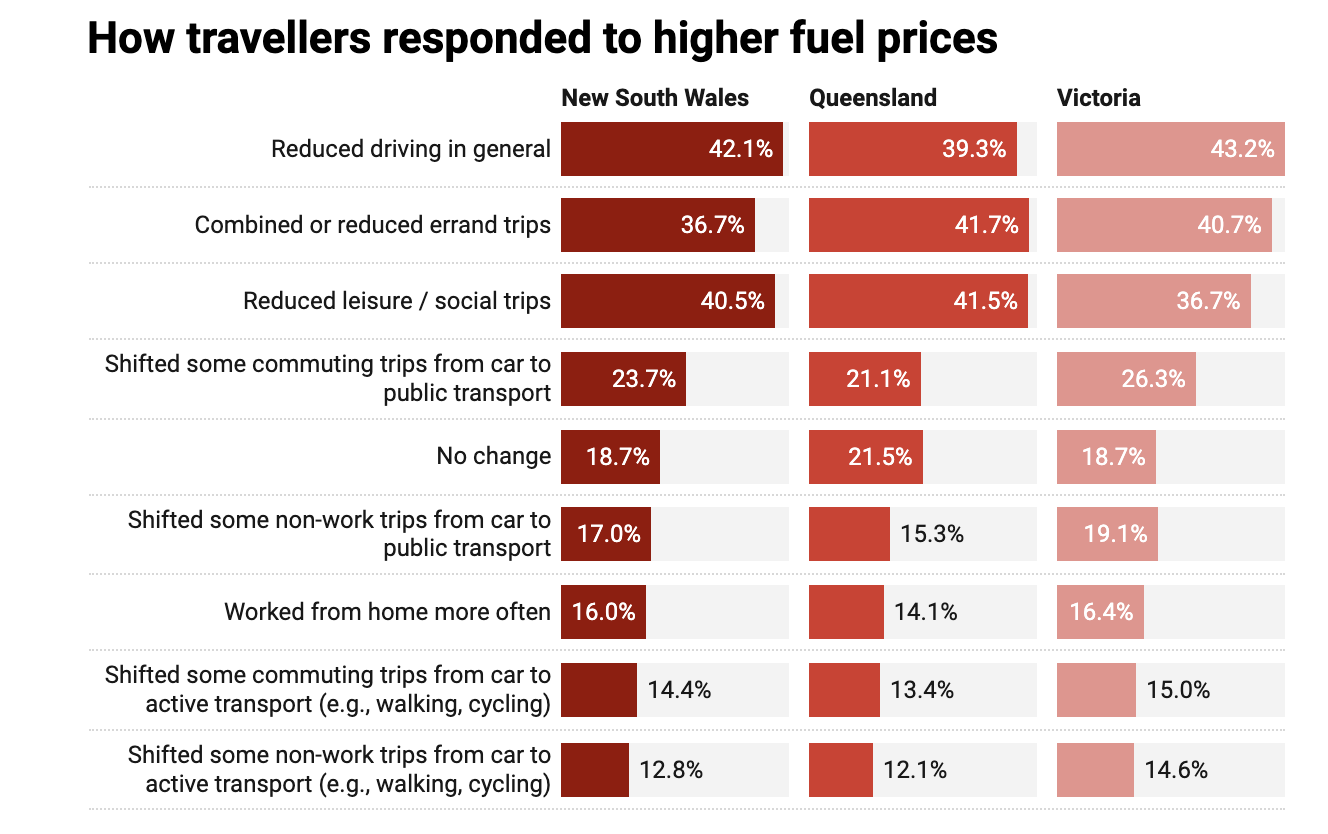
In Queensland, where fares were already heavily discounted, 21% reported shifting some commuting trips from car to public transport. This compares to about 24% in NSW and 26% in Victoria.
Conclusion
Low or no fare-PT is a popular, ineffective (and costly) policy. This evidence suggests that as soon as fuel prices come down, people who may have switched, will switch back to driving.
But the broader reduction in car use appears to have been driven by fuel prices themselves, not fare policy. Victoria’s free public transport may have helped at the margins, but it did not produce a markedly different outcome from states that did not intervene.
This suggests that while fare relief is popular and can expand options, it is not, on its own, a decisive lever for reducing car dependence.
Notes
1 Like
3 Likes
The other, and I would say more significant, conclusion to draw from this data is that car drivers are surprisingly price-sensitive to changes in their transport cost per kilometer.
A very dramatic change in transport behaviour in response to a ~25% change in the marginal cost of driving is quite an interesting result!
They are, which is the basis for Road User Charging which is being rolled out in NZ.
University of Melbourne study into free public transport and comparing it to NSW finds that it doesn’t really result in mode shift, raises equity issues and mainly benefits existing users.
1 Like
Mode shift from active transport to bus for school students (though in the Australian context, active transport to school has reached very low levels anyway)