I personally am ok with the Victoria park stadium and believe it along side the park conversion, is a great way to show off First Nations culture and modern Australia. It just needs to have the right transport infrastructure!
3 Likes
Brisbane Times has been doing some advocacy and it seems that everyone wants better infrastructure and public transport
1 Like
Exact location of Victoria Park stadium yet to be decided
By Cameron Atfield
March 27, 2025 — 4.00am
The exact location of Brisbane’s main Olympic stadium has not been determined, though one thing is certain – it will be somewhere within Victoria Park.
Games Independent Infrastructure and Coordination Authority chairman Stephen Conry said on Wednesday the artistic render released when Victoria Park was announcedwas indicative only.
That image, with the stadium at the southern end of the park, came from a submission to GIICA during its 100-day review, but the precise location and design for Brisbane Stadium was still to be determined.
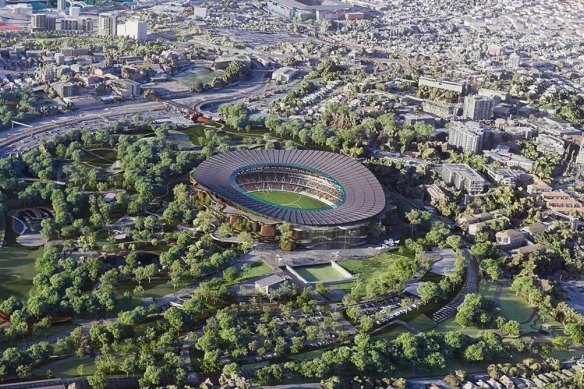
The Brisbane Stadium render released by the Queensland government this week.CREDIT: QUEENSLAND GOVERNMENT
The previously publicised Brisbane Bold proposal from architectural firm Archipelago had the stadium further east, and closer to the Inner City Bypass.
Last year’s 60-day venue review, commissioned by then-premier Steven Miles, recommended a new stadium for Victoria Park. The head of that review team, former lord mayor Graham Quirk, told this masthead last year their preferred location was the site of the existing golf club and car park.
Tuesday’s release of the review, and the government’s response, sets the scene for more detailed work to be done.
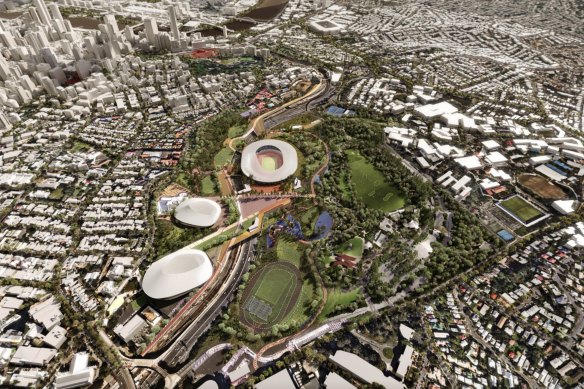
Archipelago’s Victoria Park stadium proposal.CREDIT: ARCHIPELAGO
“There are lots of renders, there are lots of ideas around a stadium,” Conry said.
“Various proposals were put forward. The final design, of course – the final site within Victoria Park – is now to be resolved.”
The venue, which GIICA recommended be called Brisbane Stadium in perpetuity, thus ruling out a naming rights sponsor, would host athletics, track and field, and the opening and closing ceremonies in 2032.
While most stakeholders have welcomed the decision – with the notable exceptions of theSave Victoria Park group, the Greens and the Labor state opposition – Australian Athletics has expressed some reservations.
Chief executive Simon Hollingsworth said Australian Athletics had presented two preferred options to GIICA – for the warm-up track to be kept as a permanent competition venue, or a modest upgrade of QSAC that could be funded in part by the recycling of the temporary aluminium stands, which were installed for the 1982 Commonwealth Games.
Conry said the planned warm-up track, which GIICA recommended be located on the other side of Gilchrist Avenue to the stadium, could be retained as a permanent legacy.
“It won’t be a temporary facility necessarily – it can be a long-term facility with a car park underneath it,” he said.
Hollingsworth said Australian Athletics would welcome any new community facility, but a competition-grade venue was a must.
“As it currently stands, unless something is done, Brisbane will not have an international and national standard venue, and it will be the only capital city in Australia that doesn’t,” he said.
In its report, GIICA recommended upgrades to potential Games training venues, with a “particular focus” on QSAC, along with Perry Park.
As for the Victoria Park stadium’s construction, GIICA expected the design to be finalised by mid-2027, with completion in 2031 – a year before the Games.
Conry said he had no concerns about sourcing a workforce to construct the Brisbane Stadium and other Olympic and Paralympic venues across the state.
“You can see some softening in the labour markets in other states. It’s not softening in Queensland because of the infrastructure spend for the Brisbane 2032 Games,” he said.
Conry was also confident of delivering the stadium within the $3.79 billion budget.
“We will make sure that the design and construction costs are within that budget,” he said.
“We are designing to a budget now, and we believe the number that has been allocated is the correct number.”
One thing the cost did not include was transport links.
“There’s always going to be costs associated with infrastructure that’s not part of the stadium, not part of the Games in 2032,” Conry said.
“Councils and all the relevant authorities will deal with infrastructure that might be required around the Games, including transport, but of course, that’s a separate cost.”
Deputy Premier Jarrod Bleijie told an Infrastructure Association of Queensland breakfast on Wednesday the LNP government could pay a political cost for breaking its pre-election pledge of no new stadiums.
“You all know what we said prior to the election, but we’ll cop that on the chin,” he said.
“The premier [David Crisafulli] made it clear yesterday, we weren’t going to put our political position or political future ahead of what is in the best interest of Queensland.”
At the same breakfast, Conry said it came down to a choice between the Gabba and Victoria Park.
“We found that Victoria Park is an unparalleled choice for a new stadium,” he said.
“The location achieves extremely important criterion for success: to stay as close as possible to the CBD, close to entertainment options – in this case, apart from the CBD, you’ve got Fortitude Valley and Paddington – and close to a variety of transport options.
“We believe we’ve achieved that, and we believe that the decision to proceed with Victoria Park has been widely accepted.”
Brisbane 2032 president Andrew Liveris said the plan had also received the backing of the international Olympic and Paralympic committees, as he confirmed his disquiet last year, when Steven Miles chose the Queensland Sport and Athletics Centre as the main stadium.
“I was very quick last year, when QSAC was announced, to basically say nothing,” he told the IAQ breakfast.
“I think you needed to say something. You needed to all say, ‘Is this what you want for your opening and closing ceremony and your athletics?’ because if it is what you want, then we [the organising committee] will go and try to make it work.
“Clearly, it’s not what you want.”
But not everyone was happy with the plan.
The Save Victoria Park campaign has raised more than $35,000 in the past two weeks to fund a legal challenge against the stadium’s construction, while other opponents have applied for the former golf course to be heritage-listed.
Considering Sydney’s PT infrastructure timeline post Olympics of 35-40 years, I can’t see significant changes occuring here in Bne pre Olympics. What I can see though is completion of projects already in the pipeline and some added Bne Metro bus routes which are still in the planning phase. Additionally BCC are still to engage in stage 2 of their bus reform initiatives prior to 2031.
There are also hints of 9 car services running between the Sunshine Coast and Gold Coast now, since the announcement of the Ekka platform extension. Furthermore, with ETCS we are likely to see efficiency in train operations on these lines with driver only operations, thus, freeing up funds and resources for frequency upgrades on the remaining parts of the network.
Post Olympics we are likely to see significant investment in Public Transport projects similar to Melbourne and Sydney, but unlikely to become into fruition until 2045-50.
Do you think the Northern and Eastern Metro extensions will come with busway extensions?
I vaguely recall that BCC’s original announcement for the Northern extension was contingent on the state government building the Northern Busway extension?
ADDIT: I suppose it also depends on what the state government decides regarding the Gympie road tunnel? Given that they halted the last segment of the Northern transitway pending that decision?
Someone fill me in. What was wrong with QSAC apart from the fact no one could reach it? Why couldn’t we have added light rail or any rail to the southside? The inner south is pretty barren, with wide roads. Could we have not added at least a tram?
And what is wrong with a temporary stadium? We have moved beyond the mistakes made in previous Olympics/world cups/etc. It’s not sustainable to build billion dollar stadiums to be used for a few months. The best Olympics cities like LA were chosen because they had all the sporting infrastructure. Our Olympics was supposed to be a return to modesty. What is modest about this stadium? If the Lions and Cricket Australia want a new stadium, they can fund it themselves. Private stadiums are more sustainable anyway. Premier league clubs are moving towards building their own stadiums and renting them out.
I just don’t see why the government should prioritise stadiums and cheap out on transport. It should be the other way around. Transport has a greater benefit to society. I know I’m preaching to the converted, but what will be more embarrassing; a minimal but fit-for-purpose stadium, or a sh!t transport system that’s dependent on buses?
Maybe I’m missing something.
1 Like
Also no hospitality precinct around it, just a forest, a cemetery and two arterial roads, one of which is a major freight route. This is the sort of place that will never, ever be an activated streetscape for pedestrians.
You might ask why that matters. I would respond by asking whether the point is to have just any stadium, or a stadium that actually gets regular high patronage and boosts the local economy. If the stadium is intended to just host the Olympics and Paralympics and sit around collecting dust for decades afterwards, then it can go pretty much anywhere. But that’s a huge amount of money spent for just one month of events, whereas spending more money but getting a full replacement for the Gabba (which has myriad issues) is a much better value proposition.
For a Gabba replacement, it needs to be accessible to most of Brisbane (therefore not too far from the CBD), have numerous hospitality venues around it and not be a depressing place to walk around. That’s what gets fans to attend events regularly. QSAC offers none of those things.
Considering how much time and money CRR is taking, and considering the state also needs to build GCLR stage 4 and DSCRL before the Olympics (and won’t even get the full DSCRL done), what chance is there that adding another rail link could be done before 2032 for a reasonable price? I would consider it close to zero chance.
Also, it wasn’t that long ago that the Kessels/Mains intersection had major surgery done to it, in order to allow road freight running along Kessels to bypass it. I can’t see any government being willing spend billions to tear that up and shoehorn in a light rail line from Garden City.
The only thing that could have been built in time for a reasonable price was bus lanes, and those can go anywhere. They can just as easily build bus lanes to Victoria Park along Kelvin Grove Rd and Brunswick St if they need to, except these wouldn’t be the main public transport corridors, they’d just be supplementing a busway and a rail line. At QSAC they’d be the only public transport corridors available.
They don’t save much money.
Correct, it isn’t, except that’s exactly what QSAC would’ve been. Victoria Park will be used all year for decades to come.
There’s only a point to modesty if there’s no ongoing use for the facility. Unlike almost every other country in the world, we have a year-round need for a large oval stadium, so the value proposition for a facility that isn’t modest is better than it is anywhere else. We’re not playing by the same rules as other Olympics cities in this regard.
Perhaps they could, but this isn’t the way things have been done in Australia up until now. The practice we’ve always had is the government builds and owns stadiums, and rents them out for major events. I can only think of one privately owned outdoor stadium in the whole country, Docklands, which is the home ground of four AFL teams rather than one, and is in the same city as an even bigger publicly owned oval stadium.
The AFL and Cricket could also quite rightly ask why the government was willing to rebuild Lang Park and give Townsville a new NRL stadium but won’t help them out when the Gabba needs a massive upgrade to keep operating anyway.
Premier League clubs can do that because they are owned by billionaires who will spend to boost their ego, or petrostates seeking to draw attention away from their human rights abuses.
You should be extremely glad we didn’t go with QSAC which would have been entirely dependent on buses, whereas Victoria Park will be accessible from the Exhibition CRR station and the Northern Busway.
3 Likes
Sadly, no, I don’t think either the Northern or Eastern metros will come with dedicated busway extensions. With how expensive construction has become, I think we’re all going to need to get used to “transitways”, because in many cases they’ll be the most that politicians will be willing to build, as they’ll deem grade-separated transport corridors to be too expensive.
The major projects that have been announced for the Olympics will all happen (DSCRL, GCLR stage 4, The Wave), but I wouldn’t count on any other new rail or busway projects in the foreseeable unless they’re in a marginal electorate. Ripley and Flagstone voters had better get the picture real quick if they ever want the railway to come to them in their lifetimes.
1 Like
Thanks for the response mate.
I should have said I thought QSAC was only a good idea GIVEN another southern transport project was done, which I would support (pipedream).
I didn’t know just how little the price jump was from QSAC redevelopment to a new stadium. From ~2 billion to ~4. This is reasonable.
In regards to funding the stadium, I still believe having private money pay at least some of the bill is a better idea, even if it means the government loses control of the stadium to a degree.
The revenue from sport-owned stadiums is enough of a draw for the codes. In the case of Tottenham Hotspur (and Everton to come, Juventus) massively increased their revenue, and the stadium has better amenities(restaurants, entertainment etc) because the club finds them that profitable to offer. Even outside of blood money clubs, it’s proving sustainable. Plus, the government could save a bit on the construction.
I suppose it bothers me that we can cough up the full bill for stadiums, but insist on public private partnerships, or just cheaping out completely when it comes to transit.
Speaking of, I just looked up how much GCLR4 costs compared to Parramatta light rail. That must to be due to privatising the planning and consultation. Maybe I’m mistaken, but I refuse to believe a tram in a denser place where land costs more is naturally cheaper than one that goes in a straight line on the Gold Coast. We have to start in-housing the projects as much as possible.
It’s not due to privatising the planning and consultation. Both GCLRT and Parramatta Light Rail are private, so the variation has to be attributed to something else.
See here https://greatrivercity.com.au/
It seems you massively overestimate the income of local sports clubs. Hotspurs had an estimated income of around $1.15 billion in 2022/23. That’s more than the revenue of the entire NRL ($744 million). The Brisbane Broncos, one of the few publicly-listed clubs in Australia, had revenues of $81.5 million in 2024.
Around half the length of Parramatta LR used the old Carlingford railway line corridor. That probably saved a big chunk of money.
Btw, how cheap do you realistically think land is on the Gold Coast coastal stop vs Parramatta? We’re not talking Upper Coomera or Nerang here, where land is (relatively) cheap.
Parramatta also didn’t have to build bridges across two environmentally-sensitive creeks and through protected bushland areas. Parramatta also didn’t involve tunnelling, which GCLR4 probably will.
So yes, there’s plenty of reasons for it to be more expensive.
2 Likes
You’re welcome.
Yeah the economics of it meant QSAC was a third-rate idea. For what it’s worth, if QSAC could have been done for $250 million or less, I think many people would have been in favour of it. But those days of construction costs in Queensland are over.
If it was a good idea, there’d be more than one privately-owned stadium in Australia already. We simply don’t have the population and regular major events for private companies to be willing to fund and own stadiums themselves. The exception might be an indoor arena, because they’re so multifunctional they can host concerts, sporting events and large conventions. And that’s why the government is choosing to fund and own the outdoor stadium themselves and get the private sector to fund and own the indoor arena.
Soccer is the undisputed major sport of both the UK and Italy, here we’re split between AFL and NRL. Maybe if we had one major sport only it would be more profitable.
All of those clubs play at least twice as many games at home as AFL teams, between league and domestic cups, and for Spurs and Juventus they have European games on top of that. They can also get more businesses buying corporate boxes because there are many more big businesses in those countries.
Also, their construction costs are lower, and they make far more money from TV rights than any Australian sport does.
PPP involves the private sector providing capital funding in return for an ownership stake. Which of CRR, DSCRL, GCLR, the Kippa-Ring line and the Springfield line were built through PPP? The answer is, none of them. The only PPP transport projects in SEQ that I can think of were the Airport line and the toll tunnels. What you can argue is the other projects were built through contracting parts of the project out to the private sector, most notably construction, but the same is true of stadiums.
Also, stadiums only get built or replaced every 30-40 years, there are many transport projects built in that time frame, as there should be. Just like everyone else here, I want more money for public transport projects. But they’re not underfunded due to stadium construction, they’re underfunded due to road and highway construction, and a general failure of government to tax businesses and asset owners properly.
I think there are many reasons why our construction costs are high, and the money-grubbing private sector is one, but not the biggest one. The biggest issue is our massive skills shortage when it comes to construction workers. This has been a steadily growing problem for over 20 years now and I don’t see any level of government addressing it.
CRR and GCLRT are both PPP. It is advisable to research these projects and their background.
Not all PPP’s involve an ownership stake being taken. As Metro says, GCLR and CRR are both PPPs:
1 Like
So we get the infrastructure and don’t give up any stake in ownership? Great. Then payments can be conditional on performance if the private company doesn’t own the asset.
I realise we didn’t discuss this at all on Sunday, but I’d like to put some more thought (and if it’s good, a media release) into concept of an events-only station along the Ekka loop, to be used by non CRR trains.
The big constraint is that there’s only the one bypass track at Exhibition and no good prospects for adding another, so only a small handful of trains can come or continue from the Northside.
So I think the shape of it has to be a shuttle to Roma St, or perhaps sometimes via Milton.
It looks like there’s about 25m in the corridor which (at slightly more than what Ferny Grove has) so there should be enough for an island platform. I don’t think we’ll have the (straight-track) length for something like the old style Ekka arrangement though, with separate arrival and departure platforms.
If it’s heavily tidal then an island platform will probably be fine for a shuttle. If it’s not tidal (and, we assume, has full-train bidirectional loads) I think that would be much better with separate platforms…
The station could be serviced by trains heading towards Roma Street from Mayne Yard (via the bypass track at Exhibition) which then continue to Roma Street and continue running North.
1 Like
Why is it needed? Can’t CRR ramp up during events
Closer than Exhibition by a fair margin and adds practically another track pair’s worth of capacity to and from the area.
(Sure Ekka station and the tunnel stations will 9 car capable by then, but what about the Gold Coast, Beenleigh, Redcliffe & Caboolture lines?)
Also allows for the possibility of expanding direct service to more lines as RowBro notes.
BTW, I learned on Wednesday that for Expo every line was routed via South Bank somehow!
Would be good to see a box on a map