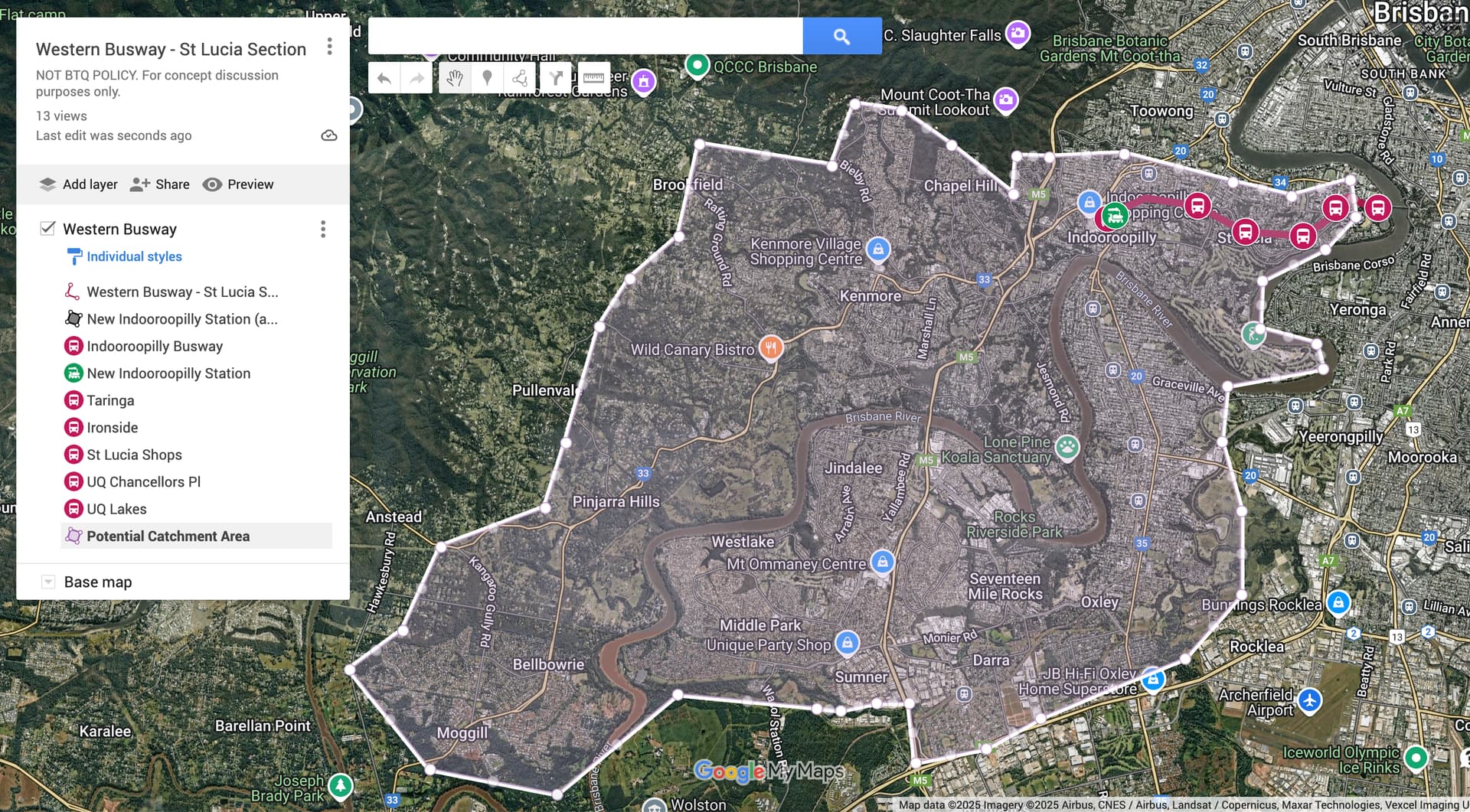
Because the UQ arm of the eastern busway is the only dedicated ROW connecting the CBD to UQ. Extending it to Indooroopilly wouldn’t transfer anywhere the number of passengers from surface routes, nor would it unlock as many additional locations as the Eleanor Schonell Bridge did at it’s opening.
I recall a study about the effect of the Green Bridge and the busway on travel patterns at UQ being required reading for my degree. I’ll see if I still have it tomorrow.
That aside, the cost of this proposal would be substantially greater than the Eleanor Schonell Bridge and eastern busway, so it’s benefits may also need to be substantially greater to get a similar ROI.
I’ll make an observations. Whilst the busway moves a high number of people and the bus network moves more than rail…in the period of the busway’s existence public transport usage as a share of all trips in SEQ has gone backwards! The busway may have increased patronage on that corridor but the battle to grow public transport share of trips has been lost. The busways were always meant to be a 1st step to higher capacity rail based system but political short-sighted killed that off.
Brisbane desperately needs to rethink the bus led future public transport path that it is heading down!! Driverless systems are the future of public transport and all plans need to lead to that not against it.
Even if a certain mode is perceived as ‘the future’ it’s still necessary to build out the concept and assess it.
Cities with automated metros also still have lots of driven buses as well. And in the future, if we have self driving cars, we might have self driving buses. They would still need a busway to travel on in congested areas.
And extending the logic of your comment, a human driven LRT or extension of one, would be looked on unfavourably as well?
If you’d like to build out that automated rail option, you could build that out in another thread. Then members can look at it.
I think BTQ has a broader discussion/position to determine rather than corridor-by-corridor proposal and that is given what we have learned over the last 15 year, the challenges being faced with driver shortage, existing rail -based automated systems and public transport’s share of trips declining should busways as an end-state solution be a solution supported in SEQ? There can be temporary steps from existing busways to make smart connection (aka the UQ Tunnel) but brand new grade separated busways? Does not include on-road BRT.
One of the issues I found is that the buses from the west get stuck in traffic approaching Indooroopilly. I always though that provision of a bus tunnel from around the on-ramp of the Western Freeway to Indooroopilly Railway Station (with a stop near the school) would greatly improve reliability and make feeding buses into the train a viable option timewise (compared to Legacy Way rockets). You could even nestle an underground bus station between the shops and the station at Indooroopilly to provide a path for through foot traffic out of the elements for the most part.
Somebody on RBOT a while back had an idea to bring it up from tunnel over the station adjacent the 7-Eleven or something which I thought wasn’t a bad thought at the time. Although if the proposal is an underground tunnel to UQ, then it might pay to keep it underground.
In the end, there will always be a need for different modes and approaches IMO. Hence the need to first build up individual competing options before deciding to rule them in or out. Every corridor presents different circumstances, and an automated metro is unlikely to be the appropriate solution for every single case. Just like a busway might not be the solution for every single case.
Circumstances can also change one way or another, and the appropriate mode for a corridor is closely linked to maintaining or sustaining a particular level of patronage.
In Melbourne for example, two heavy railway lines were converted to Light Rail because patronage on them changed (Port Railway line and St Kilda Line). Should these lines have never been built as passenger railways initially because in the end state, they ended up as trams?
Something else to reflect on when thinking about ‘Paris-style’ automated metros etc is ‘Are we solving the right problem in the right location?’
Its been mentioned that PT trips have declined as a share of all trips. So what is the cause? IMO its because very low density developments that are housing the rising population are being approved in areas far far away from any PT corridor, bus or rail. This is not something generally happening in BCC LGA, but outside of it in areas such as Ripley, Yarrabilba, North Lakes, Strathpine, West of Caboolture, Sunshine Coast etc. For each new home in such far areas, 3.3 trips on average are being generated, virtually all as car trips.
Approval of a Brisbane inner city Paris-style automated metro, even if it did happen, is unlikely to resolve this decline in share of PT patronage because it would be built in a location where PT is generally already good and not in the area where PT is bad or non-existent. Its not also clear how a ban on new busways would improve this situation either?
I can think of few heavy rail lines in Brisbane that can be converted to light rail simply because the patronage will change and its benefits overcome the limitations the current mode has. Frequency and level crossings are a good example.
Eventually all of the other SEQ regions will become part of Greater Brisbane. When this happens then it would be right to start planning a Paris-styled radial underground automated metro that will connect all of those regions together. But it has to be done that complements existing heavy rail.
My point is there are so many NIMBYs among the non-student population in St Lucia that getting even one TOD up is going to be a challenge, let alone three. TODs make perfect sense to you and I, so why aren’t they everywhere, at every train and busway station? The answer is, NIMBYs complain about them and politicians listen to them. Building a new station in the hope of a TOD around it should be done strategically, not recklessly.
Why shouldn’t they? What makes them so special that they deserve a one-seat journey to all the major destinations around the city? One frequent surface bus that connects them all to their local station, as well as Indooroopilly and UQ Lakes and maybe even Boggo Road, is a pretty good deal.
Yes. That’s how a trunk and feeder system works.
Everyone wants the station, but few want the density that makes the station actually viable. Do we want more stations like Holland Park West and Greenslopes? I’d argue they’re among the least useful busway stations because the residents fought off any proposals for higher density around them. The more stations we have, the more likely it is the NIMBYs will succeed, because they’ll say “look you have that one station over there as a TOD, that’s enough, leave us to our single storey homes with big backyards and a busway station next door”.
And I responded to this information by explaining how they serve very specific purposes, like connecting with railway lines or serving major facilities. They weren’t all built based on having a large walk-up catchment. While both Buranda and Stones Corner have started to develop that walk-up catchment now, that’s because the land value there was cheaper than in St Lucia, and significantly less hilly, both factors that made it easier to build higher density. I don’t think the same can happen for three separate parts of St Lucia. One, sure. Three, probably not.
It would be duplicating services between Indooroopilly and UQ that have frequent stops. That already exists in the form of surface buses. What doesn’t exist is a quick service between the two with very few intermediate stops.
Buses won’t hit 90 if the stops are very close together. A better analogy than the SEB, both in distance between stations and in the use of a tunnel, is the Northern Busway between Truro St, Lutwyche and Kedron Brook, where the speeds are about 40-50, no different to surface streets. But at least that stretch provides the benefit of getting buses out of the Lutwyche Rd congestion, and two of the three stations were built at the surface, keeping the costs down. Can’t say the same for three stations in St Lucia.
Potentially higher than that in peak, and they’ll require a longer and less straight tunnel, and a few minutes’ delay can be quite high in percentage terms when it comes to the UQ-Indro trip.
I’d say all those areas were significantly less wealthy than St Lucia currently is when they started significant high-density development. The political struggle will be tougher. All of them are flatter too, except possibly Toowong once you get out of the main strip. Flatter areas are better for high density development.
Also at least 3x less capacity. I’d like to see an analysis one day on what the marginal cost vs marginal benefit would be for a higher capacity mode if we were already going to build a tunnel and underground stations.
Of course it’s reasonable to explore it, and I fully support you doing so. It’s good to have concepts to discuss. It’s also reasonable to point out both the strengths and flaws and identify what could be improved. Only by doing that do concepts get more robust and refined.
Oh okay, I didn’t know that. But Milton is still an open station, nothing is built over the top of the platforms besides an overbridge. I was thinking more of busway stations, where the sunken ones tend not to have anything built over them (e.g. Buranda, Upper Mt Gravatt, Lutwyche). Whatever allows maximum use of the space around stations is what works for me.
I agree with your analysis, this is a big reason for the fall in public transport mode share, and Brisbane is certainly not the only Australian city to suffer in this way. But I don’t think the answer is to only concentrate on new infrastructure to outlying areas, it’s expensive, inefficient, and a fight we’ll probably never win. Instead, the answer is to help change the structure of future development from building out to building up. And this is best done in existing urban areas rather than greenfield sites.
Frequent, rapid public transport in existing urban areas should be sold as being the great enabler for having medium density neighbourhoods without traffic congestion. This is something that trains are generally better at facilitating because they scale up to higher usage better. Our busways have become victims of their own success, and we should learn the lessons from that instead of repeating them.
I think busways have a place, for secondary connections. For example, I think Chermside to North Lakes along the Bruce would be a handy busway or transitway. But we’ve seen their limitations for being a primary connector between two major hubs, like Brisbane CBD to Upper Mt Gravatt.
To bring this back to the thread topic, I’m not sure which category Indooroopilly to UQ falls into. I lean towards it being best as a busway simply because the connection to Boggo Rd is already a busway, and that isn’t going to change for a very long time. There’s a big opportunity to connect through. But if we’re going to the great expense of a tunnel to facilitate development uplift, I feel like the marginal benefit of going to a higher capacity mode might be greater than the marginal cost.