"Would you rather have a free bus that comes every 30 minutes or pay $2 for a bus that will come every 8 minutes? If the conversation is about the financial cost of transit to the rider, then time is money too.
Yet the choice we had in SEQ for many was would you rather pay close to $5 (at least) and have a bus come maybe every 30 minutes or pay 50c and have a bus come maybe every 30 minutes?
4 Likes
Which spends a whole heap of money but leaves the primary problem unfixed.
Considering that they pour billions into road projects that provide no benefit for road users, how about reallocating that taxpayer money to improve PT frequencies. Are 15min or better frequencies for 50c really that much to ask for at the cost of less road widening projects?
7 Likes
-
Not all roads have a perfect or comparable PT substitute, and Queensland is a big state.
-
One can’t both argue that roads have no benefit and that they induce traffic. Traffic induces as people move to consume a time saving. This is true for all modes, not just cars (as transport is the product, not modes).
-
One could argue that current road projects are not the most efficient or effective way to achieve a certain goal, but then again, neither is this fare policy. Ideally, principles should be applied consistently and fairly. Both road and PT projects should be expected to be effective investments of public funds.
-
Alternative and higher priority uses for $300 million/year exist (increased frequency, service extension) and have a much higher payoff to PT users, and non-users. This policy doesn’t really have much of a payoff to non-users, as it mostly benefits existing users, didn’t cause a significant mode shift from car users, and it didn’t result in the extension of service to new areas.
-
The policy goes beyond what is reasonable and necessary to achieve fare or cost of living relief. And there exist alternative approaches that would also achieve the same goal.
The only really good argument I have heard so far in favour of this policy, is that once fares are this low, there isn’t much more room for politicians to tinker with fare structures or levels before an election.
Post from Dr. Chris Hale
Opponents of cheap or free public transport often make this argument, but in the case of Queensland, we have concrete example.
Much weight is placed on this assertion, but has anybody actually checked if this is the case in our actually existing example?
My clear understanding was that the cost of 50c fares was simply added to the transport budget from consolidated revenue (ie revenue from across government including State taxes and GST revenue) as a “budget measure” in the 2024 and subsequent state budgets.
Of course it is impossible to go under the hood and figure out whether possible future increases in transport spending were lost. thanks to this extra expenditure from consolidated revenue, but the surface level assessment should be very straightforward.
is there any evidence that the transport budget shrink by 300 million in response to this policy? If I get some time later this week, I will go and look, but what I suspect is that operational spending on public transport remained exactly the same, and Spending overall went up as it always does.
The mix of public transport versus road spending within capital expenditure is obviously another story, and should be the real target of penny pinching in the transport portfolio.
3 Likes
Opportunity costs are costs. There were many alternative uses for that money. They chose to spend it on this.
When the argument is made that money spent on roads is money not spent on PT, under the hood, it’s the same opportunity cost principle.
I agree theoretically, but in the case of 50c fares it’s perhaps rather abstract because there is no project/initiative (or group of) that was explicitly forgone (or the ‘opportunity lost’) by deciding to spend the money on this particular policy, at least as far as I am aware.
I think typically it’s easier to conceptualize when you can actually point to a specific opportunity/opportunities lost rather than it just being a nebulous ball of ‘but what if’ scenarios.
4 Likes
Yes, and the 50c policy is designed to play into this and other cognitive biases.
If the $300 million p.a. were spent on say 50c petrol, or discount toll caps or rebates (which is actually a thing in NSW, subsidised driving) that in itself wouldn’t seem like a loss to PT in any way either.
But most of us would agree that those funds could have been spent on PT.
I strongly agree that opportunity costs are real costs, but the universe of possible uses for that money, stretches way beyond the transport portfolio, and there’s no reason to believe that there was any chance that that money would have spent inside the transport portfolio, let alone on public transport.
The real point I was making above is that the assertion that fare reductions are somehow subtracted from the existing transport budget is not correct in Queensland.
more broadly still, it’s important to remember why the policy exists: a dramatic cost of living crisis. That context gives it political potency far beyond service improvements, or new infrastructure for public transport.
more broadly still, it’s important to remember why the policy exists: a dramatic cost of living crisis. That context gives it political potency far beyond service improvements, or new infrastructure for public transport.
It’s the tendency to miss the significance of political potency that most undermines the argument against cheap or free fares. The point is that we live in a democracy where winning our preferred outcome requires building an enthusiastic constituency of voters who identify with that outcome. In a political context where we regularly have our arses handed to us when going up against the car lobby, my view is that we simply need every advantage we can get in building constituency.
6 Likes
The claim by Dr Hale that 50 cent fares have somehow led to reliability issues is entirely unsubstantiated, and makes me wonder how much more of that article is complete crap.
4 Likes
Well, simply posting the cash to people directly like Kevin Rudd did in 2007 would provide direct relief without requiring that relief to be consumed or redeemed in bus or train trips.
Notes
Rudd’s stimulus package: what will you get?
From early April, anyone earning $80,000 or less will be paid the full $950; people earning between $80,000 and $90,000 will get $650; and those earning between $90,000 and $100,000 will receive $300.
You must have lodged a 2007-2008 tax return to receive the cash, to be paid from April.
I’m not claiming 50c fares are the most fair or efficient cost of living relief (they’re not!) - I’m just pointing out why they were incredibly popular (and therefore more likely to happen and to last) vs an equivalent spend in another categeory (i.e. service improvements, or roads for that matter).
The point I’m making is about the political value in winning a big, enthusiastic constituency who see using public transport as their entitlement as citizens.
My perplexity with opponents of free / cheap fares is that they seem to overlook the value of this (frankly irreplacable!) asset in favour of arguments about opportunity cost which (at least in Queensland) look pretty thin given this ~$300m is new money for the transport portfolio.
The fundamental question we need to ask is “how, in a deeply car-dependant society, can we build a durable and politically powerful coalition of interests in favour of public and active transport, and do it quickly?”
3 Likes
Well, not with a 50c fare bus or train that still only comes at 30 min or 60 min frequency in the off peak.
People are willing to pay for quality, whether directly in fares or indirectly via taxes. That is why 80% of people in Brisbane still drive despite fares being 50c.
The other thing is that a constituency is built by adding new members, not just giving benefits to existing members.
In the 50c fare context, this means mode shift from car to PT use. This has not occurred with this policy, most new trips are existing PT users just making more trips, and not car users coming over to PT.
A better spend of this additional budget would have been service frequency improvement, which would have got us that mode shift.
Low Cost Flat Public Fare Policy: Induced Demand, Mode Switching and Policy Beneficiaries
This study analyses six waves of cross-sectional survey data collected both before and after the introduction of a $0.50 flat fare structure across all public transport modes operating within Queensland, Australia. The frequency of public transport trips is reported from 650 to 700 respondents per wave across each of the six waves of data collection, including information on trips that are reported as being trips that would have occurred irrespective of the low fare structure, trips that occurred solely as a result of the low flat fare structuring being introduced, and public transport trips that involve switching to public transport modes from some other mode of transport.
Our findings suggest that the low fare structure led to increased public transport trips due to induced demand, with much less scope for mode switching behaviour. Further, the primary beneficiaries of the fare policy appear to be younger lower income individuals and/or those who are already regular public transport users. As such, consistent with the introduction of low or zero fare policies in other jurisdictions, the introduction of a flat $0.50 fare in Queensland has resulted in increased public transport patronage for some groups, while only limited mode switching behaviour is observed to have occurred.
ACKNOWLEDGEMENTS: This research is part of an ongoing iMove Cooperative Research Centre (CRC) research project 3-041 with Transport and Main Roads, Queensland, on Investigation into the economy wide implications of large-scale price reductions in public transport.
The Paper - Highlights
In this paper, we examine six waves of survey data designed to capture changes in mode choice use over time across Queensland, noting that the first survey wave was collected the month before the faretrial was enacted. We estimate a number of models designed to determine the impact of the flat fare policy on public transport travel demand in Queensland, and in particular, whether the policy resulted in induced demand or mode switching behaviour. By looking at the impact different socio-demographic characteristics play on travel demand, we are able to determine which elements in society were more likely to be beneficiaries of the flat fare policy in terms of overall increased mobility.
- Overall PT use across SEQ is generally low. This is probably because once you get out of the BCC LGA, PT use drops dramatically. This is in turn related to how frequent network coverage drops once you get out of BCC:
Note that the low frequencies are also a function of the fact that only around five percent of people in SEQ use public transport for commuting, indicating overall low engagement with the mode (Southeast Queensland Community Profile, 2021).
- Much of the uplift in PT use is induction; that is existing frequent users are making more trips rather than car users coming across to PT. This is essentially preaching to the already converted:
Comparing the two segments, frequent public transport users are estimated to make 2.45 times more trips than infrequent users, which increased to an average of 4.16 times after the fare policy was introduced. This suggest that the modelled increase in public transport demand, which is also observed in the real go-card onboard data (see Figure 1), consists mainly of new trips undertaken by those who already are regular public transport users, and then mainly due to these people undertaking trips that they otherwise would not have undertaken.
- Low fares are a very narrow change lever, as most people do not use PT. This has major implications for constituency/coalition building. A good change lever would be broader and attract new, non-users to a constituency or coalition. And the 50c fare program does not really do that.
- Alternatively, measures such as funding extended frequent bus or train services into suburbs which do not currently have frequent PT would better achieve this goal.
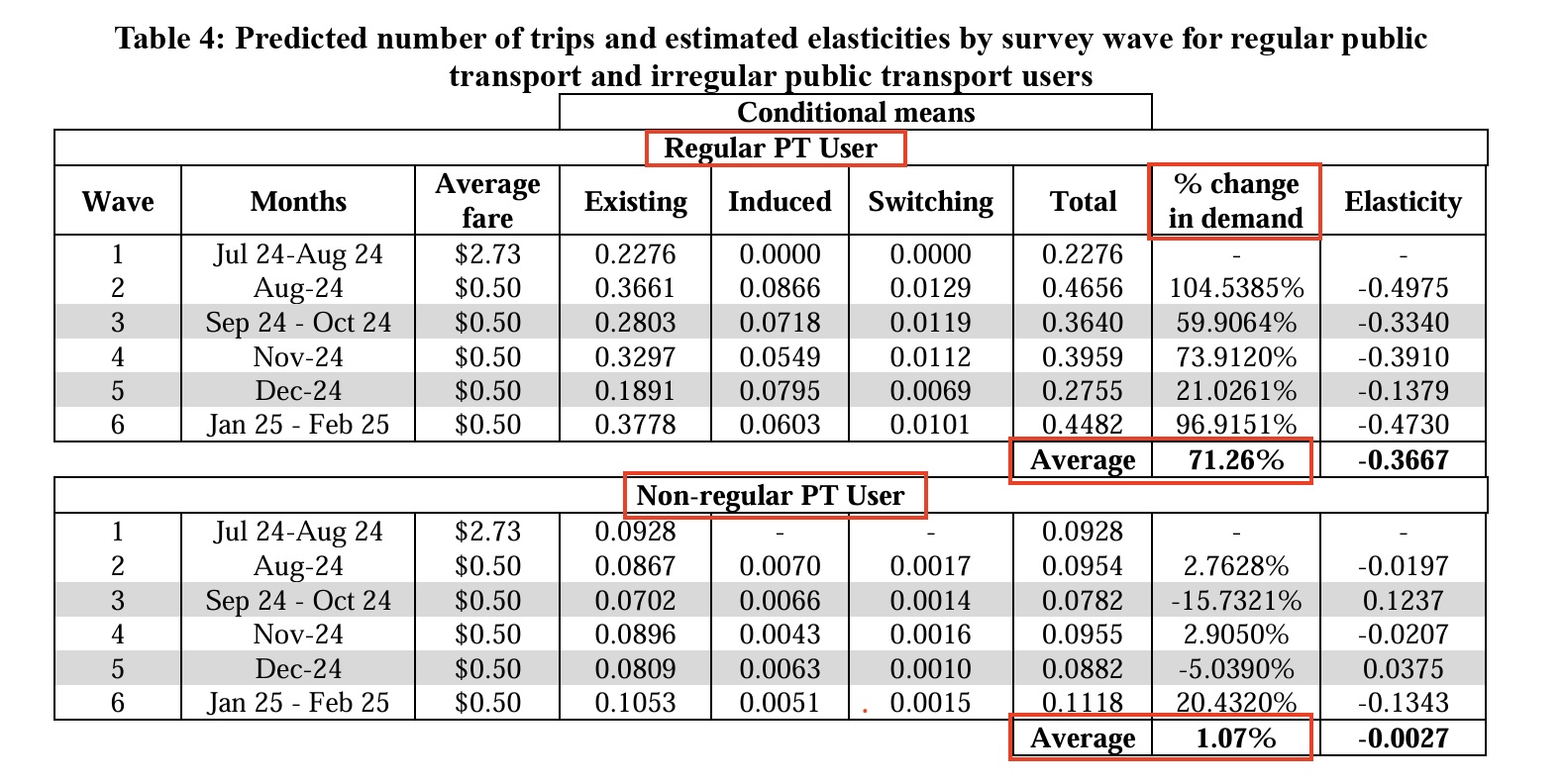
Overall, irrespective of when travel occurs, the results presented in Table 4 should be a concern to transit operators, as regular public transport user represent less than a quarter of respondents in the six samples collected, meaning that lowering fares is unlikely to induce significant changes in the majority of the population, and indeed, primarily only increase patronage amongst those who already use public transport anyway.
Table 4 shows just how stark this effect is - the relevant data has been highlighted in red. It is clear that 50c fares are not a mode share switching or motorist behaviour change tool, as much as we might hope that it might be.
- For regular PT users, demand went up about 70% for this group.
- For non-regular PT users, demand went up just 1% for this group. These would be your car users, or people occasionally using PT where it might be possible to pull them over into regular use.
Overall Poor ROI/Value:
-
It is understandable that we all want this to work, and expect it to do so. The data shows something different.
-
In exchange for paying $300 million p.a. on an ongoing basis, we are getting ~ 1% trip increase from non-regular PT users. We should expect a lot more in terms of Return-on-Investment (ROI) and new users coming across than this. Extending frequent bus and train services into new areas is likely to be a much more effective measure that actually targets non-regular or non-users.
-
There might be a basis for low fares in regional areas, given that very long distance commuters or users of PT face high cost + poor service level combination that is unlikely to improve any time soon.
Our results further suggest that a low fare structure is likely to increase public transport patronage, primarily via induced demand, with far less mode switching behaviour being observed. Indeed, the results suggest that a low fare policy may result in switching away from public transport alternatives; however, such switching behaviour 15 is far less than the gains in public transport patronage resulting from new induced demand trips. Overall, the results are consistent with the existing literature.
Notes
Low Cost Flat Public Fare Policy: Induced Demand, Mode Switching and Policy Beneficiaries Working Paper (2025)
The University of Sydney Business School, Institute of Transport and Logistics Studies (ITLS)
This might be due to the excerpts presented, but it seems the “non-regular PT user” data is very noisy/volatile. For example, immediately after 50c fares, it suggested this group had a -20% change in demand (i.e. people who didn’t use PT regularly were much less likely to use PT because of lower fares)? This seems to then be cancelled out by the +20% in wave 6, but the jumpiness of data is a little strange.
The authors have provided an explanation on Page 11. Essentially, during holiday periods, infrequent users stop using PT altogether, despite the 50c fares on offer.
For infrequent public transport users, the average elasticity of demand is very close to zero, primarily driven by a single low demand period covered in wave 3 where public transport demand dropped significantly lower for this segment than what it had been prior to the policy being deployed. In any case, the elasticities of demand appear to fluctuate for this segment widely with huge drops in demand observed during the holiday periods covered.
The modelled outcomes therefore suggest that infrequent public transport users tend to use public transport during non-holiday periods and avoid public transport when holidays do occur, presumably because of the need to use the car for the family activities.
Maybe we need both low fares and service improvements?
And rather than argue against one in favour of the other, if we get one we should celebrate that and use the momentum of that to argue for the other?
Arguing between them is putting out there that you don’t believe PT is worth anymore total investment, just reprioritised existing investment.
$300 million is dropped on relatively small road projects every other week. You never hear the car lobby say “oh no, not that one we want this one instead” - they just say “thanks and more here, here and here please.”
Just because PT investment is mediocre and wins so hard fought doesn’t mean we should lower expectations to that level.
7 Likes
That sounds well and good, but the words don’t match the data?
Both Sept-Oct and Jan-Feb cover holiday periods. One (Sept/Oct) has a significant decrease, and the other (Dec/Jan) has a significant increase.