Opportunity costs are an economic principle. It therefore applies whether the funding is new or old, and independent of the specific government process used to consider or approve initiatives. This is because every government faces a mix of tradeoffs when deciding where to allocate money in its budget.
For example, if entirely new funding of $12 billion from “further funding requests” was spent on say the Gympie Road Tunnel construction, would members here agree to it given that it didn’t take anything away from existing PT projects or services? I doubt it.
We all can see that money could be spent on an alternative PT proposal, even if there was no official ‘alternative intent’. And so it is the same here.
Requests for further funding
A question for ministers who held the transport portfolio over recent years is why at least some of the funding made available was not spent on improving high-frequency bus and train services as well?
Net new funding for improved frequent bus and train services appears to have been capped through a shadow policy that allows funding to only rise with inflation and this has been going on for many years:
A spokesperson for the Lord Mayor’s office said that the contract that the Council Opposition was referring to was since superseded after the election of the LNP state government, with a cap on bus funding for two years. This means that no new bus services can be delivered without removing a service from somewhere else. (bolding added)
and
New figures released by Lord Mayor Adrian Schrinner indicate there are now around 82,000 fewer services on the Brisbane bus fleet than there were a decade ago.
“The state government is responsible for funding public transport services and for years it has capped Brisbane bus funding increases to inflation,” the lord mayor said.
"As a result, there are now 220 fewer bus services a day in Brisbane’s suburbs than there were a decade ago.
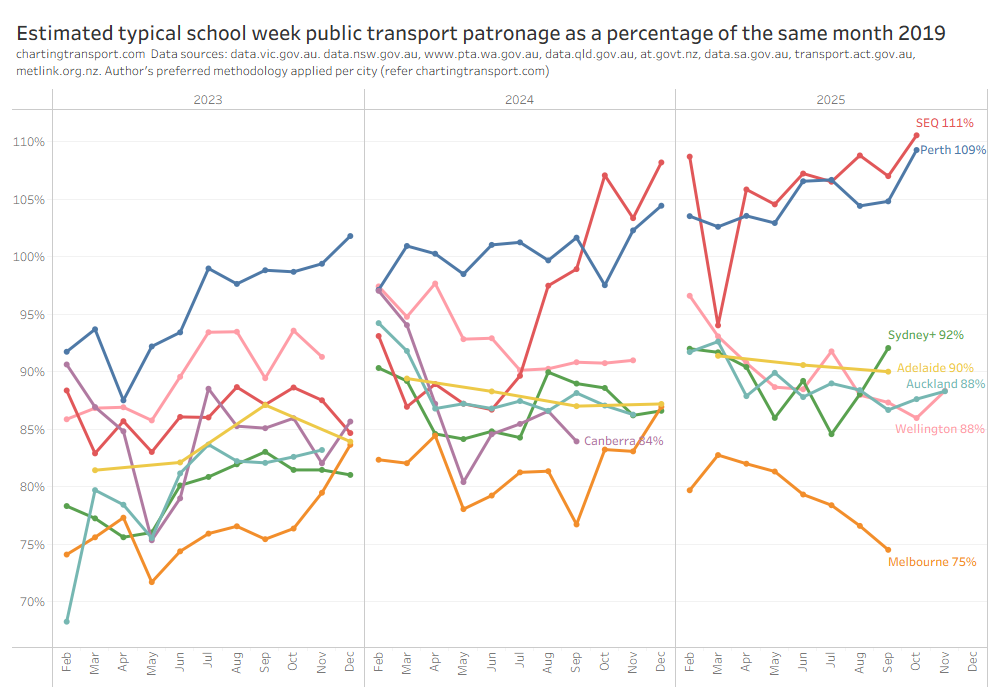
Clearly the need for more service in the off-peak was there, even if overall patronage had fallen due to COVID19. This is because much of Brisbane does not have a basic 15 minute bus frequency during the day. You don’t need high patronage to justify maintenance of a basic standard. A basic standard applies whether patronage is high or low.
Accepting a revenue loss.
This is really just another term for offset. If TMR loses $300 million p.a. but labour and operational costs stay the same, then TMR would have to eat into funds for existing or new projects/services, or savings… which would be an offset.
Concluding thoughts
At the time that 50c fares were introduced, genuinely new service had been restricted by service funding caps for many years. As a city grows it needs more services not just maintaining the same services.
There would be little objection from members here who do not support 50c fares if it had been paired with a decent increase in high-frequency train service or high-frequency BUZ service at the same time.
Notes