A dead-end siding track is being built south of Broadbeach South station.

Construction pace is very fast now. New OHLE should be appearing any time now.
A dead-end siding track is being built south of Broadbeach South station.
Construction pace is very fast now. New OHLE should be appearing any time now.
After that segment with Alex on Drive GC, there was a segment on the progress of the LRT. They said this time next year it should be open with testing to begin on sections within a few months.
Do you think it would also be possible to achieve a more gradual increase/decrease in frequency before and after 7pm? I’m pretty convinced that 10 minutes would be ideal between 7pm and 11pm.
Probably go with 10 minutes until about 9/9:30, not convinced it’s needed after that, except maybe on Friday/Saturday nights.
I suspect it comes down to what the State wants to pay for.
Once we start introducing branches (Biggera Waters, Robina etc) I expect we are not going to see daytime 7-8 minute headways all the way to Helensvale. The absolute minimum needed I think would be to have 12 minute headways on each branch 7 days a week, but preferably 10 minute headways given it makes scheduling that much easier. In a hypothetical scenario where GCUH to Biggera Waters might happen before Burleigh to Coolangatta, I’d expect something like Helensvale to Burleigh, and Biggera Waters to Broadbeach South, with a 5 minute headway in the common stretch from GCUH to Broadbeach. Any extension to Robina (assuming the curves from the GC Hwy are north-facing) would then involve pushing the Broadbeach terminating trips to Robina.
If there is enough organic patronage growth over time, crowding will start becoming an issue and they will be forced to procure more trams anyway.
Yeah I’ve been suspecting that with branches a 5 minute frequency in the core will become more likely.
10 minutes for the branches would make it easy for trams to connect in sync with half-hourly trains in the off peak at Helensvale.
I’d imagine in the early morning and late night the branches would operate only as shuttles with timed connections at GCUH and Broadbeach (or maybe Miami? Not sure if there will be any crossovers between BBS and BUR…)
Also: do you think a future branch to Robina could eventually reach Mudgeeraba? Or should be leave that work to an extended 750?
I’m hopeful that after CRR is running it will be 15 minute frequencies.
Doubtful it goes any further than Robina station in my view. There’s not a lot going on in Mudgeeraba and it’s on the other side of the M1 and thoroughly floodprone land.
I’ve been informed by a few people at Kinetic (so take this with a pinch of salt) that contractors working at GCLR3 have signed contracts to start works at Tallebudgera and Currumbin bridges starting in July 2026 for LR4.
I cannot confirm this but if true, then we should be good to go.
That would be good!
In LR3 news: greenery is starting to be planted between Tamborine Street and Nobby. Lighting is also slowly being turned on between Tamborine and Mermaid Park.
We’re getting there.
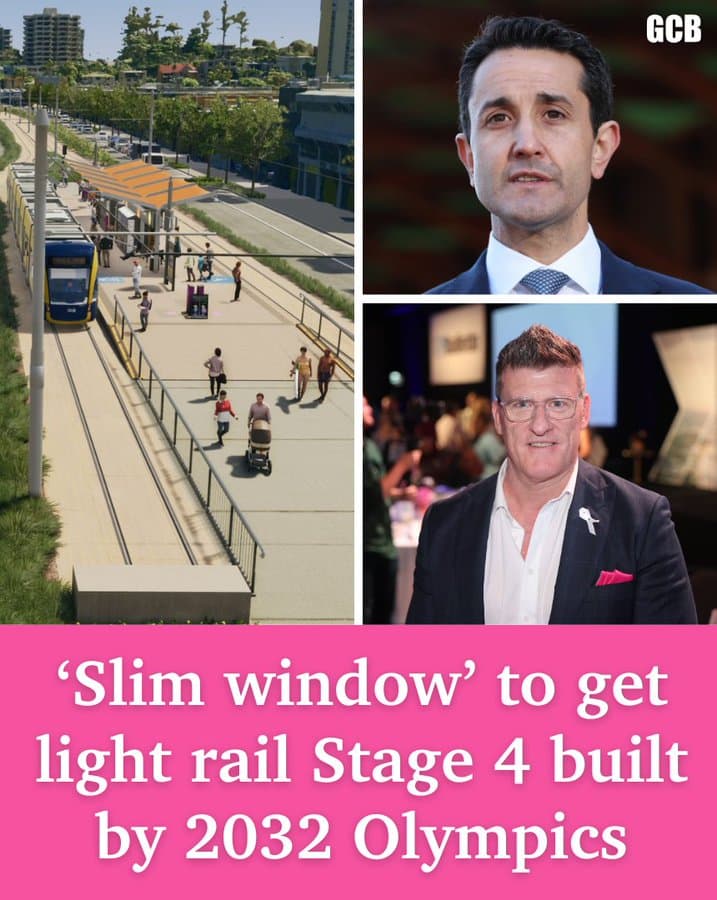
State money has been earmarked for coming years tied specifically to the in-limbo extension of light rail as political leaders are warned they have a ‘slim window’ to get it built by 2032.
GCB https://x.com/GCBulletin/status/1948473298162999697
We (and others) will have to put a lot of pressure so the libs dont bow to the annoying Nimbys from Palm Beach and shelf or turn stage 4 in BRT.
Now hydrogen trams???
It’s an AI produced article. Not seeing what the advantage is.
Another madcap idea from Tom Tate, I’ve been waiting for him to sprout a new one.
The mayor says: “I’ve thrown this into the mix … It’s cheaper to build, it’s quicker to build and at the very least should be part of the detailed business case,” he said.
Considering there is currently no hydrogen tram in service anywhere currently, I don’t know how he can say it is cheaper or quicker. Foshan, China had one that they shut down in 2024, and Daejon in South Korea is currently working on one that is set to open in 2028.
Here’s the Gold Coast Bulletin article link.
Also there’s the fact that the current system uses electric, so (I may be wrong here), they might have to retrofit the currently existing g:link services to work with hydrogen
I think I would be more supportive if it was hydrogen buses being recommended, as batteries are heavier, and there’s no power lines charging the bus as it moves (unlike the G:Link trams)
The cost of setting up hydrogen logistics (refuelling and depots) would be significantly more than stringing up electrical wires for trams.