Tilt trains obviously provide some benefits on legacy track, but they can’t do miracles. It really just allows a slightly higher comfortable speed around curves, but the winding track up the range will be slow whatever you put on it.
8 Likes
Imagine telling the people of Sydney, we’re gonna take the train to the foot of the mountain…but then…uuuhhmmmm…aaahhhhhhh…look ummmmmmmm…how’s about a bus… Welcome to Quueeenssslllaaannnndddd…sun-shining, maybe one day, always backwardly different, every day! 
2 Likes
Some movement
4 Likes
A further article ($$$)
1 Like
I can’t view this but if it happens to be this one (https://www.facebook.com/share/p/1HW8TfjbDZ) it makes for very sensible reading. I don’t agree with the conclusion any possible demand is limited to the current bus patronage but otherwise it makes good sense.
I have been slow to catch up on this developing topic as my wife and I have been managing a newborn since November 14 (we spent the better part of a week at St Vincent’s Toowoomba).
The rationale for a rail extension to Withcott as part of the project is not entirely clear to me. That’s an investment in ~6-10km (route depending) of new rail that will likely be superseded by Inland Rail in the future.
It strikes me that kind of money would be better spent upgrading the sections of the existing route that won’t otherwise be superceded by Inland Rail in the future, e.g. whatever works are needed to get that much-sought 160kph speed board between (for example) Walloon (where the track straightens out after Ipswich) and Grandchester; or Laidley and Helidon. Given those sections have some good straights and are largely dual track, it may be more a matter of heavier rail, better sleepers and ballast, some curve mitigation and some protection at level crossings (coupled with a commensurate attitude change at QR). And a nice refresh on Helidon station as an interchange, too.
Or some sort of cost-sharing arrangement to bring forth the Inland Rail alignment through the Little Liverpool Range sooner than the Gowrie - Helidon project.
Or sparking beyond Rosewood (noting the present unsuitability of the two tunnels in the Little Liverpool range is an impediment to this, as well as how it might be integrated with Inland Rail in the future).
1 Like
Whatever the outcome for the rail mode, it is pretty clear that an improved coach service that is subsidised by Translink right now is a clear good short to medium term solution.
An improved (Translink) bus service from Brisbane to Toowoomba:
- Lower investment vs Rail
- Uses existing roads and infrastructure
- No tunneling or overhead electricals required
- Handles slopes and inclines with reasonably well, allowing direct route into Toowoomba
- Can be operational within say 2 years (estimate)
- Faster than the train option along this route
- No Bus <> Train interchange or luggage transfer penalty at Helidon
- Cheap to run (1 driver, no guards on board)
- Low risk (if it doesn’t work out, buses can be reallocated elsewhere in QLD or Australia. On the other hand, rail rollingstock would likely be specialised, thus only able to operate on that line and only on narrow gauge networks which would impact resale value)
- Can handle the volume of passengers for the transport task (say, 1-1.5 million passengers/year)
While it may be true that rail would be more comfortable, smoother ride etc, this is a nice to have and not a must have. And particularly if the journey is relatively short.
[Andrew Reeson]
What’s the deal with the train to Brisbane? An (unofficial) Explainer
The short version:
There is a train that runs between Toowoomba and Brisbane twice a week. It takes 4.5 hours and costs $44. The Toowoomba Regional Council, the Chronicle, the Federal MP and business leaders are pushing to change that with an improved service. There are significant technical and financial barriers to this happening.
The long version:
The Main Line railway between Brisbane and Toowoomba was finished in 1867 and has largely stayed the same since. It is 161km long, runs through 11 tunnels and over two mountain ranges. The total journey takes 4.5 hours due to several factors.
The descent from Toowoomba to Helidon is too steep for trains, so instead of a direct route the railway takes a long winding route north through Spring Bluff and Murphys Creek. It then heads west to Gatton before cutting south to Laidley, through the Little Liverpool Range to Grandchester then Ipswich and Brisbane.
The zigzagging through the hills allows the trains to gently descend, but the tight turns have to be taken very slowly. The speed limit of 30km/h down the range means Toowoomba to Helidon takes 1h 40m. The train only hits highway speeds near Ipswich.
All these factors mean that the current journey takes too long for most passengers, leading to low ridership and a lack of investment.
The Problems We Can’t Easily Solve.
There are several reasons we don’t currently have a good rail service to Brisbane.
Topography
The Great Dividing Range and Little Liverpool Range are just too steep for trains to easily traverse. Unlike cars and trucks, trains cannot handle steep gradients so a direct route for a car becomes a long winding route for a train. This can be overcome with tunnels, cutaways and viaducts, like the range bypass, but they’re very expensive. The projected cost of the Gowrie to Helidon section of the Inland Rail is $1.35 billion, as of 2021.
Technology
Parts of the Main Line are single track. The proposed Inland Rail tunnel would be single track. This limits the frequency of services as inevitably trains end up waiting at one end of a tunnel for another train to pass in the opposite direction.
Passenger trains sharing the track with freight trains creates delays. Freight trains run slower and can only be overtaken on dedicated passing loops.
Demography
The population of Toowoomba limits the potential ridership which reduces the potential investment. Bigger population centres will always attract more investment.
The last mile problem
All public transport has to deal with the last mile problem. Put simply, if you have a train running between two stations, how do passengers go to and from the stations? If it’s impossible to reach your destination without a car, then taking a train most of the way doesn’t make sense. Brisbane has passable bus and train networks, but it’s still heavily dependent on cars. Toowoomba is worse.
What We Need To Succeed
For public transport to attract passengers it needs to fulfil a combination of the following criteria:
Cost
PT needs to be cheaper than driving. Currently it costs $30-40 in fuel to drive to Brisbane. The bus (Greyhound or Murrays) costs $33 each way. The train costs $44 each way. Bringing trains under Translink’s 50 cent network would change that, but it would need to be further subsidised by the government. For context, the current train service is subsidised by about $4000 per passenger, so an extra $44 wouldn’t matter. (The current service costs the government about $16 million each year for about 4000 passengers)
Speed
Driving to Brisbane takes 1.5-2 hours, more in traffic. The bus takes about 2 hours. The current train takes 4.5 hours. A bus to Helidon and train to Brisbane trip would take 3.5 hours. A train to Brisbane via the Inland Rail would take 2h 10m.Passengers then need to go from Roma St Station to their final destination.
Comfort
Trains are the most comfortable by far. It’s not even close.
Convenience and Frequency
Cars can take you door to door whenever you want. Buses currently run four or five times a day. The current train runs twice a week. Once at the station you need to catch more buses or trains to your destination.
One major benefit of trains and to a lesser extent buses is that you’re not driving so you can do other things. Nap, work, read, etc. You can’t do any of that when you’re driving.
Cars are currently winning in three of those categories. To attract significant ridership a train needs to take less than two hours, run frequently and cost less than petrol.
Possible Solutions
In September 2024 the QLD government, with federal funding, released the findings of a $15m “Toowoomba to Brisbane Passenger Rail Strategic Business Case”. They seriously considered four options:
Option 1:
Bus to Helidon. Existing rail line to Brisbane. This removes the slowest section of track, but keeps the 3 hour remainder. The total journey would only be about an hour shorter, but it would be very cheap and fast to implement.Option 2:
Train from Toowoomba to Gowrie. Inland Rail track to Calvert (near Rosewood). Main Line to Brisbane. This was the chosen option. It cuts out the slowest sections of track but requires the Inland Rail to be built, which is a whole other shemozzle.
Option 3:
New dedicated passenger line between Toowoomba and Darra (western Brisbane). Main Line to Brisbane). Extremely expensive to construct, but possibly a long term option if the freight corridor becomes unsuitable for passenger services.Option 4:
Use Inland Rail track and Main Line to reach Ipswich, then connect to the new Springfield line which is yet to be built. This relies on too many things falling into place and wouldn’t be viable in the medium-long term.“The Range” A fifth option from the TRC and LVRC
The mayors of the Toowoomba Regional Council and the Lockyer Valley Regional Council released a statement calling on the state government to extend the existing rail line from Helidon to Withcott and build a combined bus and train station there. There would be a coordinated bus service from Toowoomba to Withcott, then a train to Brisbane.
The Short List
The two realistic options for a successful train line are Option 1 and Option 2
Option 1 (Bus to Helidon. Existing rail line to Brisbane.) This would be very cheap and easy to implement. In fact, you can sort of already do this by driving down the range and taking the train from Helidon.
The trouble is frequency and speed. Twice a week isn’t enough. At least once a day is needed. This requires more rolling stock and drivers which costs money. To justify the expense the ridership needs to be sufficient, but at 3.5 hours each way, it’s too slow to attract enough passengers.
Option 2 (Train from Toowoomba to Gowrie. Inland Rail track to Calvert. Main Line to Brisbane.) This would be expensive and time consuming to build, but it doesn’t require any infrastructure that wouldn’t be built anyway. The big issue is the absolute shemozzle that is the Inland Rail. At this stage there is no guarantee that the Gowrie to Helidon section will be built, for economic and political reasons. Our federal MP has been pushing for the Inland Rail to terminate at Toowoomba. No matter what, it will still be years away.
This option is still the best, as it’s the only way to bring the trip duration close to two hours.What’s going on with option 5
The Toowoomba and Lockyer Valley mayors are currently pushing for an extension of the Main Line to Withcott with a new terminal there. Let’s compare it to Option one.
Option one requires no new infrastructure. Option five requires acquiring land, laying track and building a terminal, carpark and road connections.
Option one requires 20 minutes on a bus and 3 hours on a train. Option five requires 10 minutes on a bus and 3 hours 15 minutes on a train.There is no possible argument for option five. It would be far more expensive and slightly slower. There is a good reason why the business case did not consider this option. The council have stated they will fund a study investigating their option, despite the state already spending $15 million on a study.
My Opinion
I’m a huge fan of rail travel. I’ve travelled over 20000kms across three continents on trains. They are the future and it’s frustrating that Australia refuses to make significant investments in the area. Some argue that Australia is too sparsely populated to justify it, but I’ve been on the Trans-Siberian railway and it’s had all 9289kms running since 1904.
We need fast rail travel in Australia, but there is just no way I can see it reaching Toowoomba, yet.
The problem is cost vs usage. The Toowoomba Bypass cost $1.6 billion, but it had guaranteed users and a clear benefit in reduced congestion, accidents and delays.
The cost to build the Gowrie to Calvert sections of the Inland Rail is about $2.5 billion. If that is already being built for freight, then there is little cost in adding passenger trains, but building that just for passenger rail is impossible.A good comparison is the existing bus services. If Murrays and Greyhound each run four buses per day and each bus can hold about 50 passengers, that’s a maximum of 400 passengers per day. A best-case-scenario train would take longer than a bus, potentially cost more (or less) but be far more comfortable. I can’t imagine the train would attract too many extra passengers than the bus. So then, what’s the appropriate level of investment for only 400 passengers per day? Not much I’m afraid.
If we had a train service that reached Brisbane in 30 minutes for 50 cents it would be popular, but let’s be realistic. High speed trains in Australia have been talked about for decades, but are yet to materialise. We’ll be stuck with slow trains for a while.
Should we invest billions into passenger rail? Yes! In Toowoomba? No. There are major cities that are yet to have a decent rail link. Melbourne, Canberra, Sydney and Newcastle are all prime candidates for investment because they have the populations to justify it. We just don’t.
As for the councils’ Option 5, I can’t stress enough how terrible it is. The state spent $15 million looking into all options and the councillors have decided that they know better than the engineers and economists at the Department of Transport and Main Roads. They’ve stated they will fund their own study because the previous study is “outdated” despite being released in 2024. The mountains have not moved. The study is not outdated. This is just politicians chasing headlines.
So What Do We Invest in Instead?
Nationally, the focus needs to be on the major centres just mentioned. If we can get fast trains built down south, then connecting them to Brisbane would be next. By that stage the case to connect it to Toowoomba might make sense.
In the meantime the focus needs to be on travel within cities rather than between cities. We need a huge investment in public and active transport. The costs are much lower and the potential ridership is much much higher. In Toowoomba a gold standard active transport network would cost millions and benefit thousands. A fast train to Brisbane would cost billions to benefit hundreds. There are much easier wins to be had.
Some Questions
Why are our politicians pushing for passenger rail?
Passenger rail is an easy win. Everyone loves it. It generates positive headlines.
Councillors like it because they don’t have to pay for it. It’s outside their jurisdiction and in the case of option 5 all the new construction isn’t even in Toowoomba.The federal MP likes it because his party is not in government and is unlikely to be for a while. He can push it all he wants but doesn’t have the responsibility to actually fund it. He can blame the current government when it doesn’t happen.
Notably the state government has been quiet on the topic. They created the Strategic Business Case last year and have said all they can say. If they now say something different then they are undermining their own departments and might be expected to fund a project they have previously said was unviable. When the mayors sent a letter to the state transport minister about it, he responded to the mayors’ proposal with a carefully worded “no”.Why is the council pushing for it when the state has already given them an answer?
Great question. See above.
Why are business leaders pushing for passenger rail?
It’s an easy win for businesses like the Wagners and groups like TSBE. Better transport links benefit businesses and big construction projects are very profitable for companies selling concrete.
Why is the Chronicle pushing for passenger rail?
It’s an easy way to generate headlines.
Would a better rail service encourage people to move to the region?
If it were a magical fast service, probably. If the best we can do is still over two hours, no.
Will the line be electrified?
Unlikely. The Brisbane to Rosewood stretch is currently electrified, but the following section goes through tight tunnels that have no room for electrification. There are no plans to electrify the Inland Rail, mostly due to cost, but also due to the difficulty in electrifying double stacked freight trains through tunnels.What about a bus to Rosewood, then a train to Brisbane?
That would take longer than taking the bus the whole way. It would avoid congestion during peak times, but you’d lose time moving from bus to train. If the train line is already at capacity, then there’s no benefit. If the state ran the bus service for 50 cents, then the cost saving might be enough to increase ridership, but it would still be slower and less convenient than a car.
Why can’t the current train run faster?
The line was built in the 1860s. It just wasn’t designed for modern speeds. Passenger trains sharing with freight trains slows them down. Level crossings are speed limited for safety reasons. Tight turns cannot be taken at speed. Etc.
Will we ever get fast rail?
Not a chance. The generally accepted definition of high speed rail is over 200km/h. Trains in Australia currently don’t run above 160km/h. The best we’ll get is 100km/h on the open stretches of track. The “Let’s Fast Track Fast Rail” sign at the top of the range is wishful thinking.
Will an upgraded train service reduce congestion on the Warrego Highway?
Unlikely. The Main Line does not follow the Warrego and after Gatton heads south, missing the big residential areas around Plainlands. Between Gatton and Ipswich, catching the train would be unfeasible.
Could it be built privately by someone like the Wagners?
Possibly, but I wouldn’t bet on it. One major problem is that passenger services are heavily subsidised by the government. A private, for-profit service just would not be viable. Could they build the lines and have the government operate the services? I have no idea, but probably not.
Why wouldn’t rail work here when it works in the Blue Mountains?
The population along the Blue Mountains line is much higher. The angle of the mountains is much gentler. The rail line is double track and electrified. It still takes two hours to cross the Blue Mountains. Sydney to Little Hartley (same distance and Brisbane to Toowoomba) still takes 2.5 hours. It beats Sydney traffic, but it’s not magic.
Stop being so negative! Just build it!
Unless you fancy paying more tax, the government budget can only be so big. They have to prioritise projects that have the best return on investment and fast rail to Toowoomba just doesn’t make sense. If they spent the money here, we’d lose out elsewhere.
The End
Thanks for reading another explainer. Don’t trust me too much as I’m just a railway nerd and former mechanical engineer.
Andrew Reeson
5 Likes
Whoever estimated Gowrie - Helidon would cost 1.35 billion  was probably off by a factor of about 10-20x in 2021
3 Likes
Congratulations!
6 Likes
As mentioned previously in another post, the Route 539 from Rosewood to Gatton/Helidon is currently run by coaches.
Some of the existing Brisbane-Toowoomba coach services on Greyhound (or other operators) that continue beyond Toowoomba towards Western Queensland already has that leg partially subsidised by the Queensland Government.
The coaches on the Route 539 can be transferred to a “new” Route 538, which runs express from Toowoomba to Ipswich stopping only at maybe Gatton and UQ Gatton. Whilst it may not be the full length of Brisbane to Toowoomba, it gives Toowoomba residents access to the Town of Gatton/UQ Gatton and Ipswich. It can vary between Hourly or Half-Hourly connecting into the Ipswich train service.
The existing 539 could also be retimed for some connections from the 538, if anybody to/from Toowoomba needs to connect to intermediate towns like Laidley or Grandchester.
This also reduces the complications of managing the existing Toowoomba coache services including the “beyond” services which are also partially subsidised by the Queensland Government.
TMR based low-floor Volgen bodied buses can simply be leased to the operator to take over the existing coaches on the existing 539 all-stops route from Rosewood to Helidon/Gatton.
3 Likes
50c bus services to and from Toowoomba rejected.
The state government’s transport minister has shot down the Toowoomba mayor’s bid to connect locals to the rail network via 50-cent buses.
Read the exchange between the two levels of government here: No Cookies | The Chronicle
1 Like
Toowoomba Coach Service Concept
There are a few options for the overall route:
- Toowoomba <> Rosewood (not consistent with Policy Platform)
- Toowoomba <> Ipswich (not consistent with Policy Platform, unless Brisbane is read to be as Greater Brisbane)
- Toowoomba <> Roma Street
- Toowoomba <> Goodna (not consistent with Policy Platform)
Route would be subject to whether the service would leverage existing private coach operators or whether this would be an entirely Translink service run separately from them.
Another factor here is the approach into Brisbane, as there is an option for an approach via Ipswich Road, PA Hospital and then into the SEB at Buranda or Woolloongabba. This would allow the service to avoid Coronation Drive congestion and reduce duplication of the Ipswich Line (if that was desired).
^ Option not consistent with Policy Platform as these are locations outside of Brisbane
^^ Option may be consistent with Policy Platform if Brisbane is read to be Greater Brisbane (might require clarification)
1 Like
It would just take too long overall with multiple transfers. plus you have to take into consider track work as well, which would make people transfer to another bus. In hindsight that’ll be crazy.
1 Like
Enumerating some options here, there are a few others…
Option A: Toowoomba to Brisbane (Roma Street) via Coronation Dr.
• Roma Street
• Indooroopilly
• Mt Ommaney Centre
• Ipswich
• (Begin intermediate stops on request)
• Marburg
• Hatton Vale
• Plainland
• UQ Gatton
• Helidon
• Withcott
• (End intermediate stops on request)
• Toowoomba
Option B: Toowoomba via Roma Street and Ipswich Road
• Roma Street
• Buranda Busway (connections to UQ, PA, Eastern Busway, Cleveland Line)
• Moorooka (Beenleigh line connection)
• Ipswich
• (Begin intermediate stops on request)
• Marburg
• Hatton Vale
• Plainland
• UQ Gatton
• Helidon
• Withcott
• (End intermediate stops on request)
• Toowoomba
There are some other options, and these can be added here later when time permits. 
Approach into Brisbane via Coronation Drive or SEB/Ipswich Road
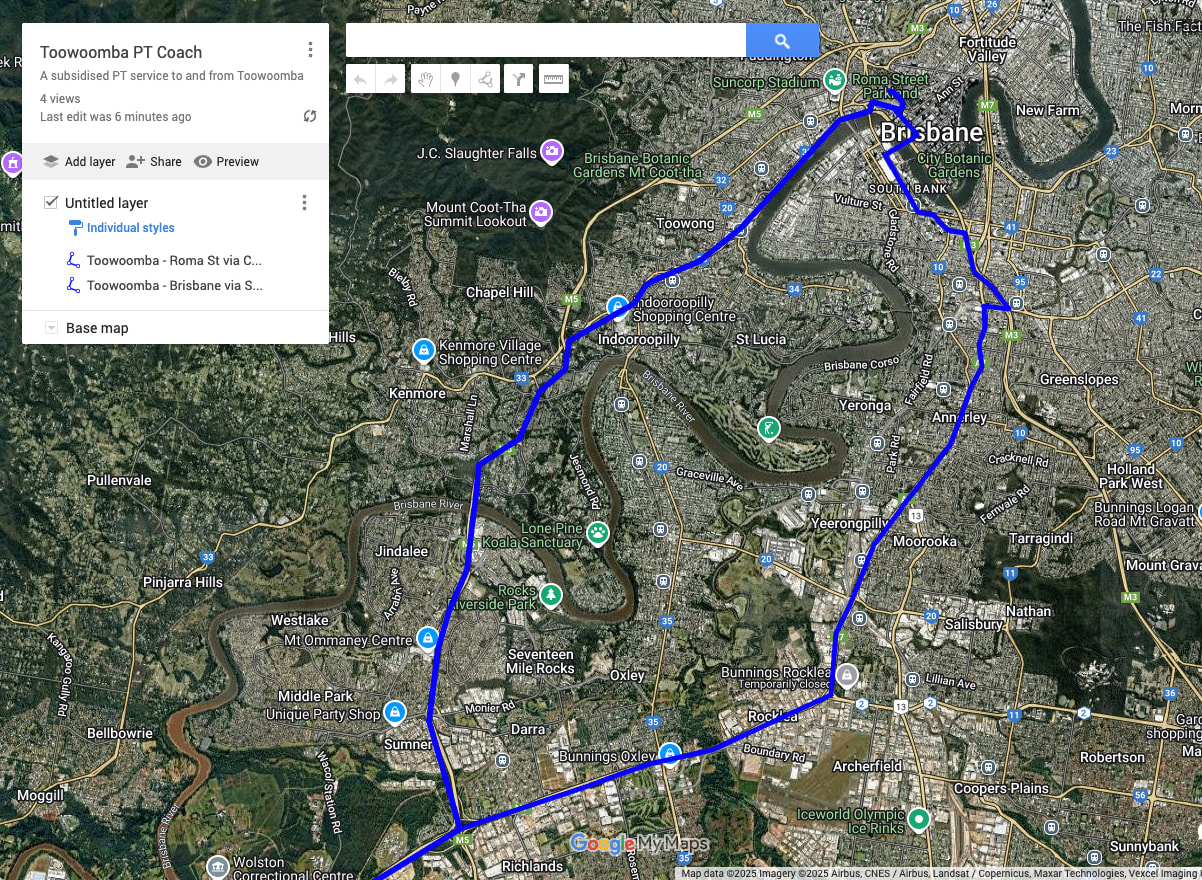
2 Likes
Would it be worthwhile to add a stop at Moorooka on this route, to allow passengers from Toowoomba to change to the Beenleigh line without travelling all the way into the city? This would be a considerable time saving for such passengers, and it wouldn’t add much to the route time as it already goes right past the station.
2 Likes

SBB has got their long-distance trains running well under the max railspeed (200kph on track for 230kph). The trains run up to 230 when they have some delay to catch up. Similarly, QLD could do the same by building the tracks to allow for 200kph speeds, but regular service speeds would be 160kph. The train would run 200kph only if the train want to save time in case of a delay.
Didn’t they run the Tilt Train like that, where it ran up to 170+kph when the train was delayed? The train crash in Berajondo pretty much killed that style of running, and all trains in Queensland have to stay strictly within the speed limit.
1 Like
Link to Google Map:
[If this area appears blank, you should be able to copy the link from the “reply” option]
https://google.com/maps/d/edit?mid=1NyG5CnBKt5U17LKlhqnsDMCO2VPGjPI&usp=drive_link
3 Likes
I’m not that familiar with the area, but just sharing my observations/thoughts.
Looking at the map and thinking if the main purpose is Brisbane <> Toowoomba connection, is it needed to go in and out of Ipswich on route? It adds quite a diversion.
A stop via Goodna Station would provide Ipswich line connection and seems to have much less of a detour involved.
I like option B too for the Morooka station stop for Beenleigh line connection (pity its not a GC line stop) and Buranda interchange.
2 Likes
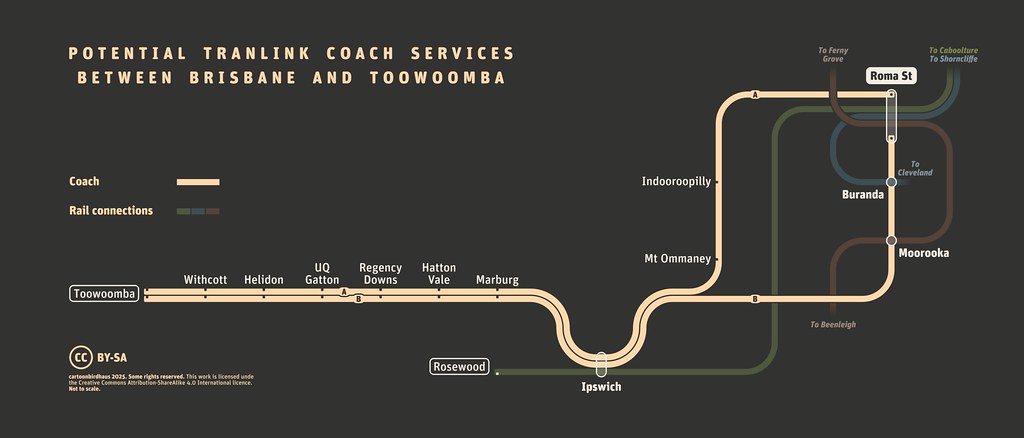
6 Likes
Could a connection to Richlands be worthwhile? That way people wanting to go to Mount Ommaney could switch to the 460 there, and the B route can be taken instead. It also connects Toowoomba to the Springfield line and the Inala-Forest Lake area
It does however add around 10 mins to the already long trip, assuming minimal traffic (which will probably not be the case during peak hours). The detour would go through the Centenary Motorway, to Richlands station then via Progress Road back to the Ipswich Motorway