Playing devil’s advocate, that makes some sense to me, but maybe we’re used to it. Maybe giving each station it’s own code is the way to go?
It’s really only the last two letters that matter to the passenger. For passengers who are going to Springfield station from somewhere up the OG Main line, you have a choice of:
- RPSP (from Kippa Ring)
- CASP (from Caboolture)
- NASP (from Nambour)
- BRSP (from Brisbane City)
Meanwhile the only thing that matters to the passenger is that they would catch the Springfield train (only denoted by the SP in the codes); the origin of the trains wouldn’t even matter to the passenger, despite being presented with all those niche through-running pairs (unless your someone on Elimbah station who wants a 1 seater journey to Springfield station, in the cause they would only be presented with NASP).
How many people who read BDVL even realise it’s meant to be a shorthand for “Brisbane domestic varsity lakes” and thus denotes a train line and doesn’t see it as esoteric nonsense
2 Likes
Really prefer numberings if we can and we know we got 3 sectors
T1 Birtinya to Beenleigh
T2 Redcliffe to GC
T3 Shorncliffe to Ipswich
T4 Airport to Springfield
T5 Ferny to.Cleveland
T6 Doomben to Park Road
T7 Caboolture to Nambour
Agree with clutter needs to go ie BRCA etc… saw strange ones that makes 0 sense when network split in half ie Caboolture to Airport via EJ lol
I think it’s important to say why line numbering is important.
- it allows improvements to signage at stations for interchanges (eg “if you’re going from Springfield to Woolloongabba then change at Roma Street and follow the signs to the T5 and T6. If you want to go from Caboolture to Central then change at Albion onto the T1, T2, T3
- It reduces confusion for short services (the Coopers Plains example Alex used above)
- It makes it clear services go beyond the city (eg. A train from Ferny Grove goes to Boggo Road) - if they’re both on the T6 it makes it clearer than today where people think of them on two separate lines
- You can’t just rely on colour - all the doughnuts Translink are rolling out aren’t DDA compliant until you put something in them
- It makes it clearer that certain stations are on certain lines - eg. Fruit grove is on the T6 not the T5 and the signage will reflect that. It makes it clearer which stations are interchange points.
3 Likes
Just a point on this - the post CRR Sector 1 pairing will be Birtinya ↔ Varsity Lakes and Redcliffe ↔ Beenleigh as per this article from CRR ( New underground will connect a new spine for our rail network - Cross River Rail ).
The separation will allow GC to SC to be timetabled as ‘long distance express’ services while Redcliffe to Beenleigh will be timetabled as ‘turn up and go’, predominantly all-stops services (using the wording from SEQ rail connect but you get the idea).
The idea as well for the Olympics is that one line will allow people to travel between the coasts and Brisbane, so if someone wanted to go from an event on the Gold Coast to an event on the Sunshine Coast or anywhere in between they have a single seat journey for the rail portion of the trip.
1 Like
I have no doubt that less than 10% of users pay attention to the 4 letter codes or know what they mean.
Most users would just look at the final destination on the station PID and consider that the train name. Though I know from talking to both locals who rarely use the train and visitors find it confusing to work out which train they are looking for or what line they’re on.
2 Likes
And if we have the same number for Beenleigh and Coopers Plains terminators, how will that help people wanting to travel to anywhere from Banoon to Beenleigh?
The real reason these 4 digit codes are problematic for the majority is because some maps use them to allow filtering.
Here’s google maps for instance.
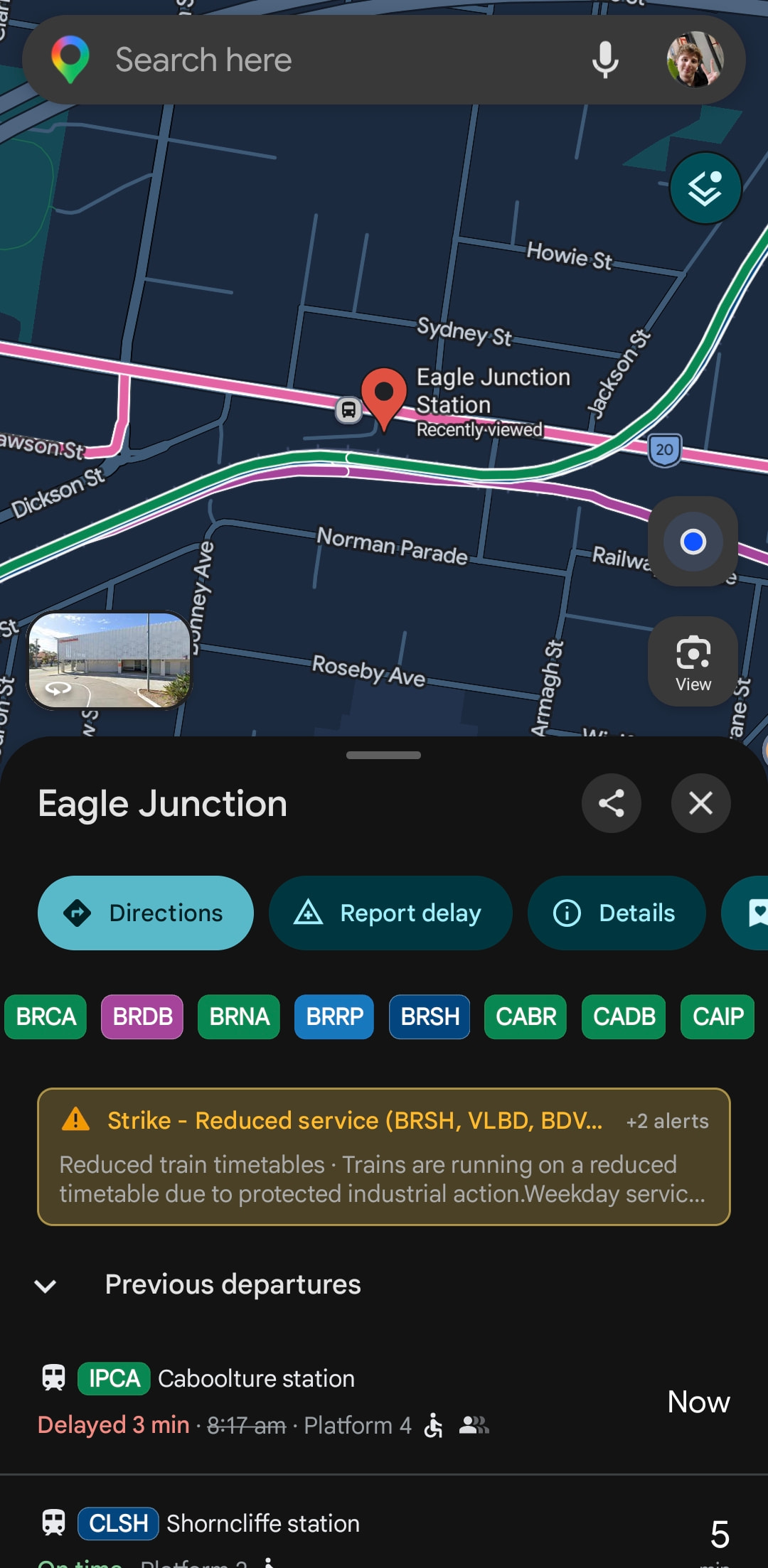
An absolute UX nightmare 
4 Likes
Truth. Sydney and Melbiurne got all grouped under their number or line of destination
2 Likes
Do the lines even need to have a letter attached?
The London Underground works perfectly fine with colour identification. If we upgrade the PID’s as per that proposal someone designed on the other thread, this will give clear and precise stopping, line and service information.
What more do we need?

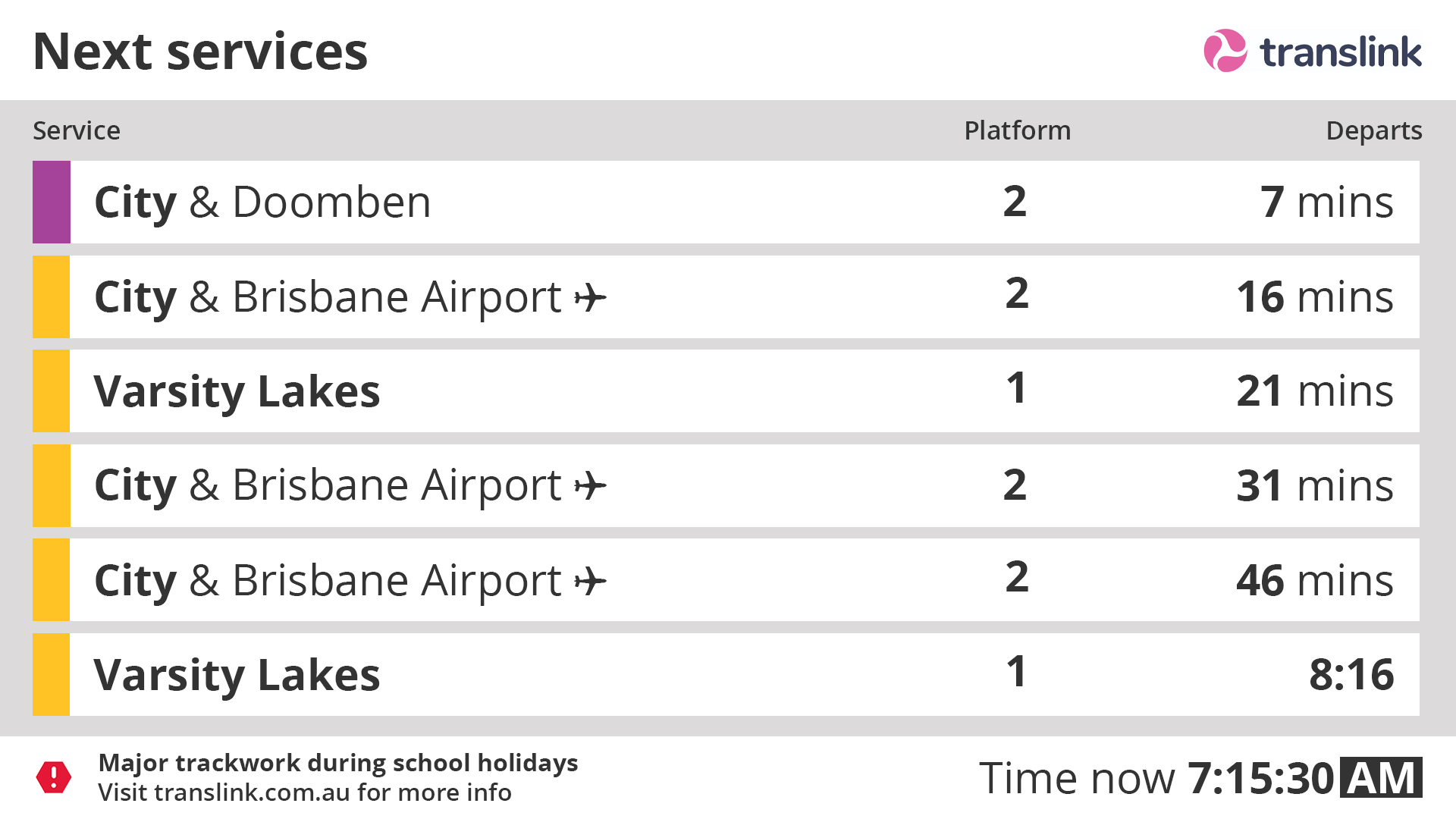
Is there any reason to number them. Why not just name them after line colour. For example, the Gold Coast line is the yellow line whilst the Beenleigh line is the red line and the Ipswich line is the Green line. Cleveland can remain the blue line but we recolour the Springfield line to brown and call it the Brown line.
1 Like
Numbers are shorter for print and iconography and colours alone without text aren’t accessible for those with colour blindness.
8 Likes
Don’t touch CACA!
3 Likes
Disability accessibility (colour blindness) and as you add more lines you need more colours so you start taking about blue, light blue, dark blue etc.
3 Likes
If they retain colours I also think that they should change the Gold Coast colour line, simply because the tram is the quintessential gold line
I’ve had more than one person looking on the map in confusion while sitting on the train and coming to the conclusion the train goes to cavil avenue because the tram and the train have the same colour
Or at least make them noticeably different shades of yellow, like one stays as yellow the other can be like burnt brass gold
Couldn’t it be displayed as say:
T1 Beenleigh
T1 Coopers Plains
That could work. The number is a supplement to the station destination where the train terminates.
A suggestion:
Numbers clockwise using North as 1.
So
T1 Caboolture
T2 Kippa Ring
T3 Shorncliffe
T4 Doomben
T5 Cleveland etc.
You could potentially separate out long distance services as well.
R1 Nambour/Gympie North
R2 Gold Coast
R3 Rosewood
Alternatively, you could go anti-clockwise so that the train numbers matched BCC bus numbers. T1 Beenleigh T2 Cleveland T3 Ipswich/Springfield Caboolture, T4 Caboolture etc.
That would be so your 100 series buses would connect with the T1 train, your 200 buses would connect with the T2 train, your 300 buses connect with your T3 trains and your 400 buses connect with your T4 trains.
2 Likes
Yep. Code plus headsign. Just like buses and ferries.
6 Likes
I have to ask…what even is this service? A Caboolture loop?!
IPIP, IPEI, IPBO, IPBU, IPEV, IPDI, IPRI, IPRE, IPGO, IPGA, IPWA, IPDA, IPOX, IPCO, IPSH, IPGR, IPCH, IPIN, IPTA, IPTO, IPAU, IPMI, IPRS, IPCE, IPFV, IPBH, IPEJ, IPNO, IPPE, IPDA, IPNA, IPBU, IPMO, IPCA, CACA
Ipswich to Caboolture 