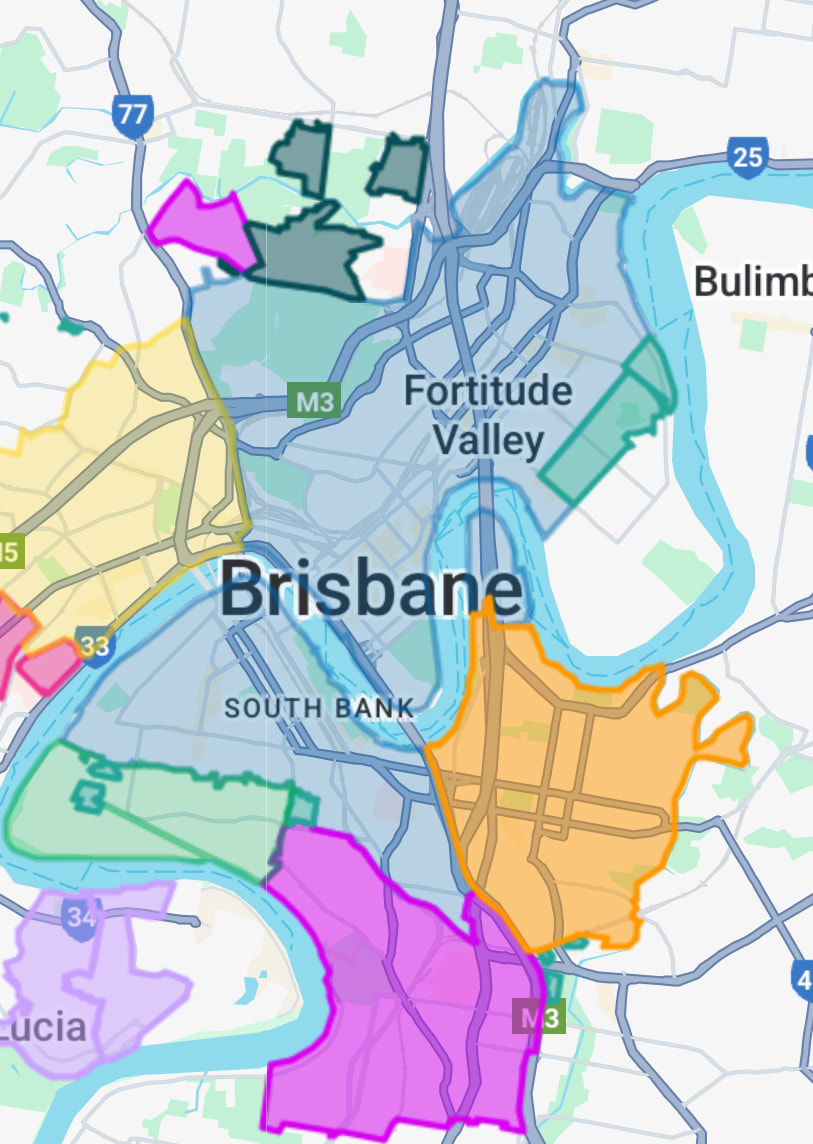
Basically my idea is the bit in orange (Gabba Traffic Area), bit in yellow (Lang Park Traffic anrea) and bit in Blue (Brisbane City Traffic Area) would be tolled/congestion pricing. For the Gabba and lang park area it would be weekday peak only as well as during major events, whilst for Brisbane area proper it would be a full weekday congestion toll and will also apply on late Friday and late Saturday nights for the valley area. Both will be untolled on weekends and public holidays. Also local traffic could have some exemptions. Also think some streets like Adelaide street should be bus only during peak hour unless your actually got to park up there. Problem with this though is how do you enforce. Ultimately the council would be getting most the revenue from this.
It won’t happen, politicians are sh*t scared of annoying drivers. But if it did, I think the best opportunity would be on a smaller scale, like a congestion charge for entering or leaving the CBD during peak hours, and then perhaps increasing the size of the zone in future.
Well yeah obviously we would need to pilot it
Should add, congestion pricing could also raise money for the storey bridge restoration
The Story Bridge is owned by Brisbane City Council. Councils do not have the power to create their own taxes like state or federal governments, they can only raise revenue through rates/fees/charges (on land, not on vehicles or road users) where authorised by state legislation.
Doesn’t Council get a cut of the revenue from Legacy Way and the Go Between Bridge?
I don’t think they get a cut of each toll. They benefit financially with the initial construction costs and ongoing lease costs etc.
Toowoomba Regional Council has implemented a Council Public Transport Levy
A new levy aimed at improving accessibility to public transport services across the Toowoomba Region has received strong backing from the highest levels of the Queensland State Government.
Toowoomba Regional Council’s (TRC) new Public Transport Levy, introduced with this week’s adoption of the 2024/25 Council Budget, has received praise from Queensland Minister for Transport and Main Roads, Bart Mellish.
This includes partnering with the State to deliver key elements of the TRC Sustainable Transport Strategy 2023 which simply would not be able to be delivered in a business-as-usual approach.
(bold added)
“TRC now has skin in the game when it comes to public transport and I look forward to continuing to work with the State Government to improve the approach to public transport services across the Toowoomba Region,” Mayor McDonald said.
Notes
No extra levies on rates or utilities please to pay for something.
I agree on the developer levies though.
Of course the State is happy. It’s somebody else raising taxes.
The State could and should collect a levy determined on a Statewide basis for any LGAs with public transport services. It can be done very easily through rates notices, same as the emergency services levy. No reason Bulloo or Pormpuraaw residents should be paying it but those in the bigger councils should, and it would be a good way of getting the ball rolling on some other parts of the State with no or only limited public transport but which should have it - Mt Isa, Emerald, Ayr / Home Hill, Oakey, Roma, Charters Towers, Mission Beach, Moranbah etc.
Some more detail.
Toowoomba has adopted a scaled-down version of the BCC approach where LGA money funds bus operations within the LGA. This is expected to give an edge against the other 11 LGAs also asking for more PT funding in their LGA.
Public Transport Levy
This is a new levy in 2024/25. It has been introduced taking into consideration community feedback over many years. It will give us greater leverage in advocating to the State Government on improvements that are much needed to our Region’s public transport network.
This levy is set at $39.80 for the full year.
(bolding added)
Some Statistics:
Estimated Resident Population from Profile.ID
- Toowoomba (2023) 181,821
- Ipswich (2023) 251,148
- City of Moreton Bay (2023) 510,104
- Logan City (2023) 377,773
- Sunshine Coast LGA (2023) 365,942
- City of Gold Coast (2023) 666,087
We can estimate rateable properties from population by dividing by 2.55, the average household size in SEQ. See Household size | South East Queensland | Community profile
We can then multiply by Toowoomba’s $39.80 levy per property to see what revenue this could raise assuming no business revenue funding.
‘Before Leverage’ LGA PT Levy Revenue Estimate (assuming Toowoomba levy levels).
Toowoomba - $2.8 million
Ipswich - $3.9 million
Moreton Bay - $7.9 million
Logan - $5.8 million
Sunshine Coast - $5.7 million
Gold Coast - $10.39 million
Now this might seem modest, but as a contribution the LGA funding would be used to attract and leverage more Queensland Government funding.
‘After Leverage’ Estimate
Let’s set the contributions to a similar level to what BCC has, where 25% is BCC funding and the remaining 75% is State Government funding. The figures below are the estimated totals for LGA + QLD Government funding assuming a similar ratio as for what BCC has currently:
Toowoomba - $11.35 million p.a. => 2 High Frequency bus routes
Ipswich - $15.6 million p.a. => 3 High Frequency bus routes
Moreton Bay - $31.8 million p.a. => 6 High Frequency bus routes
Logan - $23.5 million p.a. => 4 High Frequency bus routes
Sunshine Coast - $22.84 million p.a. => 4 High Frequency bus routes
Gold Coast - $41.58 million p.a. => 8 High Frequency bus routes
(assuming $5 million p.a. High Frequency bus operating costs, and assuming these are new routes and not top-ups of an existing bus route)
Conclusion
Assumptions and limitations - this is only an exploratory model for the purposes of discussion, and which relies on assumptions about future Queensland Government policy.
However, if the larger LGAs within SEQ (a) raise a modest PT levy, (b) succeed in attracting Queensland Government funds on a similar subsidy ratio as to what BCC has, and (c) focus on only contributing to specific high-frequency, high patronage bus routes rather than diffuse low patronage coverage services / flexi link services, the impact of introducing these new services enabled by the levy and the Queensland Government funds attracted could be significant.
Notes
The differences in pay are one of many reasons why I think contracting out services leads to worse outcomes compared to if the state government simply owned and operated the entire system themselves. Could get some real economies of scale there and eliminate pay differences for staff. Or they could even pay a bonus to drivers willing to be based out of depots with a severe lack of them.
It may be better if the contracts were legitimately put to a competitive tender each time it goes up for renewal. There is little incentive for contractors to improve their driver availability (and in turn conditions) if they get the new contract regardless.
Bringing fleet ownership into TMR and simply leasing buses out to operators is a good step in the right direction when it comes to enabling competitive tenders.
I mean with the 400+ buses they’re building (currently leasing out to private operators and for rail replacement) I imagine this is the path we’re heading down, at least for non-BCC routes.
Owning the state fleet is a good first step, but I can see a future where TMR take over from Kinetic, Bus QLD and all the smaller operators. It would be a logistical nightmare in terms of workforce, rostering, etc but in the long term, probably a good outcome.
I’ve lost count of how many bus operators are operating in just SEQ alone, each with their own fleet, maintenance, rostering, workforce, network control, enforcement officers, etc. It seems so inefficient.
Having TMR take over the actual operation of bus services would be a major case of “nationalisation” (‘municipalisation’ I guess would be more accurate) of multiple private operators, as well as a transfer of a major department of BCC to state control.
I don’t think TMR would ever go that far - they might provide all the vehicles and possibly some depots for a service area (and maybe take over these type of assets from TfB at some point down the track), but I don’t think they would ever bring the operation of bus services completely in-house. They will continue to tender out the operation side of things, as they are doing now with the tender for the new services in Logan’s west.
To be fair that’s why I said non-BCC operators. I could see TMR relatively easily taking over bus routes outside BCC once the respective contracts expire, in a few years they will have a big enough fleet to do that.
BCC is really the biggest obstacle, they’re an absolute behemoth when it comes to bus services and they won’t give that up any time soon. The closest we’ll ever get to a single unified state bus network is probably BCC continuing routes in their LGA and TMR running everything else.
It would be interesting experiment at the very least to see how the translink network would run with just two bus operators. I definitely think when it comes to staffing the current model of a bunch of small companies running contracts is a bit a handicap.
Even if we exclude TfB from the equation, I still can’t see TMR taking on the day to day running of the wider SEQ bus network. That is still a significant nationalisation of private business, and a major extension above their current operating remit.
Honestly, I don’t know if we would want to see it - when Governments try to undertake business operations, they often end up being a less efficient and more costly operation due to the bureaucracy inherent in Government-controlled commercial operations.
It would almost certainly not happen under an LNP Government at any rate.
A reasonable alternative is to have the LGA buy out the bus operator. For example, Ipswich City Council could buy out the bus operator in its region.
This would be a simpler task to organise and would come with local funding from the LGA similar to BCC and Toowoomba.
Don’t forget City of Gold Coast as well, which I’m pretty sure was the first in SEQ to fund services in collaboration with QldGov.
Are these regular operational services or special services like flexilink