Wouldn’t this only serve to turn the individual service areas into their own little fiefdoms, in much the same way the BCC has gained effective control of PT services within their LGA?
Ipswich, Logan, Redlands and Gold Coast aren’t going to want to spend their own ratepayers’ money on operating transport routes running outside of their own LGAs, at a time when what we need is more services crossing the border between these LGAs.
It would be more of an issue if LGAs were responsible for 100% of operational funding, which is not being proposed here.
BCC has the most frequent service of all SEQ LGAs and that’s because they top up the funding ~ 25% to get premium service levels.
They can invest in new depots, driver pay, infrastructure, new buses and service innovation in ways that private operators on fixed value contracts simply cannot afford to.
BCC also didn’t ‘gain control’ as BCC always was the PT agency since they ran trams. Is was only in the 1970s and 1980s when passenger numbers dropped and state subsidies were required that State Government took a greater role.
You mention service between LGAs but right now there is a huge problem with bus service levels within LGAs. That is the much bigger problem to solve.
If we look at bus service between non-BCC LGAs such as Logan and Gold Coast or Logan and Redlands where the QLD Government has 100% control of service across LGA boundaries, is the bus service between LGAs any better?
The train network is what really carries passengers between LGAs. If the Qld Government wishes to improve PT between LGAs they could fix that.
Most frequent service does not automatically mean the best service. They may be making some improvements in recent times with the introduction of the Metro Routes moving the Busway a bit more towards a proper trunk and branch operation, and the associated New Bus Network changes on top of that. However, they still shoot rockets everywhere in peak, carry air on duplicated runs along certain corridors as noted ad nauseam over many, many years, and consciously avoid connecting to train stations.
If TfB started looking at ways to operate more cooperatively with rail rather than in competition, trim out some of their duplicated, air carrying routes and look at grounding some of their rockets, they may not need that level of funding top up, or Translink may be able to reallocate some more of their funding towards the other LGAs which are less able to afford top up transport funding (as an example, Logan Mayor Jon Raven has just announced that the Council’s operating surplus of $23 million has almost completely evaporated in the face of rising costs for providing council services. Council is expecting to fall into deficit in a month or two - I don’t see them adding any money into transport services when they are struggling to fund stuff their own responsibilities).
Not all LGAs are Brisbane City Council, and have the ability to finance new depots, new bus fleets, infrastructure, etc out of their own budgets. As we have seen with the tender for new Logan Bus Services, the State Government is chipping in the bus fleet and the depot for the services, meaning that these is no requirement for the private operator to do so. Public transport is part of the State Government’s remit, so their supplying the fleet and depots makes sense - dumping that responsibility onto LGAs does not.
I’m talking about in more recent, post-Translink times (2013), when BCC worked out that they had the clout to actively override the State Government - who has the responsibility for Public Transport provision across the state - and kill a wide ranging, network-wide bus review in favour of their own much narrower review that, IIRC, didn’t really produce much that was beneficial at all.
The bus service between LGAs isn’t adequate, but forcing Councils to operate their own bus services isn’t going to improve matters. Councils don’t want to provide funding derived from their local ratepayers, towards anything that is outside their boundaries. This is probably a large part of the reason TfB services only make minimal incursions across BCC borders.
As for the train network, it has a primary aim of transporting people into/out of Brisbane City specifically. It doesn’t facilitate direct transport between LGAs like Redlands and Logan, or Logan and Ipswich, without requiring you to go via the inner city. If I want to travel from my home out to Ipswich, Translink tells me that the best option to do so is a 2 hour journey via Central Station - this is a distance I can drive in 45 minutes. Trips like these show that we simply are not a truly interconnected region in terms of PT.
LGAs have a hand in every other mode of transport. Simply repeating that ‘PT is a state responsibility’ isn’t really a justification because it can always be amended not to be.
LGAs are State Government agencies and exercise State Government powers delegated to them. They exist to exercise State Government functions locally.
LGAs are starting to realise that leaving PT up to the state only will only get them the basic package of service and that their lobbying efforts for more service will be generally crowded out by the other competing 11 or so SEQ LGAs who are also vying for funding.
The current state of affairs is not optimal and I can see other LGAs follow Toowoomba LGA and start to provide operational bus funding.
I’m talking about best practice examples of public transport networks - there is more to having a true world class transport network than just throwing money to boost frequency across a network where major inefficiencies exist and overall connectivity is lacking.
And there is a big difference between LGAs providing transport funding above and beyond state infrastructure spending, and forcing LGAs to become the transport operators themselves. That was the crux of my argument - the status quo of contracting out bus operations to those in the business of running said operations in an efficient manner, is a better outcome than forcing it into the hands of Councils (if such a change was to take place, Councils would likely just contract it out themselves rather than attempt to run it in house, no different to council services like landscaping or rubbish collection, etc.)
Well, nobody here is talking about ‘forcing’ a council to fund or take over PT operations. That’s a bit of a straw argument.
Obviously they are free to add or not add certain services to their scope of service as they see fit.
I do think there is merit in LGAs funding bus service, and in some cases it may make sense for the LGA to buy out the local bus operator if it will improve things. Certainly, BCC bought out many private bus operators itself in the past, at a time when council was much smaller and had less money than it did today.
It’s worth looking at this article from the past, councils used to do lots of things.
…legislation provided local authorities, such as Rockhampton City Council, with the right to apply to the Commissioner for Transport to be issued a licence to operate passenger services within their area. If granted, Council would displace all existing privately operated services affected by the application.
In June 1947, Rockhampton City Council applied to the Commissioner for Transport to acquire 8 privately operated services with 29 registered buses under the terms of the State Transport Facilities Act 1946 (Qld).
Private bus operators back then were much smaller operations compared to what they are now.
While there are still some smaller operators around like Logan Coaches and Clarks, there are now many more multi billion dollar international groups like Kinetic and Transdev which would be well beyond the capacity for a LGA to acquire.
We are just going to have to agree to disagree on this and have widely different positions.
There is nothing preventing an LGA acquiring parts of an operator. For example, the Ipswich only depots of Bus Queensland. It’s not necessary to buy an entire entity.
I know it’s a bit of an edge case but it would be quite awkward for City of Gold Coast to acquire Kinetic’s operations on the GC because they have also an operating contract with… Transport for New South Wales.
Honestly I would advocate to merge those operations under translink’s oversight. TfNSW can give the money to translink and delegate all planning to them, ticketing and all included.
The buses being owned by TMR and leased out would certainly attract more bidders, since I doubt many companies would have enough spare buses or be able to acquire enough of them at short notice to win a bid and fulfil the terms. But I still think this isn’t as good an outcome as TMR taking everything in-house. Economies of scale and fewer overheads mean larger operators can run at lower cost, and not including a profit margin will also bring savings. It seems to me that contracting services to the private sector is based on an idea that they can achieve high levels of service for a lower cost, but I’ve seen very little evidence to suggest this is actually the case when it comes to public transport in Australia.
Well I for one definitely want to see it. I think our society has been fed a lot of propaganda by the media over several decades, to convince us that governments can’t do anything properly and the private sector is always more efficient. But I strongly disagree with this idea when it comes to major public services and infrastructure.
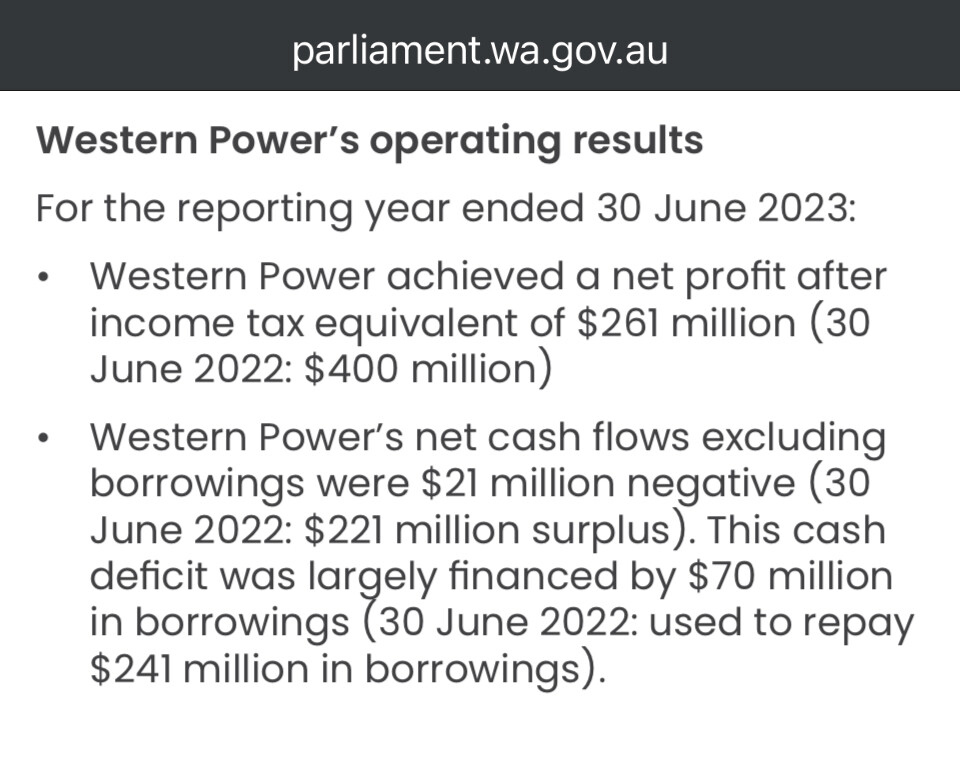
Western Australia has some of the lowest power prices in the nation despite being isolated from the rest of the Australian electricity grid and not being able to buy cheap power from other states. So why are their prices low? The state still owning and operating their own electricity grid probably has something to do with it. There’s no profit margin involved, and no incentive to gold-plate infrastructure and pass the costs onto the public. Unsure if any other states or territories have a similar arrangement still.
When it comes to public transport, if I remember correctly, the suburban trains in Sydney and Perth are still operated by the state (excluding Sydney Metro), whereas the trains in Melbourne have been contracted out. I think Sydney and Perth have far better train operations relative to their respective population sizes, compared to Melbourne.
I’m willing to consider evidence in support of the notion that government operations of public infrastructure are often less efficient and more costly, if you can provide some. But I have seen plenty of practical evidence against that idea.
This is true, blue team don’t seem to like the state running things, except for nuclear power plants.
I’m not sure this is quite right. There is always a margin, a requirement to pay a return (cost of capital) and a state owned operator still has to pay dividends, it just gets paid to the shareholding government.
Government owned =/= Non-Profit
Competitive neutrality also means that a public owned operator must charge commercial rates.
The efficiencies from scale haven’t been defined - what precisely would be more efficient? Generally when you have a large centralised organisation, oversight is diluted and this is when you tend to get problems.
Well surely that depends if it’s a state-owned corporation run for profit or an aspect of a government department. Translink is certainly not run at a profit.
Let me rephrase then, a government-owned corporation isn’t incentivised to maximise profit as much as possible because that’s what the market demands, like a company listed on the stock exchange is.
My understanding is they’re allowed a certain level of profit over capital investment, which is what incentivised gold-plating in the electricity distribution system.
Both buses and spare parts are cheaper per unit when they are bought in bulk. So for the same number of vehicles overall, having a larger fleet rather than multiple smaller fleets is less expensive to purchase and more efficient to maintain.
When building a depot, the marginal cost of housing each additional bus is lower as the number of buses increases.
Scheduling is easier if you have a larger team working on it, as opposed to each smaller player constructing their own schedule with fewer staff.
Accounting, HR, IT, social media and marketing can all be done efficiently by an in-house team rather than being outsourced.
Well, the board of directors is legally required to act in the best interests of the firm. Increasing return would be one of those things.
The other thing is that many private businesses, in fact the majority, are not listed on the ASX. Optus, for example, is not listed on the ASX as it is privately held. It absolutely is going to be trying to make money despite not being ‘on the market.’
That depends on the company’s charter and principles. If those principles suggest maximising profit isn’t the sole goal, then they are not bound to act in service of maximising profit in all situations.
That’s a bad example, because their parent company, Singtel, is listed on the SGX in Singapore. And private shareholders will of course still be demanding profits even if the shares are not publicly traded.
Politicisation of procurement wipes out economies of scale
If we look at a trains example, you have social procurement and local content / local manufacture requirements. This means the train might be procured at a higher cost than otherwise to comply with that local content and manufacture requirement.
To set out a bus example, you can imagine that Queensland will only buy buses manufactured in Queensland. NSW will only buy buses manufactured in NSW. Victoria will only buy buses manufactured in Victoria. And so on…
So you might end up with a small bus manufacturing plant for each state, each with their own depot, HR, parts suppliers etc rather than just one large single efficient facility servicing the entire country because of this.
Government ownership implies, but does not guarantee, low or no profit operation
There are a number of examples of government owned entities making a profit and paying dividends. Western Power, Ergon, Energex, Medibank Health Fund (after 2009), Qatar Airways, government-owned (or formerly owned) toll roads etc.
Example - Ergon and Energex, which are Queensland Government owned commercial businesses.
Ergon and Energex dividends to Queensland Government triple, electricity lobby group says prices too high
The Queensland Government’s dividend from state-owned power companies has tripled in one year, prompting a call for profits to instead be passed onto consumers via lower power bills.
The Energex annual report, released last week, shows dividends paid to the State Government rose from $406 million in 2014 to $1.3 billion in the 2014-2015 financial year.
Alliance of Electricity Consumers lobby group spokesman Jonathan Pavetto told 612 ABC Brisbane Ergon dividends rose from $400 million to $1.9 billion over the same period.
He said profits for Ergon and Energex doubled in one financial year.
Buses run by the Queensland Government would likely be run on a non-profit basis
Despite the above, if bus services were brought into public ownership, either at the State level or LGA level, it is fair to think that they would be run on a non-profit basis similar to QR or BCC’s buses. AIUI BCC’s buses are run as an internal division of BCC, not a separate corporate entity.
The gain from replacing for-profit private bus operators with a Translink run not-for profit operator is likely to be very modest
This is because the market structure in Queensland is that of a monopsony. That is, you have multiple suppliers and one large buyer of services (the Queensland Government).
This means that the Queensland Government has all the bargaining power to set prices. Either you provide your bus services to the Queensland Government at a (modest) rate that the Government decides, or you refuse to and shut down (or sell to another operator). It’s not like there is much demand for passenger public transport services from customers outside of the Queensland Government and one cannot run a PT bus service on farebox alone.
That profit margin? It’s going to be low.
Competitive neutrality further narrows the benefit from public operation
This is not currently an issue as bus regions are not competitively contracted out, but should they be, this principle would come into operation.
Competitive neutrality
Competitive neutrality is the principle that a public sector business or agency should not have a competitive advantage (or disadvantage) over the private sector solely due to their government ownership. Public sector businesses should compete with private sector businesses on an equal (competitively neutral) basis.
Public sector businesses may have competitive advantages over private sector businesses. For example, some public sector businesses may:
be exempt from taxes and charges
have access to less expensive funds because of direct or indirect government guarantees
be exempt from complying with certain regulations and procedures.
Potential for rising labour and operational costs, due to creation of a large singular workforce
This is true, however the largest ongoing cost for a bus operation would have to be labour (at least until a time buses might become self-driving).
An interesting policy in QLD was the BPIC which increased labour costs.
Independent economic modelling by Queensland Treasury over 2024-30 estimates BPICs are likely to increase project costs by up to 25 per cent and create a net economic cost of up to $17.1 billion.
It is not unreasonable to imagine a scenario where you had an election coming and bus operational costs were being increased for a similar reason.
Whatever savings were being made on the bulk buy of buses, parts etc will be wiped out entirely from having a very large singular workforce.
It would also mean that should an industrial dispute ever arise (e.g. over periodic EBA negotiation), rather than this being contained to one sector or operator, the entire SEQ region’s or state’s buses could stop all at once.
Conclusion
Centralising buses under Translink seems unlikely to result in a model of economic efficiency that some are imagining.
Bus operators are likely operating on a shoestring profit already (due to the monopsony market structure). It also seems probable that operational costs would ultimately rise due to a combination of (a) local-only manufacture requirements which reduce economies of scale and (b) cost increases over time due to the creation of a large singular workforce.
For members who might favour public ownership as a preference, the LGA model seems to avoid much of the potential problems while also providing that public ownership, incentive for co-investment, closer oversight and alignment with local transport planning goals.
Notes
Competitive Neutrality
Ergon and Energex dividends to Queensland Government triple, electricity lobby group says prices too high
MEDIA STATEMENT: Construction productivity boosted with BPIC pause