This thread title does not fit my comments as I didn’t mention LGA involvement in public transport operations.
That’s an investment in local manufacturing jobs then, something that is good for our society. A private company has no incentive to care about local jobs unless it’s their own workforce.
And we already know with trains that this doesn’t always happen. Yes, QTMP is a thing, but the NGRs were of course manufactured in India. NSW’s Waratah sets were manufactured in China, as were Victoria’s High Capacity Metro Trains.
Transwa, Transport Canberra, Metro Tasmania and our own TfB are all publicly owned bus operators that see no need to only buy buses manufactured in their own state/territory/council. Why would others be different?
Well since Sydney, Melbourne, Perth, Adelaide, Newcastle and SEQ outside TfB all have bus systems that are contracted out to private operators, their combined demand should have created that one large single efficient facility serving all of them, right? But it hasn’t. Why not?
These are all irrelevant to public transport because they are expected to make their money back, and charge their end users high fees as a result. Outside of a few places with extremely high population and density, public transport does not, it relies on large government subsidies to operate. A government subsidising its own wholly owned subsidiary is just shuffling money from one balance sheet to another, and any profits are returned to that same government.
If a subsidy to a publicly owned operator is too high, what happens? Some gold-plating occurs no doubt, but their budget will simply be cut in future, or they will find worthy improvements to invest them in. For a private operator? The government can’t short-change them on the multi-year contract they signed, they’re stuck paying extra, and it will likely result in a higher private profit.
If the subsidy to a publicly owned operator is too low, why would that be the case? Usually they have forward cost estimates and an annual budget, so an internal investigation will occur to understand why those estimates were inaccurate, to ensure that it doesn’t happen again. After all, they have no incentive to underquote to their own government. For a private operator? Metro Trains Melbourne got bailed out in 2004, and is getting bailed out again now due to lower patronage compared to 2019 affecting fare revenue.
And if buses aren’t running on time? Well in Sydney, they just cancel services to lift their percentage of buses on time and pocket the bonuses.
Thank goodness the government has the power to actually dictate this, and give back the money as credits on the next bill, instead of private shareholders receiving a massive windfall.
Is that so? Then why hasn’t a contract changed hands in many years outside of a company being fully bought out? Kinetic and Bus Queensland are acquiring more and more small operators. If that’s keeps occurring then they’ll have the bargaining power to not be pushed around by the government setting prices.
I don’t think the likes of Kinetic are struggling with razor thin margins. I can’t find figures for Queensland specifically, but the company as a whole makes close to $450 million in annual profit on revenues of nearly $1 billion, so that’s a profit margin of around 45%. Granted, maybe they make potloads elsewhere and relatively little in Queensland, but then why are they making such a big effort to expand in Queensland by buying out other operators? It surely wouldn’t be to continue making small potatoes in profit.
With one state-owned operator, this could be treated as a whole-of-state issue rather than each operator needing to solve their own individual problem.
When there are a shortage of skilled workers, an employer needs to pay high wages to attract and retain them. I have no issue with people with skills in high demand being paid well to ensure public projects run smoothly. If that ends up applying to bus drivers, then it’s still better than cancelled services. We talk about needing frequent services for good public transport, well, that comes at a price.
That’s a pretty big assumption. Do you have modelling or a history of similar situations in an Australian context to prove that?
Why is that fine when it comes to public sector nurses or teachers, but not bus drivers? Are hospitals or schools any less important than the bus system?
Has this been written with ChatGPT?
I don’t agree because they have little incentive to cooperate across council borders in the interests of the broader public. The rail network would be less useful if it were split by council borders, because services cross council regions, so why is that appropriate for buses? And I’d argue the incentive for co-investment is present regardless of whether the council operates buses or not, after all both the Sunshine Coast and Toowoomba have public transport levies now. The closer oversight can always happen through regional offices of the transport authority.
3 Likes
Interesting that the State ownership approach of own bus but not operate it is the opposite of QR which is lease vehicle/maintenance but plan/operate? Why not same model for buses, ferries, light rail?
2 Likes
QR doesn’t “lease” the fleet, the QTMP project involves the design, manufacture and commissioning of 65 six-car passenger trains for the State Government, who will own the delivered fleet (as well as the Torbanlea manufacturing facility, the Ormeau maintenance facility and the training simulators).
Beyond that, the contract involves the maintenance of the new rollingstock fleet, simulators and the Ormeau maintenance facility for an initial term of 15 years. A further 20 years of operation and maintenance beyond this will be handled by the State.
3 Likes
Not going argue the technical it y of the PPP but when you are paid by service levels and availability then that’s bloody close to it.
Either way the point was about separating the bus operations from the bus supply.
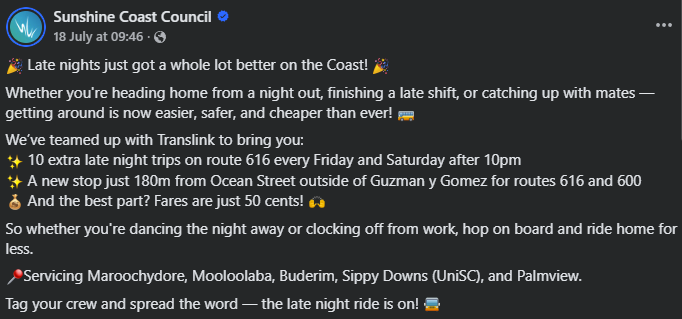
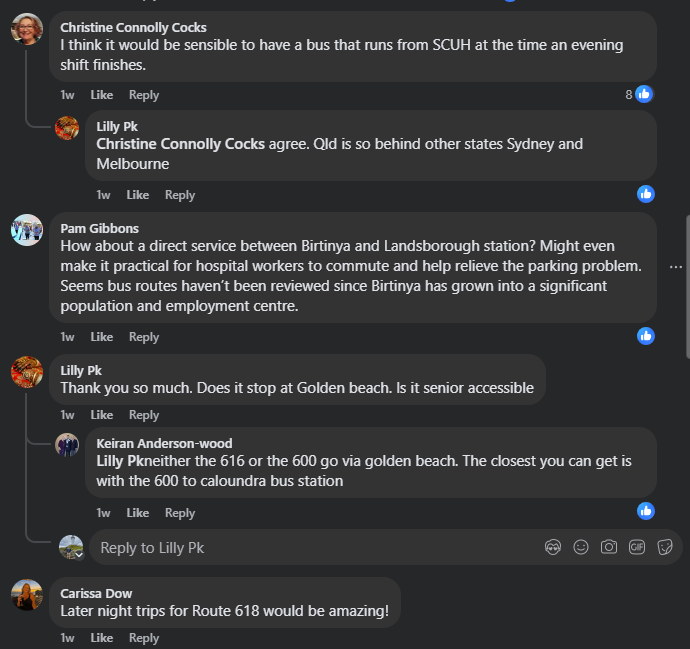
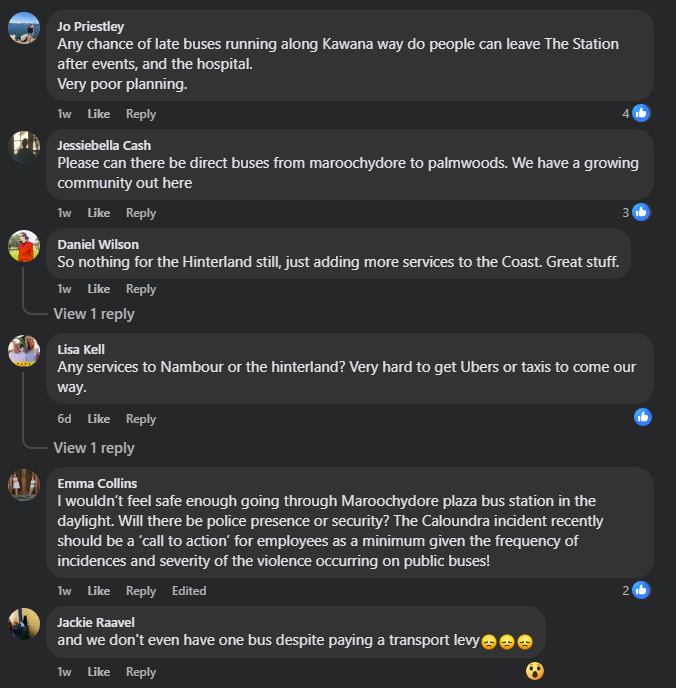
Pretty loud demand for more service improvement, following the announcement of council funded late night translink services on busier urban Sunshine Coast routes.
Ironically, in the same budget where this was funded, council reduced the transport levy by $3 per household as a cost of living relief measure. Hopefully council and TMR are taking notes.
3 Likes
Good to see that another local government has committed to co-funding regular route bus operations.
Together we achieve more.
That means BCC, Toowoomba and Sunshine Coast council are in the better service club.
Gold Coast City Council next, perhaps?
BCC is not in that club as whilst they co-fund the drive division, confusion and self-promotion as the price!!
1 Like
Not really the first time the SCRC has done this. 620 used to be hourly on the weekends and the SCRC funded the extension of this service to weekend half-hourly prior to the Noosa/SCRC demerger in the mid 2010s.
By Sean Parnell
February 27, 2025 — 12.22pm
Money for transport upgrades, studies as federal Labor courts SEQ votes
The Albanese government has tapped its $5.5 billion election war-chest so Labor can promise $200 million for a series of existing and co-funded projects in south-east Queensland.
After announcing the funding on Thursday, Infrastructure Minister Catherine King held a media conference in Brisbane with local Labor candidates to promote the party’s commitment to the city.
The funding – from $5.5 billion set aside in the October budget update – includes $50 million for Brisbane City Council’s planned business case for an extension of the Metro network.

The federal Labor government has promised $2.25 million to scope the work required on Brisbane’s Story Bridge.Credit:Courtney Kruk
“We know how popular Brisbane Metro has been here in Brisbane,” King told reporters at New Farm.
Another $2.25 million would be spent helping the council scope the work required to restore and maintain the Story Bridge – “one of the most iconic bridges in the country” – while $1 million would go towards an updated business case for a pedestrian and bicycle bridge from Toowong to West End.
Related Article

Brisbane Metro
Brisbane Metro is changing the city bus network. Here’s what you need to know
King said $5 million would go towards a $12 million council project to complete the missing cycle link between the Western Freeway Bikeway and Bicentennial Bikeway at Sylvan Road.
“What we’re trying to do is provide as much opportunity for people to move around,” King said.
Other funding would go towards covering blow-outs in the cost of the Indooroopilly roundabout project, and safety upgrades for the Brisbane Valley Highway.
Lord Mayor Adrian Schrinner welcomed the funding commitments, although the council’s transport chair, Ryan Murphy, said ongoing support would be needed to “keep Brisbane moving”.
“While business case funding will help us progress these critical projects, ongoing support from all levels of government will also be required to deliver them,” Murphy said.
While the federal Labor government this week found another $2 billion for the Melbourne airtrain, King said Queensland would need to formally request funding to deliver on the LNP’s pledge to extend rail to Maroochydore before 2032.
King said she had not been briefed on the draft report of the review of Brisbane Olympic and Paralympic Games venues and infrastructure, and would not comment on any hypothetical changes or implications for the Commonwealth-state funding agreement.
She said she was aware the Crisafulli government had the draft because she had received a text message from Deputy Premier Jarrod Bleijie.
Related Article

Exclusive
Brisbane Airtrain
Airtrain slugs Brisbane Airport workers with 114 per cent fare increase
“We look forward to hearing about it as soon as the Queensland government is ready to share that with us,” King said.
Bleijie had said only the final report would be shared with stakeholders in a two-week confidential consultation process set to start next week.
With a federal election due within months, the federal Coalition will also have an opportunity to outline its commitment to Brisbane and south-east Queensland, and how its plans differ to those of the Labor government.
There is no evidence available to confirm the impact of the Metro. More Trasport planning by press release!!
Yaaaa Another business case that will show reduced capacity but get approved anyway!!!
1 Like
MATTHEW MCLAUGHLIN, THE UNIVERSITY OF WESTERN AUSTRALIA, GRANT ENNIS, MONASH UNIVERSITY AND [PETER MCCUE, UNSW SYDNEY
4 FEBRUARY 2025

What could you buy for 90 cents? Not much – perhaps a banana.
Unfortunately, that’s how much the Australian government has per person annually on walking, wheeling and cycling over the past 20 years.
Unfortunately, that’s how much the Australian government has invested per person annually on walking, wheeling and cycling over the past 20 years.
Sign up for our free newsletter.
How would Australians’ lives change if that figure rose?
The state of play here and overseas
From 2008–2028, the federal government spent $384 million on the following active transport investments:
- $40 million for cycling infrastructure in 2008
- an estimated $60 million in the 2018 Perth City Deal for the Boorloo Bridgeand CBD transport plan
- $144 million for the Kangaroo Point Bridge in Brisbane
- an estimated $40 million as part of the Pinch Points program in 2020 for Oxford Street and Doncaster Avenue in Sydney’s east
- $100 million for the national Active Transport Fund, announced in 2024, to be allocated from 2025 to 2028.
All up, about $714 per person is spent annually on roads; 90 cents out of this $714 is just pocket change.
Even if you don’t want to walk, wheel or ride, you should care because less driving helps everyone, including other drivers, who benefit from reduced traffic.
As a result of this over-investment in car road-building, Australia has the smallest number of walking trips of 15 comparable countries across Western Europe and North America.
Cycling rates are equally dismal.
Globally, the United Nations recommendsnations spend 20% of their transport budgets on walking and cycling infrastructure.
Countries like France, Scotland, the Netherlands, Denmark, Sweden and the largest cities in China invest between 10% and 20%.
These places were not always known for walking and cycling – it took sustained redirecting of investment from roads to walking and cycling.
Meanwhile, many Australians are dependent on cars because they have no other choice in terms of transport options.
Why spend more on walking and cycling?
Road use is inherently dangerous – in Australia last year, more than 1,300 people died on our roads, which is more than 25 people a week.
Owning a car can also be expensive, which is especially concerning for those struggling with the cost-of-living.
The typical Australian household spends 17% of its income on transport – with car ownership making up 92.5% of that figure, compared to 7.5% on public transport.
Many Australians feel forced to own a car to get around, so investing in paths and public transport provides people the freedom to get around how they choose.
Congestion is getting worse in most major cities and we can’t build our way out of it with more or wider roads.
About two-thirds of car journeys in our cities could be walked, wheeled or cycled in 15 minutes or less, but these short car trips clog up our roads with traffic.
A major source of all emissions in Australia are from driving.
If more people felt safe to walk, cycle or take public transport, it would reduce this major emissions source.
There is a strong rationale and economic argument, too. The NSW government has estimated every kilometre walked benefitsthe national economy by $6.30, while every kilometre cycled benefits the economy by $4.10.
This means that by simply walking 500 metres to the local shops and back, you’re saving the economy about $6, while riding five kilometres to work and back saves a whopping $41 for the economy.
https://datawrapper.dwcdn.net/euk8b
But where could we get this funding from?
Redirecting funding from the current road budget makes the most sense, because getting more people walking, wheeling and cycling eases pressure on the transport system (think of school holiday traffic).
This is a popular proposition. One study found two-thirds of Australians supported the redirection of funding from roads to walking and cycling infrastructure. Another found many Australians support building more walking and cycling paths where they live.
This is not a partisan issue: all Australians in all communities would benefit, including drivers who would face less traffic and enjoy more parking availability.
Unfortunately, false solutions to our unwalkable and un-cycleable communities continue to derail our focus on fixing the root cause of our problems. For example, telling people to ride to work, while not providing them a safe place to do so, doesn’t make sense.
What could $15 per person get us?
Investing $15 per Australian per year would create a better built environment to walk, wheel or ride and deliver significant economic, social and environmental benefits.
If this was matched with 50:50 funding from state and territory governments (which often happens with transport projects) over a ten-year period, this investment would deliver the four national projects already shortlisted on Infrastructure Australia’s infrastructure priority list for our largest capital cities: Sydney, Melbourne, Perth, Brisbane.
It could also fund up to 15 regional cities to build comprehensive networks. Wagga Wagga for example, is about to finish building a 56 kilometre network of walking and cycling paths. As a result, those using the network are 3.7 times more likely to meet physical activity guidelines than those who don’t.
Such an investment could also fund supporting initiatives, such as electric bike subsidies which have proven extremely popular in both Queensland and Tasmania.
What could $10 or $5 per person get us?
The Australian government could invest less than $15 per person – at $5 or $10 per year, the key projects outlined in Infrastructure Australia’s infrastructure priority list could still be targeted, but those would just take proportionally longer because there is less money.
Or, instead of investing in the four capital cities on the infrastructure priority list, it could invest in two.
A different approach could be to spend $5 or $10 to fund infrastructure for regional towns, but this wouldn’t help the problems in our capital cities.
When it comes to transport, the saying goes “we get what we build” – so if we build more roads, we get more people driving. If we build paths, we get more people walking and cycling short journeys and our roads are less congested.
We need bold solutions, and $15 should not be seen as an extravagance.
Acknowledgement: We would like to thank Sara Stace, President of Better Streets Australia, for her expertise in discussions regarding this article.
1 Like
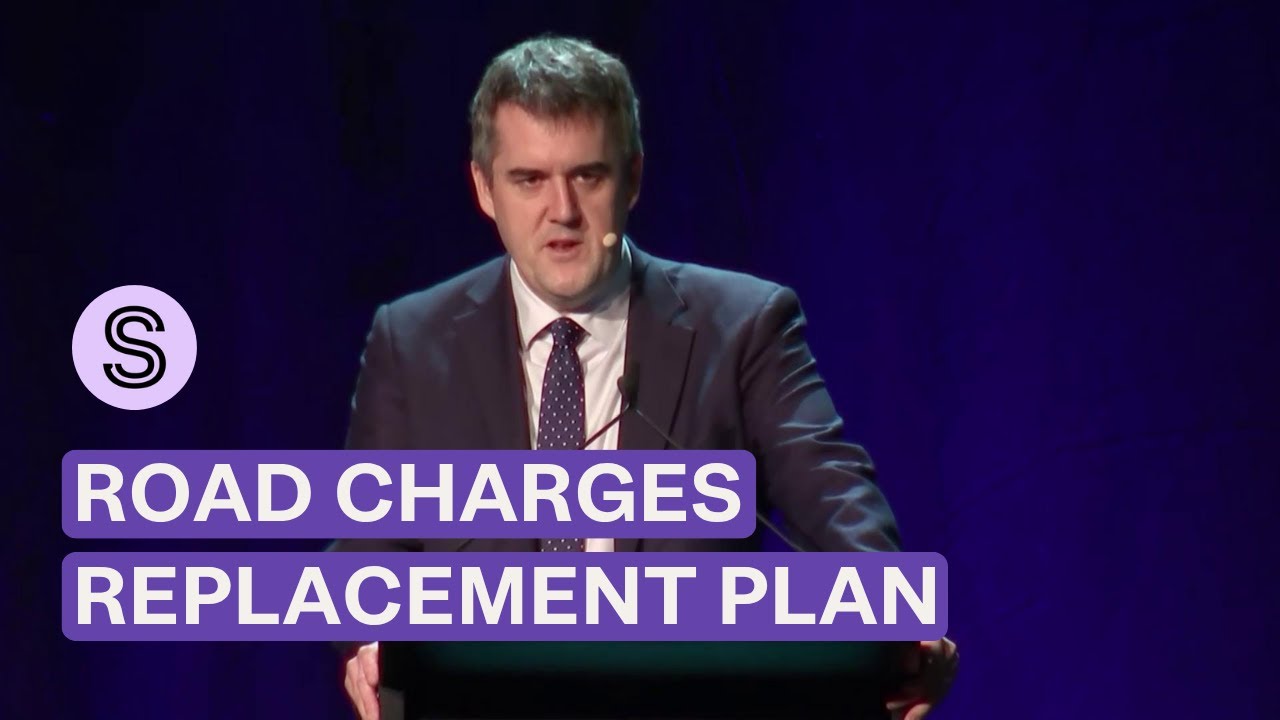
A thread for discussing road user charges and like fees.
NZ to introduce Road User Charges to replace petrol tax.
Anyone using New Zealand’s roads contributes towards their upkeep. Most road users pay levies when they buy fuel. Others pay through road user charges (RUC).
https://nzta.govt.nz/vehicles/road-user-charges
1 Like
As someone who lives in NZ, I’m ok with this plan as it means that those who use EV’s or low emission vehicles are contributing to upkeep of roads.
What I’m not ok with is the talk of this potentially being used as a subtle congestion charge, so driving on certain roads at certain times of the day will potentially cost more if that plan comes to fruition. The reason why I’m against this is because NZ, with the exception of perhaps Wellington and to a lesser degree Auckland, lack viable alternatives in many cases. In the city I live in (Tauranga), the bus network is shocking, which means the city is the most car dependent in the country. I am all for public transport usage, but it’s simply not feasible for my family to use it due to the way the network is structured, very low frequencies and the cost.
So it will be interesting to see what eventuates!
1 Like
Guardian: EV drivers set to pay road user charges as record number of electric cars selling in Australia
I drive an EV (when I’m not catching PT) - more for financial reasons than environmental but whatever.
Anyway, no issue with a RUC, there’s no such thing as a free breakfast. Scrapping fuel excise and implementing a blanket RUC is fine by me, I know excise goes into consolidated revenue but it’s unrealistic to expect that EVs shouldn’t contribute anything.
1 Like
The issue is that there is no charge for the pollution that fuel burning cars cause, so it is not good policy to apply the same user charges to EVs as them. I would prefer there was a moderate universal road user charge for all vehicles and maintain fuel excise at a lower rate.
3 Likes
That sounds like a very good solution. We drive a hybrid vehicle, so we save a bit of fuel excise but obviously not as much as an EV. Such a solution would be a fair outcome. RUC could be tweaked to class of vehicle - EV, hybrid, or ICE only.
3 Likes