A thread for historical Queensland Plans that don’t fit into another category already.
1 Like
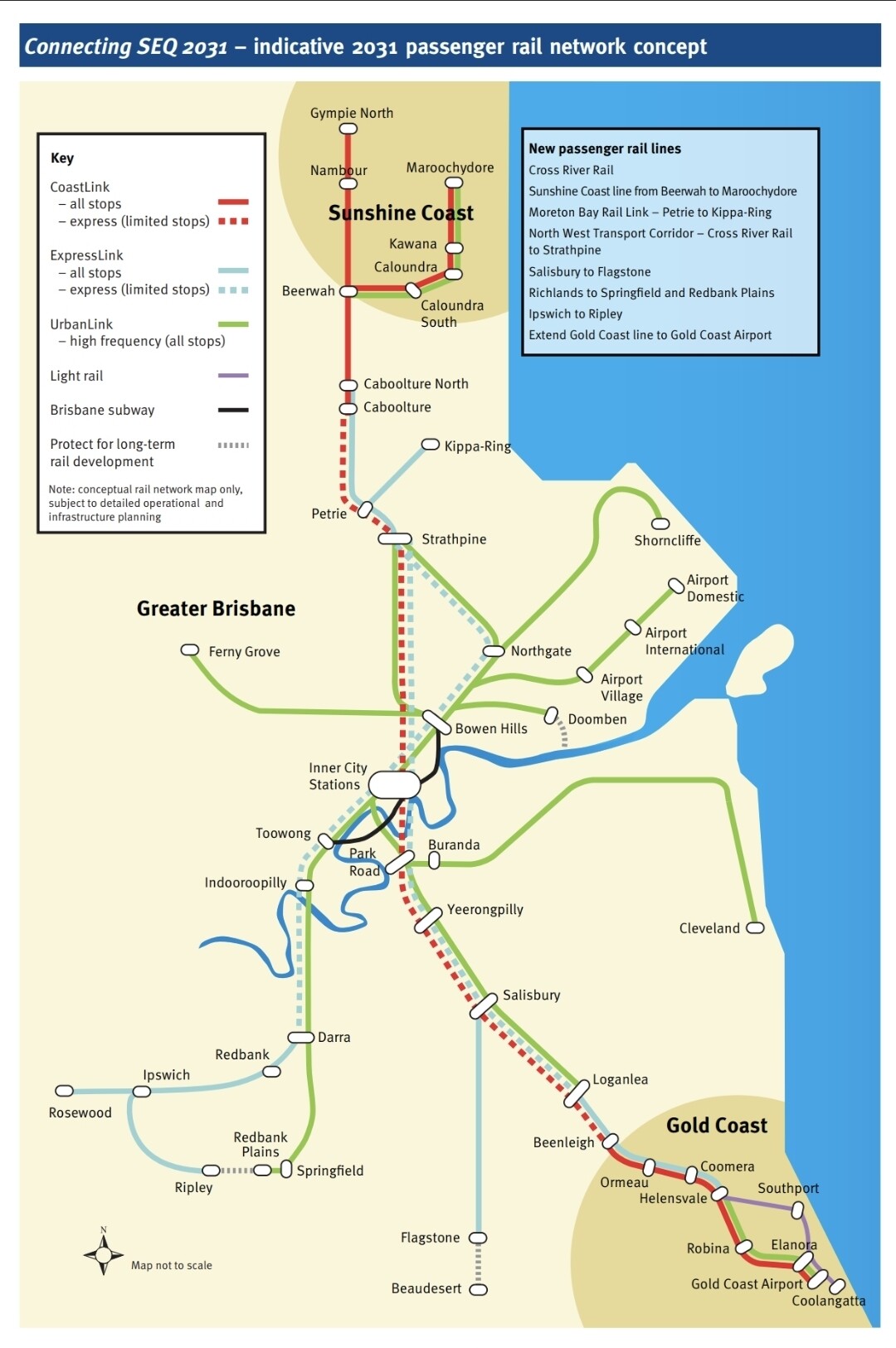
Connecting SEQ 2031
Released 2011.
Contained many flashy/expensive concepts - some were built, some stayed concepts.
1 Like
Gold Coast City Council Transport Plan 2031
The Connecting SEQ 2031 Plan
Released in 2011, it is now worth looking at what has come to fruition, and what has not.
-
North-West Transport Corridor (NWTC) - dropped. The corridor is likely to stay protected for environmental reasons and because the community would prefer a subsurface tunnel alignment versus a surface alignment. NWTC is now the Gympie Road Tunnel, which was not even mentioned in the original plan. From reading the summary business case and seeing the BCR of just 0.2, the Gympie Road tunnel substitute or replacement for the NWTC too is also unviable.
-
Frequent Trains - partial achievement. Daytime 15-minute trains were introduced on the Ferny Grove Line, parts of the Cleveland Line and parts of the Beenleigh Line. However, much of the network doesn’t have 15 minute daytime trains and unlike Perth, frequent train service disappears on weekends. This is interesting, because frequent BUZ bus service doesn’t disappear on weekends, even though trains and buses may be covering more or less the same residential areas.
-
The concept of coast-to-coast express trains resonated with the public and looked good from a PR perspective, but operationally, exposes the network to cascading delays and unreliability. So it’s very unlikely to be implemented.
-
Springfield Line Extension - dropped. Due to the high cost of extending modes that use Priority A ROW or Corridor, the Springfield rail line has not been extended from either Springfield or Ipswich. This corridor is likely to be delivered as a Brisbane Metro BRT bus or ordinary frequent buses. Implementation of rail extension is likely to be 20+ years away. There may be an opportunity to incrementally extend the line or pursue construction of the Ellen Grove station (along with TOD or denser land use around the proposed station).
-
The CAMCOS/Sunshine Coast/Sunshine Coast Direct Line/The Wave/[Insert Future Names here] Line - Substituted. The rail line has a very high per-km unit cost to construct compared to other lines around Australia, so part of it will be delivered as rail and part of it (possibly most of it) will be delivered as a Brisbane Metro BRT bus. The high cost is partly a reflection of the line having to travel through environmentally sensitive areas.
-
Cross River Rail - achieved. This project was delayed and rescoped many times, surviving multiple reviews and being cancelled twice. But it will be opened, albeit after a delay.
-
Extension of Gold Coast Line to GC Airport - dropped. There seems to be little urgency to extend the line incrementally into the Gold Coast Airport precinct. An extension of the line would be a quick win. The terminus at GC Airport should be redesigned so that further extension south of the GC Airport is possible.
-
GC Light Rail - paused. Like the Sunshine Coast Direct Line, this will be introduced as buses for the short term. However, at some point the buses will simply not have the capacity and there will be little alternative but to extend the line at increased cost to GC Airport.
-
Brisbane Subway (rail mode) - it is not a serious proposal. This proposal is unsound in that a proposed solution has been selected that does not properly fit or address transport problems at hand within Brisbane. It appears to have been included to impart a forward-looking futuristic vibe or “progress narrative” to the document.
-
Not only are rail-based metro systems incredibly expensive (about $1.2 billion/km based on Sydney Metro), but it is arguably on the wrong alignment and solving the wrong problem too. The core issue within Brisbane and Greater Brisbane is that middle and outer suburbs do not have frequent all-day 15 min PT service. Placing a subway that goes from Toowong to Bowen Hills, will do nothing to expand the 15-minute PT service coverage area. Worse, it will actively divert funding from other projects that could solve this lack of service issue.
-
This is a project with both very high direct costs, very high indirect (opportunity) costs. It is only really viable if it is a replacement for the South East Busway or runs on a parallel alignment to it as a relief line.
-
Extension of Doomben Line. Extension of the Doomben line would be a sound concept if the line was already double tracked. However, it is not. This means that funding for extension also needs to include funding duplication of the line and potentially a separated rail junction at Eagle Junction and a viaduct structure over Kingsford Smith Drive. Given this, the project is mode-contestable and a BRT option that would not require the construction of an expensive viaduct over Kingsford Smith Drive could be a viable alternative. In addition, as the Olympic Stadium and Village has moved to near Victoria Park and the Brisbane Exhibition Showgrounds, the urgency is not there to extend the line.
Reflections
Overall, when reflecting on these plans it is clear that any long term plan is likely to be changed significantly from the original over time durations of 10-15 years. Most of the plans that have high costs or long lead times have been watered down as pursing them would simply be cost prohibitive.
Certain projects look good and sound good but are operationally or financially not viable (coast-to-coast trains, brisbane subway). There needs to be far more stress and viability testing done on any concepts that are included in plans, and it may even make sense to name and include ‘runner-up options’ in the plan as well for first-preference projects.
A good long-term plan should be reasonably resilient to change over time.
6 Likes
The population in the areas serviced by the proposed subway was around 115,000 people in 2021 and the 2046 forecast/planned population according to QLD government is around 230,000.
Current public transport systems cannot adequately manage that level of high density population across the city.
2 Likes
So looking at these numbers, if the population doubles in the time period given, then the PT trips in peak hour and during the day overall can be expected to double too.
I don’t think it would warrant the construction of a rail-based metro around the inner city though. Lots of BCC buses carry air in peak, and upgrading more routes to Brisbane Metro and BUZ services around the CBD and inner Brisbane suburbs would help a lot.
A mix of bus upgrades and potentially introducing LRT along selected corridors (e.g. rebuild the Victoria Bridge, LRT down the middle of Kingsford Smith Drive) would likely meet the transport task while avoiding the time and costs of a rail-based metro.
Assuming ballpark unit costs of:
- $1.2 billion/km for rail-based metros
- $100 million/km for LRT
for every 1 km of rail-based metro you can get 12 km of LRT
It seems an mix of Brisbane Metro BRT and potentially LRT would meet the additional demand in and around the city.
1 Like
Salisbury to Flagstone ain’t getting built for another 100 years at this rate
1 Like
Brisbane Subway and Salisbury to Flagstone Rail should be revived as Mass Rapid Express (MREX) in my opinion.
It’s likely to start as an express feeder bus initially, and that might be viable now.
They would need to move towards LRT replacing the Blue Glider in due time.
The population increase in West End and the Valley will be phenomenal in comparison to the mid and outer suburban areas.
1 Like
It will be, so we might see LRT appear after all. Certainly, the announcement that Parmalat will close gives high certainty to this idea.
I would like to point out that the original Brisbane Subway proposal largely follows the 60 Blue CityGlider route, visibly one of the busiest and consistently busy routes on the network. It’s obvious that the Connecting SEQ 2031 plan had quite good foresight in what problems need addressing and that the idea of the Brisbane Subway was not for “vibes” or “progress narrative”. Yes, right now there are other, much more pressing problems to address in the local transport landscape, but this one is important for the long term.
I remember reading somewhere that route 60 was the result of a transport study some years back, though I can’t find it at the moment, and that some form of rail-based mode was dropped in favour of what has been a very good bus service for 15 years so far. I also remember reading that a rail-based mode was not favoured because of the disruption it would cause to businesses and critical roads in the area, a very justifiable reason. Today, with so much more private residential development and local business than even 15 years ago, and the Victoria Bridge being a busway- and active transport-only bridge, construction of a surface light rail system would be unacceptably disruptive. So, I’d like to challenge the option of surface light rail along this corridor and say that a traditional ‘subway’ would be more suited to the current landscape.
It’s my opinion that, to solve problems as critical as this one, higher cost to the taxpayer should be warranted over extreme disruption to service and amenity. A ‘subway’ would be far more robust for and expandable in the long term. Sydney Metro is not an appropriate comparison for cost to construct - the scale of their trains and stations is far too big for what Brisbane needs. Furthermore, while light rail construction costs may be cheaper, the loss endured by local communities from years-long disruption cannot be measured. Whether a ‘subway’ involves tunnelling under the Brisbane River or converting part of Victoria Bridge to a railway is up for debate, but I know I’d rather the latter on a complete scale since, as folks here know, the busways need a better trunk and capacity solution soon anyway.
My 2c: after redesigning the city’s bus network to do a bus’s job properly, I think the Brisbane Subway is more relevant now than ever before.
7 Likes
How can we estimate this?
Brisbane CityGlider
60 minutes / 5 min frequency x 85/pax per bus = 1,020 passengers/hour in peak
Upgrading to say Brisbane Metro, 150 pax/bus = 1,800 passengers/hour in peak
(based on a 1-hour peak)
Infrastructure is generally selected on the need to accomodate peak hour load. A subway would be required when peak load hits about 20,000 pphd in peak.
Working out the difference between an upgraded CityGlider and a Subway:
20,000 pphd / 1,800 pphd = 11x increase in peak hour patronage required.
Now, we also know:
If the population doubles, then the transport demand in peak should be expected to at least double too. Because there are twice the number of people.
So, by 2046, if population doubles then you could estimate CityGlider patronage to at least double as well. That would take a service doing 2,000 pphd to about say 4,000-5,000 pphd during peak hour, which is well within what BRT and LRT systems do.
Inferences
For a subway to be worthwhile, it needs to have a decent length (say 10 km at least) and the right alignment. The current proposal contained within the Connecting SEQ 2031 plan meets neither criteria and is not supported by the report’s own population growth projections to 2046.
Now does that mean a rail-based metro in general is unviable? No:
- If the SEB were to be upgraded (40 million passengers/year) it would be supported on current patronage.
- If the Springfield line were separated from the Ipswich line and converted to a rail-based metro, and built to travel under West End and South Brisbane, then the combination of access to new and growing suburbs and existing alignment might work.
But the current proposal for the Brisbane Subway as it stands in the Connecting 2031 report? I’m not seeing the value add.
Brisbane Subway concept extended beyond the Blue City glider route to Toowong, which brings in new catchment and would throw your numbers out slightly
Personally I’d swing it through UQ, and continue it through Newstead, Bulimba and onto Hamilton instead of finishing at Bowen Hills. You’d get a fair bit more catchment there, and would drive patronage through intense upzoning around stations (plus some value capture as a result)
I’d prefer QIC profited from over station developments ala Hong Kong MTR, but that seems a bit beyond them
2 Likes
Your maths needs to add other complexities. For example in the inner city areas if the population doubles we need public and active transport growth to more than double. This is because the local roads cannot cope with continuing even moderate car ridership in the relevant suburbs.
Additionally the broader SEQ region will experience significant growth and the city (plus valley and south Brisbane) will mostly remain the main job centre for the region. Can our current inner city infrastructure accommodate growth in driving at the same rate (proportional to population)? If the answer is no to that then some means must be found for infrastructure investment and upgrade that can meaningfully cover a large amount of this projected doubling of demand.
2 Likes
The metro mode is only really justified when peak hour patronage is approaching or reaches 20,000 pphd on a corridor.
Blue CityGlider patronage is likely to go from 1x to 2x or perhaps 3x by 2046, based on population doubling. It is very unlikely to go to 11x, which is what would need to be true to reach the 20,000 pphd threshold.
To get to that level of patronage, the metro line would need to be significantly longer. For example, you could convert the Springfield Line to metro mode and then go from Toowong, under the Brisbane River, through West End and South Brisbane, into the CBD and Fortitude Valley. That could work well because the catchment area would be much, much larger than what is described in the Connecting SEQ 2031 proposal, and fed by Western Suburbs BCC buses at Indooroopilly.
(an option via Centenary Suburbs is also possible)
In essence, if you want to have a chance at a rail-based metro in Brisbane by 2046, assuming that finances are not an obstacle, then the metro must leave the inner city and enter the middle and outer suburbs of Brisbane.
If the metro is confined only to the inner suburbs of Brisbane, as described in the Connecting SEQ 2031 proposal, it is likely to be a non-starter.
This is still the best way forward IMO. There would need to be some refinements, but generally spot on.
5 Likes
If they are to build a subway and want to get a good ridership it can’t just stay inner city. It needs to connect to something. Considering that even with Cross River Rail, it would be hard to accommodate future rail to Flagstone with good frequency and also given the fact eventually we will need a second public transport link to the airport (which is currently proposed to just be a metro expansion), this justifies MREX in the long term.
You have just identified a solid justification for LRT, and the irrelevance of the “Brisbane Metro” going forward.
I think the $100m/km for LRT is a bit high, but yes it still more feasible than a subway, if the purpose is to replace the 60 Gilder.
Agreed, however…
An LRT should phase out The Brisbane Metro and not complement nor compete with it. It will be its own standout service. Future ‘Metro’ extensions by the BCC are thought bubbles with no funding, analysis to date, or direction.
The BCC can be put their buses to good use by servicing Springwood/Logan directly or ‘loan’ their surpluses to the Sunshine Coast for their ‘Wave’ thing.
An LRT can easily handle 6,000+ passenger in peak per hour if designed properly and can accommodate the projected 2046 patronage numbers on day one of operation.
1 Like
Brisbane Metro isn’t irrelevant and won’t become so, any more than footpaths or bicycles will become irrelevant because cars, buses and trains have been introduced into the city.
Virtually every city over 1 million people has some form of bus. It’s not going away just because a new rail-based mode is being introduced.
Brisbane Metro is a useful upgrade on standard and articulated buses where other higher capacity modes are not yet feasible, or are feasible but require an interim solution to fill the lag between now and when that higher capacity rail-based mode can be delivered.
1 Like