Bring on the Inland Rail mk II a.k.a the HSR.
Good riddance. Putting ARTC in charge of this project means this was inevitable.
Wasn’t Inland Rail Pty Ltd split from ARTC in 2024?
It does make you think whether we might have a chance of cracking what other nations have not - using high speed lines for freight. It’s difficult to see why it should not be possible. May not be the most efficient, but if it’s possible to increase utilisation of a line.
Inland Rail is axed. Any ideas for a replacement project
Also why dump inland rail but not the Newcastle to Sydney HSR or Melbournes SRL East first, seems pretty backwards and politically motivated decision to me.
1 Like
I can think of a reason - You don’t win elections with a handful of seats that are larger than a number of European nations, which is where the line runs/would have run.
Unfortunately, a good number of people in cities couldn’t care less about the means by which their goods get to them, as long as they get them. And $45 billion = big number go brrrrr 
If there is a subsequent effort to complete targeted upgrades to freight rail such as level crossing removals, increased passing loops, new SEQ track, and flood protection then this might be an acceptable outcome. It depends if this ends up being a rejection of the single inland rail project or backing away from real investment in all freight rail.
1 Like
3 Likes
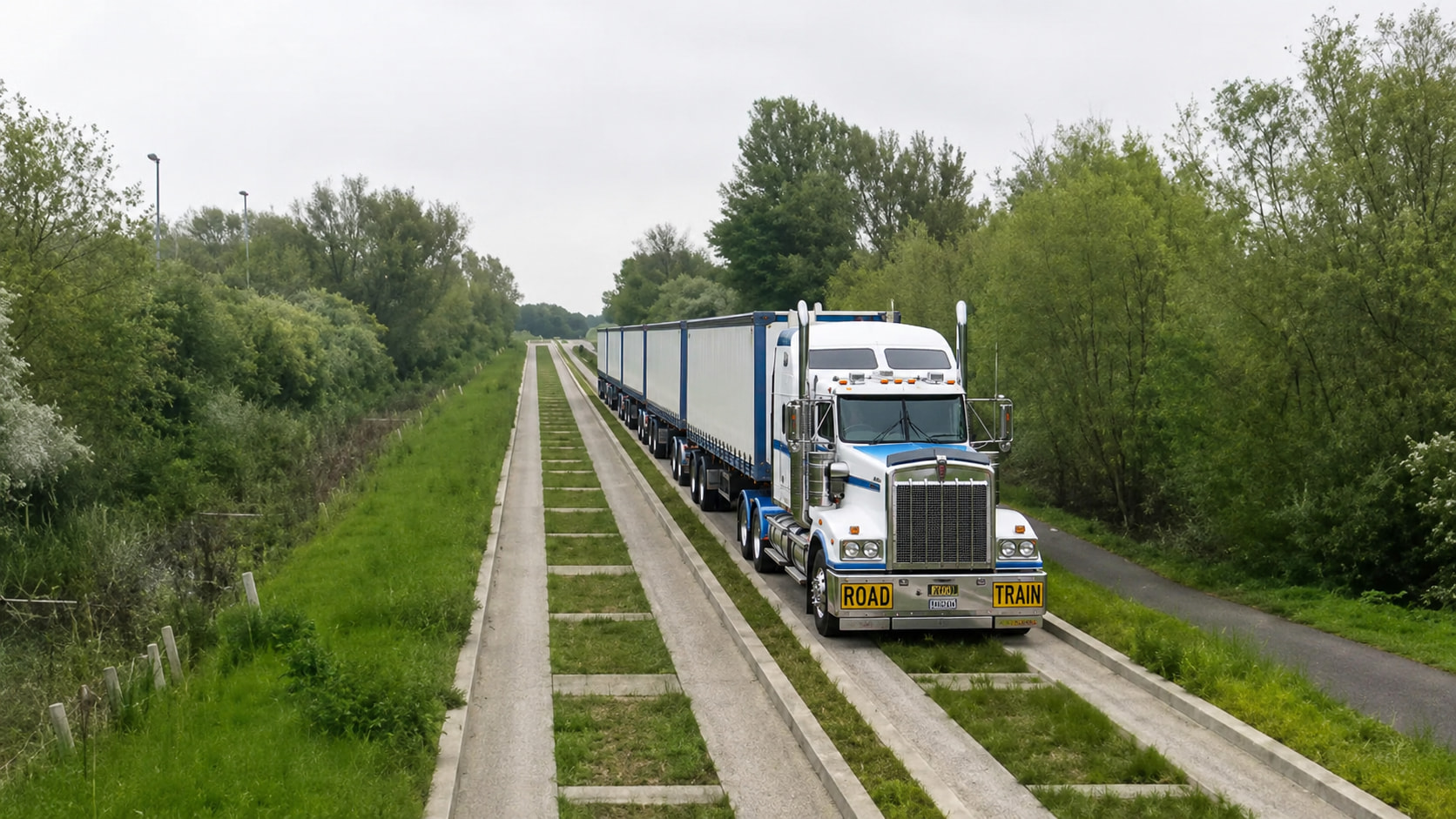
All the way to Gladstone.
Jokes aside, I wouldn’t be surprised if some idiot in the transport department actually suggests a watered down version of this that would probably end up costing the same as finishing Inland Rail would of anyways.
It is disappointing for those of us up on top of the range. But $45 billion, irrespective of being ‘on’ or ‘off’ budget is a lot of money.
This whole 24 hour travel time requirement seems to have been so rigid that rather than loosen the project requirements, it should just go in the bin.
The existing south-western line could have been dual gauged with some tactical curve reductions, level crossing removals and stronger rail etc. rather than huge embankments across the Condamine flood plain (Warwick itself could be bypassed with a shortish track between Cunningham and Deuchar). But there would have been a time penalty. The line could then have branched north of Cambooya towards Wellcamp.
The range railway was always going to be a money pit (hence why some suggested double stack should end at Toowoomba). It might have been suboptimal and leave future passenger service in the bin, but it was an option. Plenty of coal and wheat uses the existing railway.
The other north component many don’t think about was the new Narromine to Narrabri railway that was going to be needed. 200+km of new greenfield track - not an insignificant project, and the only alternative I can think of is a little dubious. The Gwabegar Line through Coonabarabran goes the wrong way and has completely fallen apart, but using the existing Troy Junction-Merrygoen line North of Dubbo through Mendooran and then up to Binnaway (part of the Gwabegar Line that is still in service) would mean only a greenfield connection from there to somewhere between Gunnedah and Boggabri would be needed - about half the distance. But those lines are kinda sketchy.
My main issue is, alternatives that might add time but could be a lot cheaper were not even considered.
3 Likes

1 Like
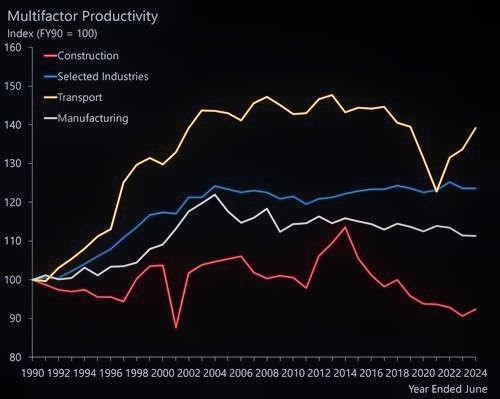
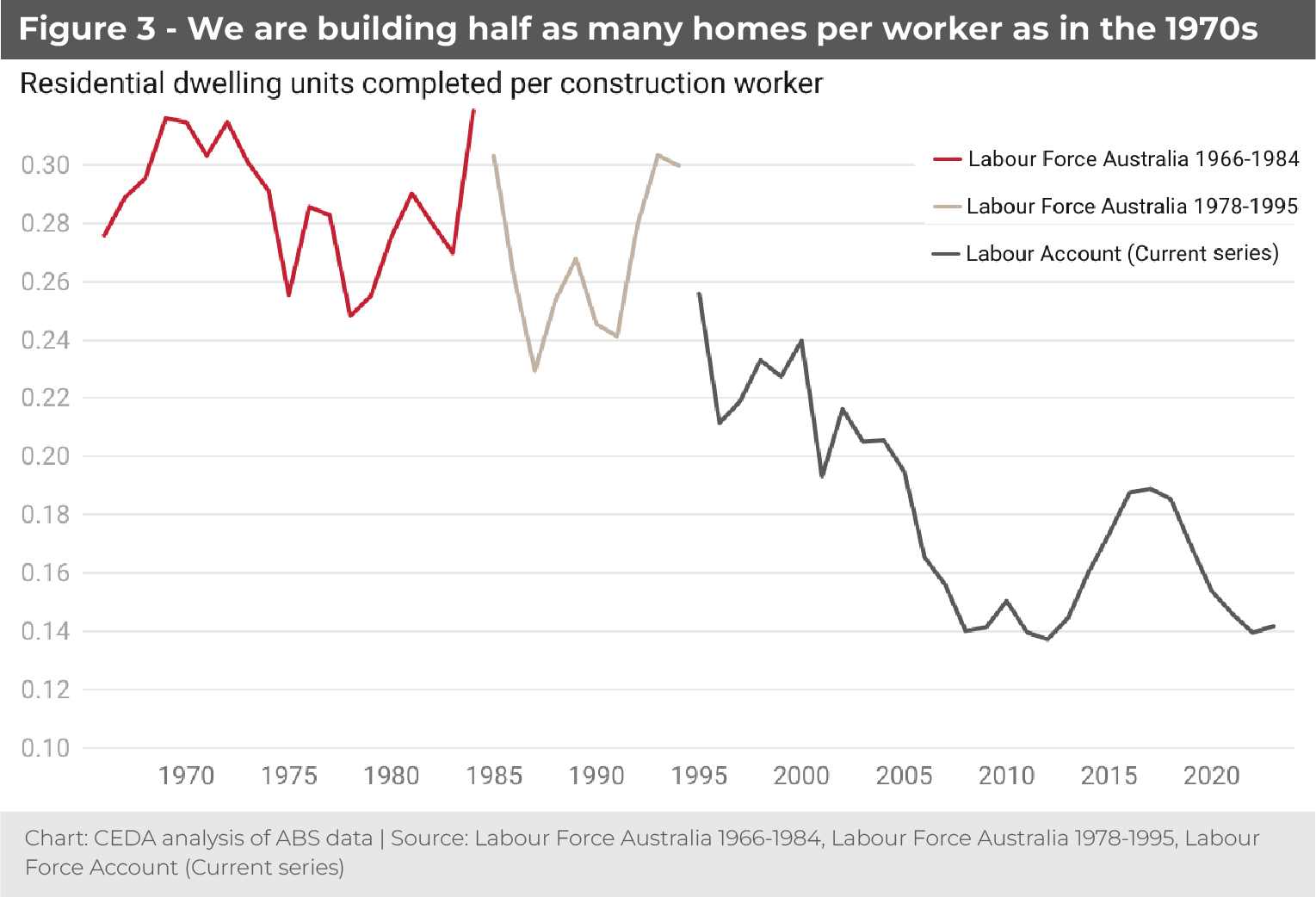
Correct, costs are high due to the immense skills shortage in construction trades. At the same time our construction industries have repeatedly failed to invest in the sort of labour-saving measures that countries like Japan have adopted to increase construction output. This has lead to a decline in construction sector productivity over the past 30 years while transport operations have become much more productive in that time.
This is even more obvious in housing construction:
As I understand it, a very large part of the projected cost of Inland Rail was getting it from Calvert to Kagaru due to to having to go through the Great Dividing Range. This is only necessary if the northern terminus of Inland Rail is in Brisbane. But it didn’t have to be. The original vision for Inland Rail as proposed by Everard Compton didn’t go to Brisbane at all, it went from Toowoomba to Gladstone, where the port will have ample available capacity as the coal export industry begins to wind down in coming decades.
That’s what this project should have been to begin with. Instead the eyes of politicians and big businesses all lit up at the prospect of getting it to the Port of Brisbane for bigger profit potential. And yes, that would have helped with getting a commuter rail service to Toowoomba, but the cost is just too great for that.
Depends on how much you think the railway is about exports versus domestic goods. For example, goods from New England south wouldn’t go to Gladstone (or Brisbane) to export when there are closer ports.
I do think it’s in the national interest for inland rail to get all the way to Gladstone, but there still needs to be a direct connection into Greater Brisbane given the primary function is domestic freight. Ideally it would be via Toowoomba, but I think some real considerations to other potential crossing points of the range were required; ones that might have less ground issues and/or avoid the tunnel segment.