A thread on TODs, TADs and value capture.
What exactly qualifies as a ‘TOD’?
This paper by Dr Chris Hale is behind a paywall. It proposes a performance-based standard for what a TOD is and is not. This is different to other definitions which focus on built form or presentation.
A performance based standard aligns much better with our own goals, as at the end of the day, we want patronage to increase as well as mode share.
Bolding added to the original.
Abstract
This paper discusses the distinction between transit-oriented development (TOD) and so-called ‘transit-adjacent development’ (TAD)—a label sometimes applied to less-successful TOD efforts. It is suggested that transport performance is the key factor distinguishing between the two outcomes—and that despite complexities, clearer quantitative benchmarks are needed. Much of the literature and discussion on TOD centres around a perceived failing of many TOD project attempts to deliver a ‘genuine transit-oriented outcome’. Often, this discussion has remained at a thematic level, or has rested on subjective qualitative appraisal, or critique of design or built-form outcomes. With a few exceptions, researchers and experts have generally been reluctant to provide a clear benchmark for TOD success or failure—perhaps because so many well-intentioned TOD efforts fall short of initial expectations.
This paper puts forward a proposal that mode share should be the apex metric for determining TOD project success or failure. It is suggested that a majority (50%+) of travel movements need to be accommodated by the sustainable modes (walking, cycling, and public transit) for a location to assume the label of ‘genuine TOD’.
Equally, other locations that attempt TOD, but do not deliver a sustainable travel majority, might be placed in the ‘TAD’ category. Benchmark figures from international precincts and locales are used to sustain this argument—with reference to the broader planning, urban development, and design contexts in which these ideas sit.
Notes
TOD Versus TAD: The Great Debate Resolved…(?)
Planning Practice & Research Volume 29, 2014 - Issue 5
Chris Hale
Pages 492-507 | Published online: 14 Dec 2012
https://www.tandfonline.com/doi/abs/10.1080/02697459.2012.749056
The transit transformation Australia needs
This paper explores different options for supplementary financing of new PT infrastructure and potentially services.
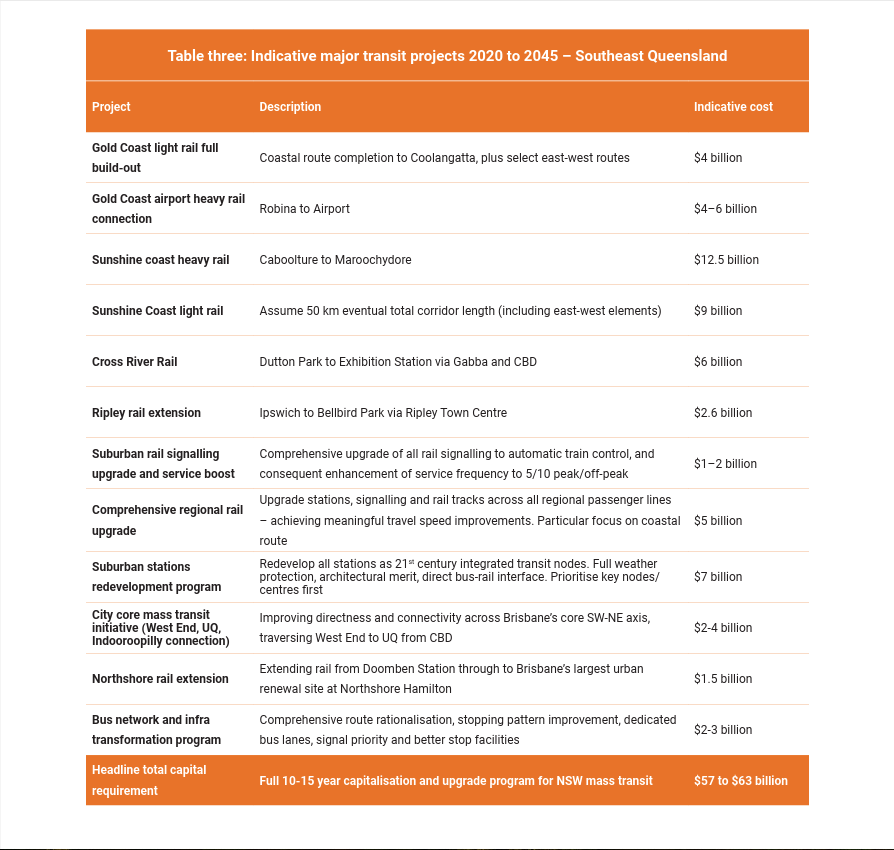
The infrastructure ‘wishlist’ is long and very expensive. The following table was published in 2019:
Hale sets out five ways to capture value from development around stations. This is significant, because a new PT authority could be empowered with planning powers for redeveloping areas around station precincts.
1. Mechanism A: Value capture through the existing, mainstream taxation system
Readers should note that by the ‘existing tax system’ we mean ‘with no change intended or required’. This should immediately differentiate TIF from other options and mechanisms that involve new or special levies and fees (see below) in the minds of funding policy stakeholders.
2. Mechanism B: Special fees or levies
Special fees or levies target a very specific and clearly delineated beneficiary or ‘customer’ base. In beneficiary funding and project delivery environments they are essentially a ‘fee for service’ utilised directly and solely for improving transport conditions. They should never be confused with taxes.
3. Mechanism C: Sale or auction of development rights
In practice, value realisation in a transit context usually means the sale of ‘air rights’ development opportunity above rail corridors or properties. Or it may involve the sale of some larger landholding around a new or upgraded station – on the presumption that the sale revenues go back into the infrastructure funding need, or that the incoming bidder is obliged to deliver station facilities and associated infrastructure according to appropriate specifications and standards.
4. Mechanism D: a comprehensive TOD and urban renewal agency (with value capture capabilities)
These include: precinct master planning; land rezoning; achieving value through design; public realm amenity and urban design; subdivision and property sale; as well as embedding a comprehensive and intelligent strategic vision in precinct plans, with clear leadership and accountability. All of these aspects impact on value creation. A planning ‘authority’ seems well-placed to marshal resources and carry out such complex tasks under a robust governance umbrella.
5. Mechanism E: Direct property – with rail agency as developer
A transit operator or agency proactively involved in developing and trading property holdings associated with stations and precinct or corridor-scale projects on a commercial basis, with the intent to use some of the profit from those activities for transit infrastructure and facility funding.
Notes
Authored by Chris Hale CEO & Founder – Hale Infra Strategy Pty Ltd. PO Box 440 Brunswick VIC 3056 PhD – Civil Engineering (transport strategy) Master of Property Economics Bachelor of Arts (Economics)
Interesting view that people prioritise other factors such as living near water etc over locating next to a train station.
Similar views have been put by other community organisations.
2 Likes
Seven News article on how Brisbane median home prices are now $1 million.
Median house price tops $1 million in major Australian city
‘That fundamentally changes who can afford to live here.’
Queensland’s capital joins Sydney and Canberra as the only Australian capitals with a seven-figure median.
The property market has surged 13 per cent in the past year.
Median house prices jumped $120,000 from $890,000 in just 12 months to $1.01 million today.
Quarter-on-quarter growth also rose by $40,000 from $970,000.
The city’s five-year performance tells an even more dramatic story:
Brisbane: 82 per cent growth
Adelaide: 77 per cent growth
Perth: 76 per cent growth
Sydney: 55 per cent growth
Melbourne: 17 per cent growth
The sad thing is that next to many busway and railway stations there are single story low-density homes or mostly industrial uses. This space could be used much better.
Alarmingly, median home prices have gone up $120,000 in 12 months - that is more than most people earn from work in 1 year.
4 Likes
The BrisbaneTimes is running a story on density uplift for Mt Gravatt precinct. Submissions need to provide certain details and be in by this Sunday night.
This is a great opportunity to suggest that Route 175 be upgraded to a BUZ service (would only require a service top-up) or even a CityGlider.
Submissions —> Mt Gravatt Centre Suburban Renewal Precinct Plan project | Brisbane City Council | Your City Your Say
Unlike other areas that have been flagged for massive urban renewal projects, Mount Gravatt does not have a train station, and is not walking distance to the South East Busway.
However, the LNP-lead council under Lord Mayor Adrian Schrinner argues allowing apartment towers will completely transform the area, revive the struggling high street and attract additional services over the next 20 years.
Making a Submission
Submissions
To be formally considered by Council, submissions must be properly made. A properly made submission must:
be in writing and signed by each person (when sending by post)
state the name and residential or business address of each person making the submission
state what you support or do not support in the draft precinct plan and why (suggest specific changes and use your own words to accurately reflect your own view)
including a phone number and/or email address if you are happy for Council to contact you for further information
be posted or emailed to Council by the closing date.
Submissions can be sent to Council by the following methods:
make a submission in City Plan online
write to:
Neighbourhood Planning (Mt Gravatt Centre Precinct Plan)
Brisbane City Council
GPO Box 1434
Brisbane Qld 4001.Following a review of submissions, Council will write to everyone who has made a properly made submission on the proposed changes and will publish a copy of the consultation report online.
3 Likes
I find myself somewhat agreeing with some of the sentiments in that article. While Mt Gravatt Central has some decent bus connectivity, it’s hardly the kind of rapid transit that an area with the sort of density they’re proposing is suitable for.
My foamer idea is an underground along the Logan Road alignment, using the abandoned site of the old shopping centre on the northern side of Creek road as the staging site for the TBMs, to be turned into a major station with TOD on top. A man can dream…. 
4 Likes
I mean neither is Chermside, and the reality is we can’t afford to wait for mass transit to start rezoning these places if we are going to provide enough housing here.
Interim measures for buses every few minutes will be fine for the first few years anyway, because it’s close to the busway and it takes a while to get uplift delivered at a meaningful scale.
I agree with your metro idea, I also have that site as my tbm launching point on my fantasy plans.
4 Likes
If there’s any sense to it then it should mean bus lanes on Logan Road to support a high frequency routes connecting not only between Garden City and City/busway but also to GU Nathan and QEII, and to Carindale. That would open the residential up to more people (not just CBD workers and drivers), which has added benefit of spreading PT demand over multiple directions.
1 Like
Most of the area around Eagle Junction is zoned with “Character” which is an appalling zoning type designed purely to protect home values.
All character zoning should be ended and switched to “low density” and all train stations should have either medium or high density zoning within 1km surrounding stations.
Further I’d say all greater Brisbane councils should harmonise their zoning types to match each other and simplify into far fewer zone types.
3 Likes
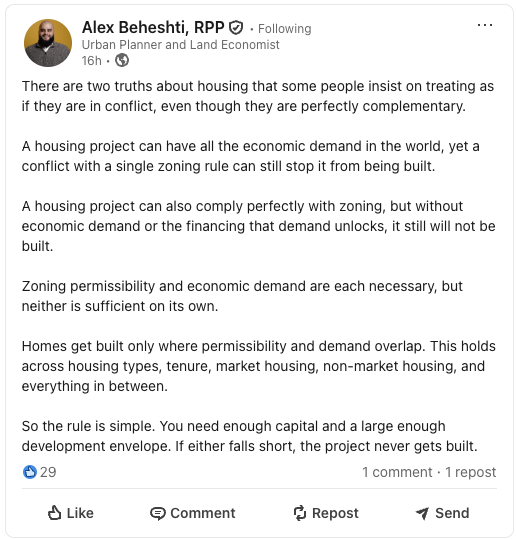
TOD Development
This author argues that at least two things need to be true for TOD development to proceed - I would suggest that a third requirement is also present. There must be services and the overall journey time (wait + in-vehicle trip) need to be competitive against whatever alternative competing mode is present (usually this is a car).