There is no reason a new shopping centre for the area must cover the entirety of the same site.
At what cost? Flood mitigation technologies often are not cheap, and construction is expensive as it is. That’s probably one reason why Mirvac didn’t build anything in the time they owned the site. Somebody has to pay the cost, and likely it will be reflected in higher prices at the businesses and residences constructed on the site.
My general view is, we should have high density buildings in places that don’t easily flood, and open space in places that easily flood. Now obviously we can’t rebuild Brisbane CBD somewhere less flood-prone, that’s a sunk cost, but we can avoid building on a place that recently suffered badly in a flood, and is likely to flood again and again as climate change worsens.
The land north of Masefield Street is barely enough space to build a shopping centre. Why does the cost matter if it’s a private developer? The public isn’t stumping up any cash, and if it’s not financially viable neither will the private sector.
Then they should either get efficient with space and stick to the major attractors, or just build a mixed-use neighbourhood. Not everything needs to fit into the 1950s drive-in suburban shopping centre with huge parking lots model.
Should we just allow anyone to build anywhere if it uses private money? Or is there such a thing as a public interest in land use planning and environmental planning? Even if there isn’t, I am entitled to have views on what is good planning and appropriate development.
And the consequence of heavy development in high-risk areas is higher insurance premiums for everyone to compensate. I think it’s in the public interest for a government to put restrictions on development for that reason.
For the record, theres no commitment to just build a similar shopping centre with lots of parking, So far what has been talked about is to build a mixed-use thing.
Obviously we shouldn’t let developers build anywhere, but that’s a strawman argument. It was previously a shopping centre, it is zoned as a shopping centre, and the land is 100m from Kalinga Park. There’s no shortage of green space in the area. What the people in the area desire is another shopping centre so they can avoid Chermside. That’s been made abundantly clear.
In fact, I’d go as far as saying it would be in the public interest to have as much mixed use housing there as possible (assuming the proper risk mitigation is done) due to its location next to Toombul Station.
At the end of the day, I am going to reserve judgement until the development proposal is made to council. Until then, you can’t judge whether it will sufficiently mitigate the flood risk or not.
Your logic doesn’t make sense here… it costs more to build a flood resilient development with known risks, so therefore we shouldn’t let developers spend more because it will increase insurance premiums? If more money is spent on flood risk mitigation, then the insurance will be lower because inherently the risk has been reduced.
It isn’t a straw man argument because the facts have changed. I don’t know if you appreciate how much climate change is increasing the frequency and severity of major floods. Areas that haven’t flooded since European settlement are now flooding. And it’s only going to get worse in coming decades.
We have one park so there’s no need for another? If that’s what you’re saying, I don’t agree. As population grows, we need more infrastructure and that includes the amount of accessible parkland.
We have dozens of railway stations we can build higher density around, and even plenty of other land around Toombul station that isn’t a major flood risk, but this specific place needs to be Jam-packed with housing despite the vulnerability to floods? On this we can agree to disagree.
I was speaking in general rather than for this specific site. Sure, putting in immense amounts of flood mitigation controls on this site won’t raise insurance premiums, but the resulting extra costs will make the housing and businesses less affordable. Do we really need yet another playground for the well-off? And some types of flood mitigation end up increasing the risk of floods to nearby properties, because the waters are simply pushed to the sides.
I believe it’s better for society and a better use of resources if we leave places with huge flood risks to be open spaces instead of developing on them. And I don’t believe it’s a good thing when private enterprise are permitted to go against the principles of good environmental planning simply because they can throw money at the issue.
I live in the area, and I can assure you Kalinga Park is huge, and it adjoins the equally large Shaw Park Sports complex. Additional housing in the area would do far more good than a little extra parkland.
I am acutely aware that climate change is increasing the frequency and severity of flooding events. It’s also true that previously it was a huge asphalt parking lot with very little ground permeation. If modern sustainable building techniques are employed, the risk of major flooding on the site can be mitigated.
Morayfield is an example of a shopping centre build on flood prone land. It’s elevated above flooding level using stilts, with the at risk land being used for carparking. Now, is this the best kind of sustainable flood resilient infrastructure? No. It was built decades ago, but it does show that it’s entirely possible. With our more advanced understanding of land permeability and flood simulations, I am confident that any development could be made sustainable and resilient.
Of course this will come with a cost, which is why I will not pass judgement until the development plan is released. I’m approaching it with an open mind.
If the locals demand more parkland at Toombul then they have better chances of getting it it included rather than rely on the new owners to have bullshit “provisions” for parkland in their design.
Logical …if only Brisbane City Council shared that design philosophy when it comes to DA approval time.
Paradoxical - Brisbane has a lot of low/medium density buildings in known flood areas but that has never stopped property development from building there. One would say that it was intentional.
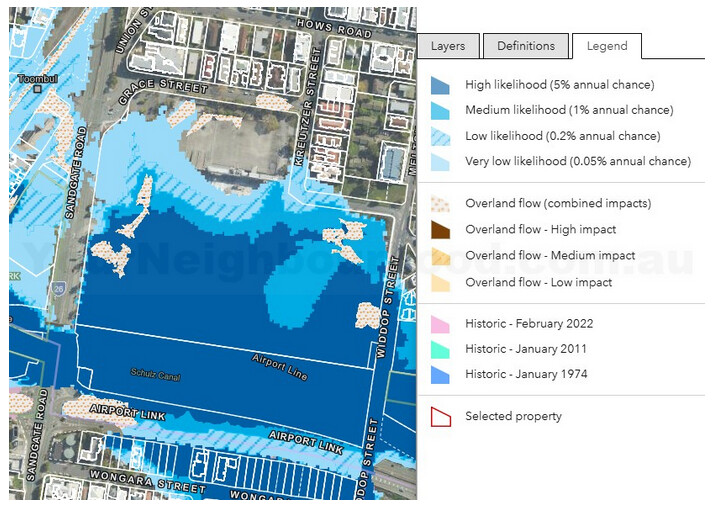
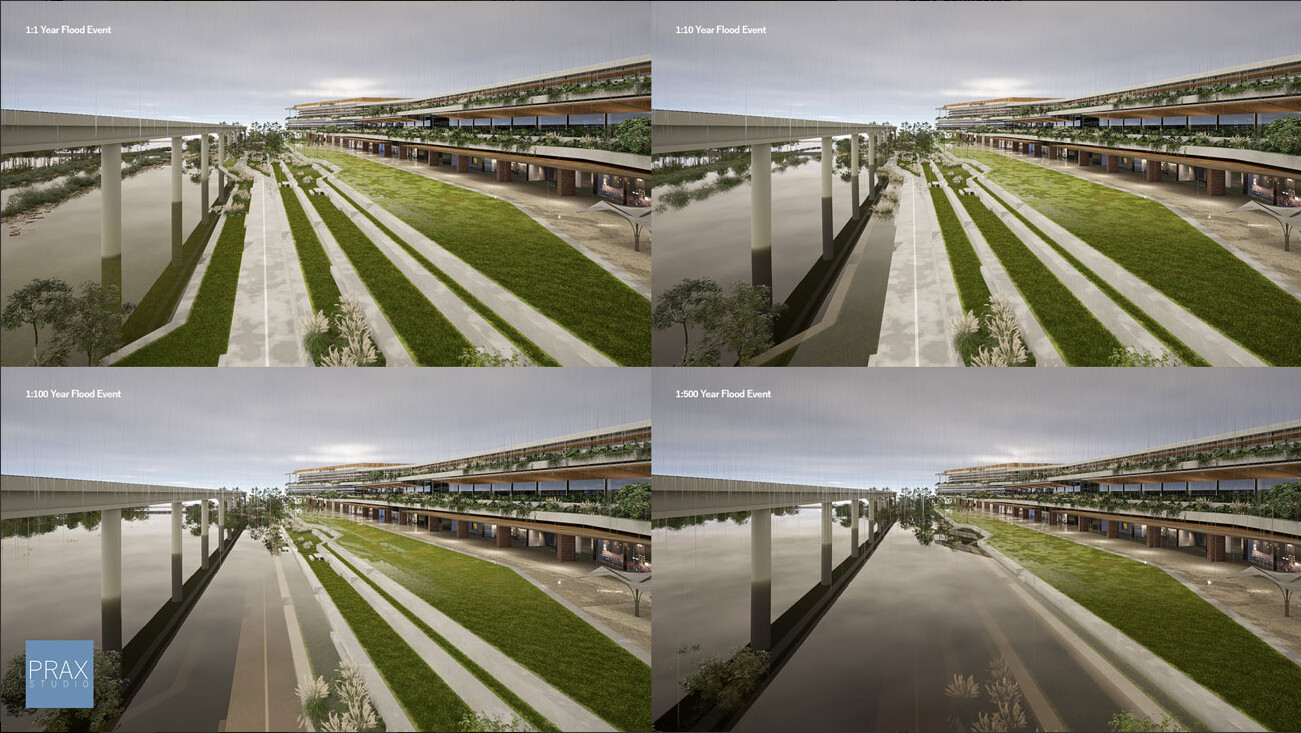
As for Toombul, the image above says it all. You either floodproof it or you don’t build on it at all - it is simple.
if you spend time and money on flood mitigation then the risk is lowered so is the insurance premiums. Why do they act like engineering doesn’t exist when we talk about construction. Saying flood mitigation is not cheap is saying that flood clean up and repairs is cheaper than having flood mitigation and no little/no repairs and clean up. How is flood mitigation not profitable?
If you want to develop Toombul the price you have to pay is flood mitigation. As a new build they will naturally charge higher prices for business and residences because they can, not because they should.
What was wrong with Mirvac’s proposal that they couldn’t finish what they started?
They will likely build a couple of mid rise apartment buildings and a park along with a supermarket and a cafe. Kmart is better off at Skygate stage 3. It can then run 24/7 improving customer delivery options and logistics.
The mid rise apartments could have 3 initial podium levels dedicated to parking and retail then residential above that with generators and pumps on floor three.
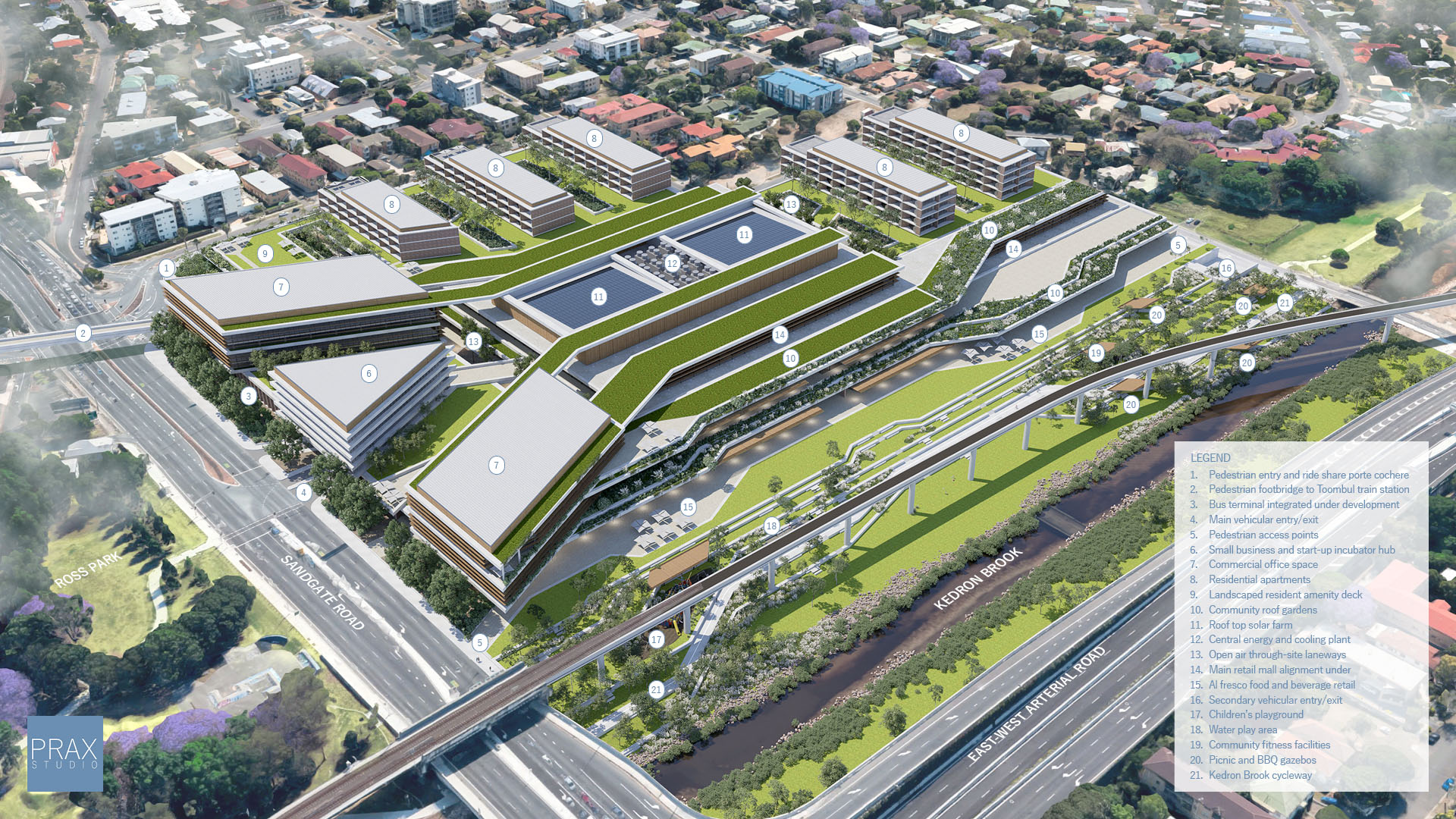
That wasn’t Mirvac’s proposal. That was a visualisation put together by an architecture studio independently (probably to drum up publicity). It was in no way connected with what Mirvac had been working on, which probably hadn’t gotten to the detailed visualisation stage.
The articles about the sale of the Toombul site indicate that Mirvac had developed a masterplan for a mixed use development of the site, which had received in-principle support from BCC but nothing beyond that. It had not been submitted as a development application, so this was all behind-the-scenes discussions.
Irvine Group have said that they intend to make use of Mirvac’s masterplan, while accelerating the development of the retail component. This plays to Irvine’s strengths - they are a much, much smaller developer than Mirvac, and even if Mirvac’s plans were fully developed, they would likely have struggled to fully replicate them. If Mirvac couldn’t make the figures work for their plan, Irvine wouldn’t have been able to either.
Mirvac were last month warning about downturns in the construction sector due to foreign investment, shortages of staff due to a lot of infrastructure projects and construction costs (they did state they were cooling). They just don’t appear to have the same risk appetite and this project has too many Politicians invested in it (all trying to appeal to locals wants for Toombul V2 - it ain’t happening) and I doubt they love this either. I think people are going to be upset when Irvine’s plans are released and it’s a very boutique mixed use option on a much smaller footprint. I think a small boutique mixed-use site is perfect, I would look at attracting Harris Farm to move from that awful Clayfield site.
In addition to the points above Mirvac has made a big push towards build to rent projects. I think there’s probably a business strategy component to selling this. They’re nothing like Sekisui house or others with expertise and competence in long term place making developments.
Easier to do flood resilient development if you’re a sole occupant and large enough to self-insure. Generally that’s probably going to be the use-case to make it work. Mixed-use sites the flood resilience will be a large up-front cost a lot of developers may not wish to make and recoup in residential and rental costs. Will be interesting to see what Irvine can do, most of their work is big-box industrial on freehold and a lot of just refurb history.
Queensland’s capital joins Sydney and Canberra as the only Australian capitals with a seven-figure median.
The property market has surged 13 per cent in the past year.
Median house prices jumped $120,000 from $890,000 in just 12 months to $1.01 million today.
Quarter-on-quarter growth also rose by $40,000 from $970,000.
The city’s five-year performance tells an even more dramatic story:
Brisbane: 82 per cent growth
Adelaide: 77 per cent growth
Perth: 76 per cent growth
Sydney: 55 per cent growth
Melbourne: 17 per cent growth
The sad thing is that next to many busway and railway stations there are single story low-density homes or mostly industrial uses. This space could be used much better.
Alarmingly, median home prices have gone up $120,000 in 12 months - that is more than most people earn from work in 1 year.
The BrisbaneTimes is running a story on density uplift for Mt Gravatt precinct. Submissions need to provide certain details and be in by this Sunday night.
This is a great opportunity to suggest that Route 175 be upgraded to a BUZ service (would only require a service top-up) or even a CityGlider.
Unlike other areas that have been flagged for massive urban renewal projects, Mount Gravatt does not have a train station, and is not walking distance to the South East Busway.
However, the LNP-lead council under Lord Mayor Adrian Schrinner argues allowing apartment towers will completely transform the area, revive the struggling high street and attract additional services over the next 20 years.
Making a Submission
Submissions
To be formally considered by Council, submissions must be properly made. A properly made submission must:
be in writing and signed by each person (when sending by post)
state the name and residential or business address of each person making the submission
state what you support or do not support in the draft precinct plan and why (suggest specific changes and use your own words to accurately reflect your own view)
including a phone number and/or email address if you are happy for Council to contact you for further information
be posted or emailed to Council by the closing date.
Submissions can be sent to Council by the following methods:
write to:
Neighbourhood Planning (Mt Gravatt Centre Precinct Plan)
Brisbane City Council
GPO Box 1434
Brisbane Qld 4001.
Following a review of submissions, Council will write to everyone who has made a properly made submission on the proposed changes and will publish a copy of the consultation report online.