Any such alternative would have to run at a frequency of 7.5mins (equivalent to the frequency of the 130/140) for it not to result in a substantial service reduction with increased dwell times for passengers.
This could be seen as an upside though. Isolation would indicate low NIMBY impact. It’s well served by PT and poorly served by roads. That sounds like a plus for PT patronage.
Not sure this gets them to double the capacity even if 300 per tram x tram every 2 mins (questionable) that’s only 9000k per hour. Simpler network but not double the capacity.
Gold Coast trams are routinely loaded higher than this, whether it is well publicised or not - the crush capacity figure is more like 400+. Similar, E class trams in Melbourne routinely get about 300 pax despite notionally having a capacity of I think 220.
The figure gets even higher with high-floor LRVs like they have in Calgary and other parts of North America. 50m sets (2 coupled pairs) should be capable of taking 600 people at crush, depending on how you spec the seating. I think you would need platform extensions at Mater Hill, a proper underground Cultural Centre station, new bridge connecting directly to the Adelaide St tunnel and various other enabling works (most of which would displace buses from the inner city tunnels but so what if this acts more as a genuine line-haul collector).
750 x 30 = 18,000pphpd in the core of the system, and 9,000pphpd on each branch (UQ Lakes / Springwood). You could potentially run more frequently as well since there would be no at-grade intersections anywhere. You would need a significant rollingstock order though, I’d be thinking about 150 LRVs.
Then, displace Brisbane Metro vehicles to other corridors (eg Capalaba), regular buses become entirely feederised and significantly improved in frequency and operating hours. Gabba becomes an on-line station by constructing platforms along the existing alignment, and the Gabba bus turnaround and existing station are disconnected from the SEB.
^ Except much of that capacity would already be taken up with Gold Coast and Beenleigh passengers. In practice it would not be adding that many, which is part of why I have gone completely away from the idea. If you want to make GC/Beenleigh services faster, they do not have to follow the M1 alignment. I’m also completely unclear how this can hook into CRR without an enormous amount of cost and effort - probably dramatically more than it would take to make the busway corridor suitable for high-floor LRVs.
Challenge 1: Entering the Brisbane CBD from the South
Light Rail needs its own river crossing into the Brisbane CBD (either Bridge or Tunnel) plus platform lengthening of most busway stations. It also needs to go somewhere when it lands in the Brisbane CBD, and this is unlikely to be the Adelaide St tunnel (due to gradient and design). LRT is going to come with its own high costs if it takes a southside approach.
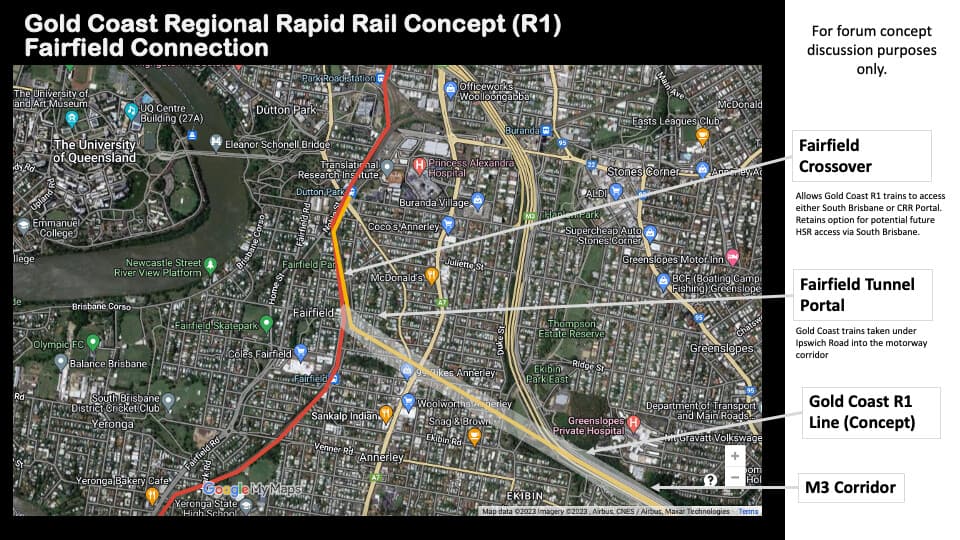
Heavy Rail can use the existing CRR tunnels. A short tunnel is required to take trains out of the M1/M3 Corridor and into CRR between Fairfield and Dutton Park (see concept image).
There are a few of these types of tunnel already in Perth (e.g. Rockingham, Joondalup).
Even with LRVs operating in consists, carrying say 750 pax each, the overall capacity would be similar to what the SEB does already, say - 18,000 pphd.
So, Heavy Rail is the better option on capacity.
You could run 20-25 trains/hour, possibly 30 trains/hour with advanced signalling. You could also run 9-car trains, which also increases capacity massively.
Light Rail carry 750 pax, but a 9-car train would carry 1,500 pax.
At 20 trains/hr that would be about 30,000 pphd.
And because it is rail, provided the corridor was well built, that train would be going at 130 km/hr. An LRT service is not going to match that (or deliver region-wide benefits from speeding up Gold Coast and Beenleigh trains).
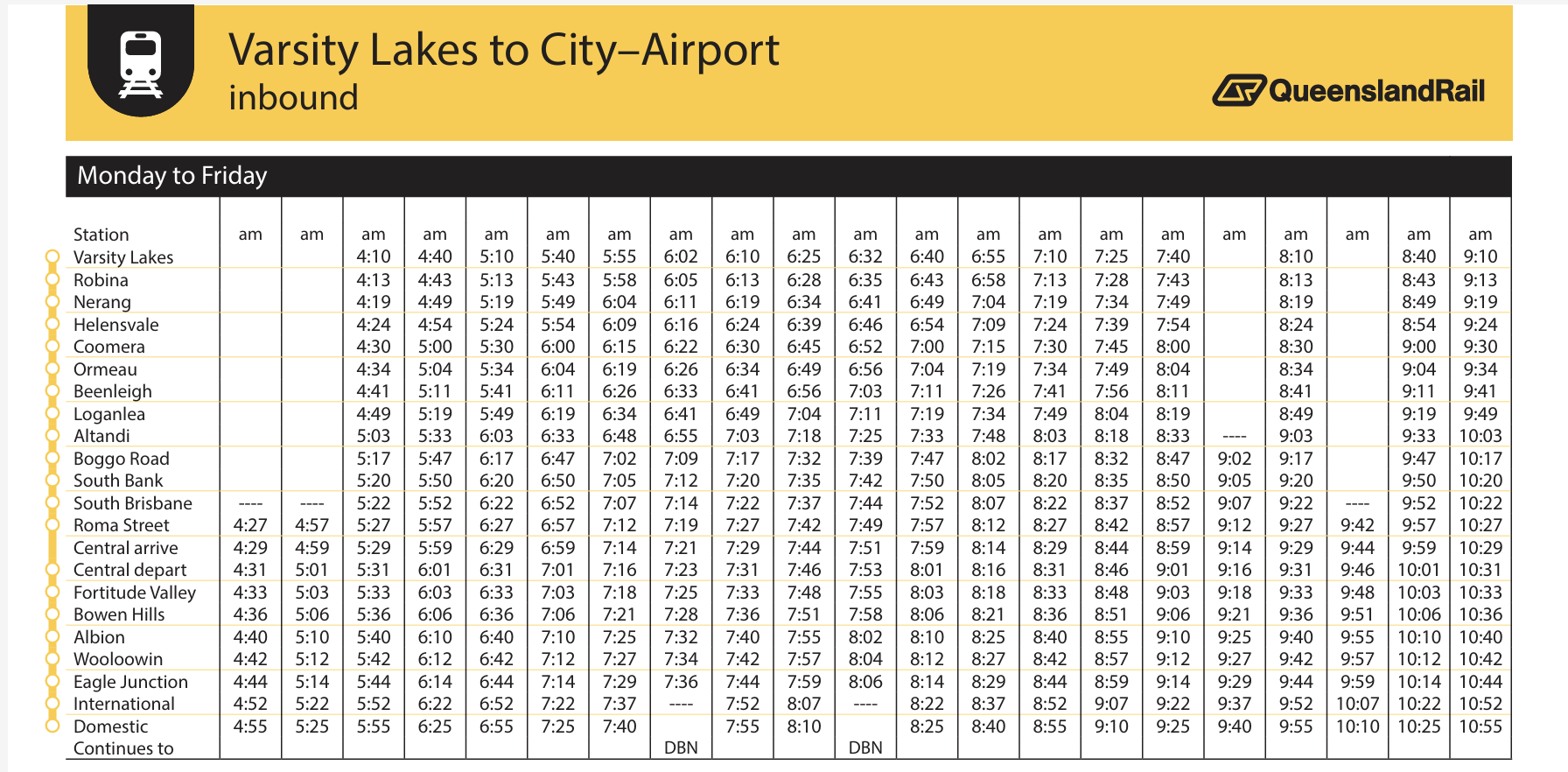
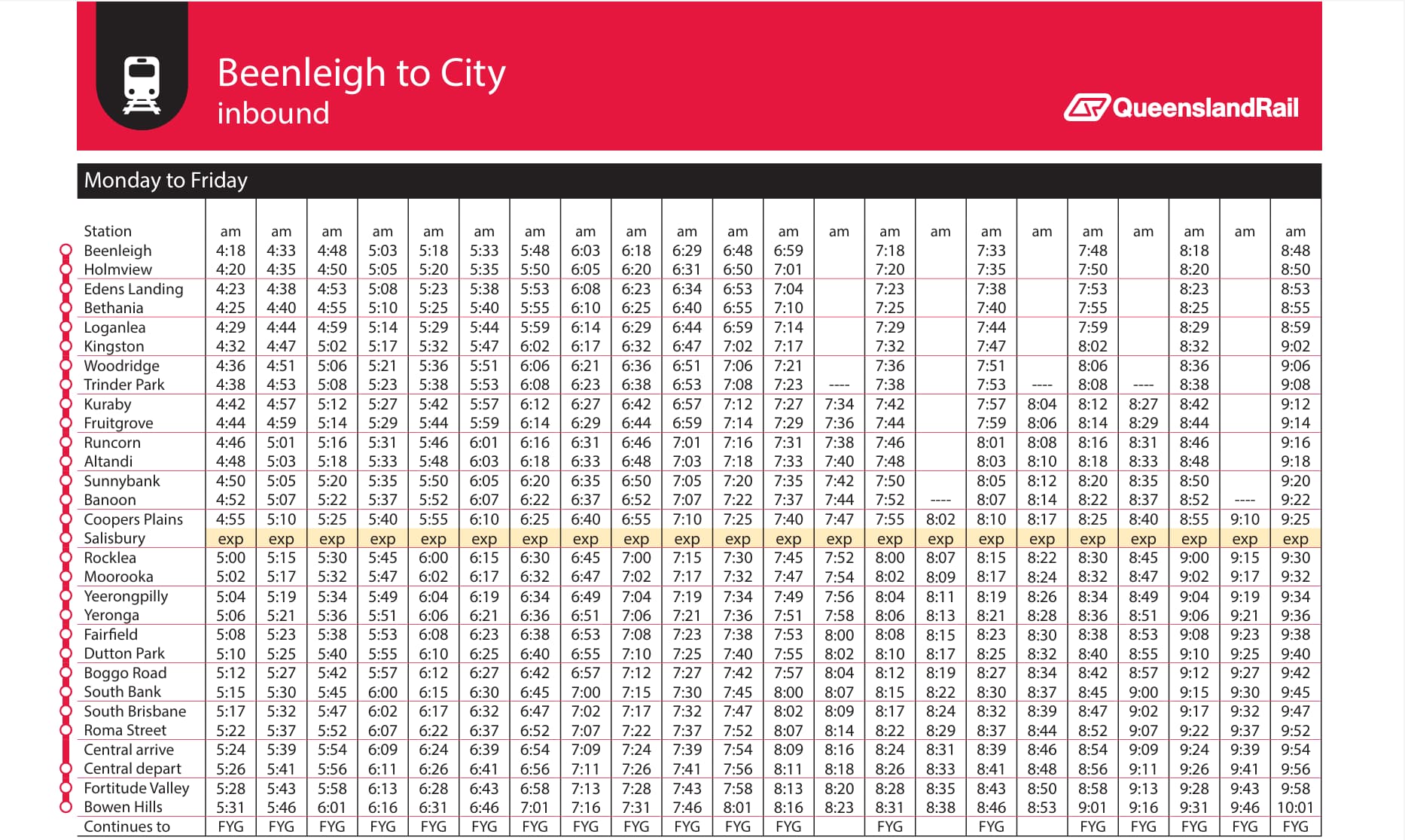
Let’s look at some timetables
Train Departures ex. Beenleigh
Between 6 am - and 7 am, about 5 Beenleigh line trains depart for Brisbane, and 5 Gold Coast trains.
That is about 10 trains. This implies that if capacity issues were sorted out, you could essentially run say another 10 trains in peak, possibly more. So, 1,500 pax trains x 10 added trains = 15,000 which is a similar peak capacity to an new busway.
Overall, the Heavy Rail upgrade option is worth including in any options assessment for relieving SEB capacity. A lot of buses originating in Logan, for example, could transfer their passengers to QR trains at Westfield Upper Mt Gravatt.
Why are you using LRT as an example when that R1 concept seemed to be designed only for heavy rail?
You could run a LRT on the heavy rail network if you were attempting a tram-train system like they have in Karlsruhe. A dual-gauge high floor LRT that can run on the streets and rail network. Very novel, but why?
Only problem is that buses cannot use the SE Busway anymore unless you are planning to build the rail line in the middle of the freeway, as they have in Perth.
Trams are sexy, trains are not. Any upgrade to the SEB must be made in baby steps. The next mode up is light rail. We’ve milked buses to the max.
Question is why do you need the SEB capacity to double?
The BCC can throw as many fake-metros on it if they want to, but when it gets to capacity, then what do you do next - weld two, three or even four electric bendy boi’s together and call it a trackless train, or a metro-train-bus? The human centipede of buses; I present The Brisbane Metro-pede, because the BCC believe that buses should compete with rail, then why not fake heavy rail.
That is the only scenario how you can double capacity on the SEB without a rail solution.
Question is why do you need the SEB capacity to double?
As I originally proposed the question.
Because our PT usage is so low that even our existing trunk routes (bus, light rail and heavy rail) need to be able to move twice (if not 3 times) the number of people even before you add the areas that are under serviced today.
In my book this is as much about service legibility, ease and passenger experience as it is about capacity.
To hit a theoretical 18,000 an hour, we’re talking a comfortably full (150 pax) Metro BeRTie every thirty seconds (120/hour).
This ~120/hour figure is chosen because we believe it approximates what you can comfortably do with stopping services.
I’ve attempted to calculate the rate of buses per hour through the Gabba Junction by looking at the GTFS data for today. We seem to peak at a whopping 338 bph for 8-9am inbound, which would imply ~54 people/bus to hit 18k/hour.
Importantly, this number includes all buses whether or not going via Mater Hill. The latter is substantially lower, peaking at 133 bph for 8-9am inbound (only 40% of the Gabba Junction total). These numbers seem to be in line with previous discussions.
For what it’s worth, Cultural Centre peaks at 172 on platform 1 in that hour, so perhaps if platforms are long enough 120 can be exceeded. But then you have the issue of platform length.
Gabba Junction BPH estimates
hour
direction_id
trips_passing
4
0
4
5
0
41
5
1
15
6
0
125
6
1
57
7
0
290
7
1
109
8
0
338
8
1
109
9
0
165
9
1
110
10
0
114
10
1
100
11
0
111
11
1
99
12
0
107
12
1
99
13
0
106
13
1
99
14
0
104
14
1
110
15
0
113
15
1
166
16
0
118
16
1
259
17
0
117
17
1
293
18
0
101
18
1
147
19
0
81
19
1
85
20
0
72
20
1
75
21
0
63
21
1
68
22
0
65
22
1
63
23
0
27
23
1
50
24
1
4
Mater Hill BPH counts
hour
direction_id
trips_passing
4
0
4
5
0
33
5
1
15
6
0
79
6
1
46
7
0
105
7
1
83
8
0
133
8
1
82
9
0
104
9
1
84
10
0
88
10
1
80
11
0
83
11
1
79
12
0
80
12
1
79
13
0
78
13
1
79
14
0
79
14
1
87
15
0
79
15
1
114
16
0
79
16
1
112
17
0
82
17
1
114
18
0
71
18
1
94
19
0
63
19
1
68
20
0
62
20
1
64
21
0
53
21
1
58
22
0
54
22
1
53
23
0
24
23
1
42
24
1
4
Why might all this matter? Well, will Busway conversion to light rail still feature this reverse branching? Hence we have to shoulder the full load, or leave it in place, or some combination.
Does it matter? I’m not convinced. Looking at go card data, I suspect we’re averaging about 20 people per bus.