Prices high probably due to workforce shortages and a lot of alternative projects going on up and down the east coast.
Queensland Government already has a public construction firm called QBuild.
Prices high probably due to workforce shortages and a lot of alternative projects going on up and down the east coast.
Queensland Government already has a public construction firm called QBuild.
QBuild doesn’t have the size or expertise to independently undertake a project of the scale of Cross River Rail. With the exception of smaller scale maintenance works, QBuild almost always undertakes projects together with private enterprise.
If that’s the case, why weren’t they on the project
Because this isn’t the sort of thing that they do? In my understanding they barely do anywhere near as much actual construction at schools and public housing compared to what they did before Blue Team were around last time, with a lot more private sector companies used now.
Looking at how existing projects are going suggests that future projects might have similar issues.
Cross River Rail has ongoing cost pressures and a revised delivery timeline
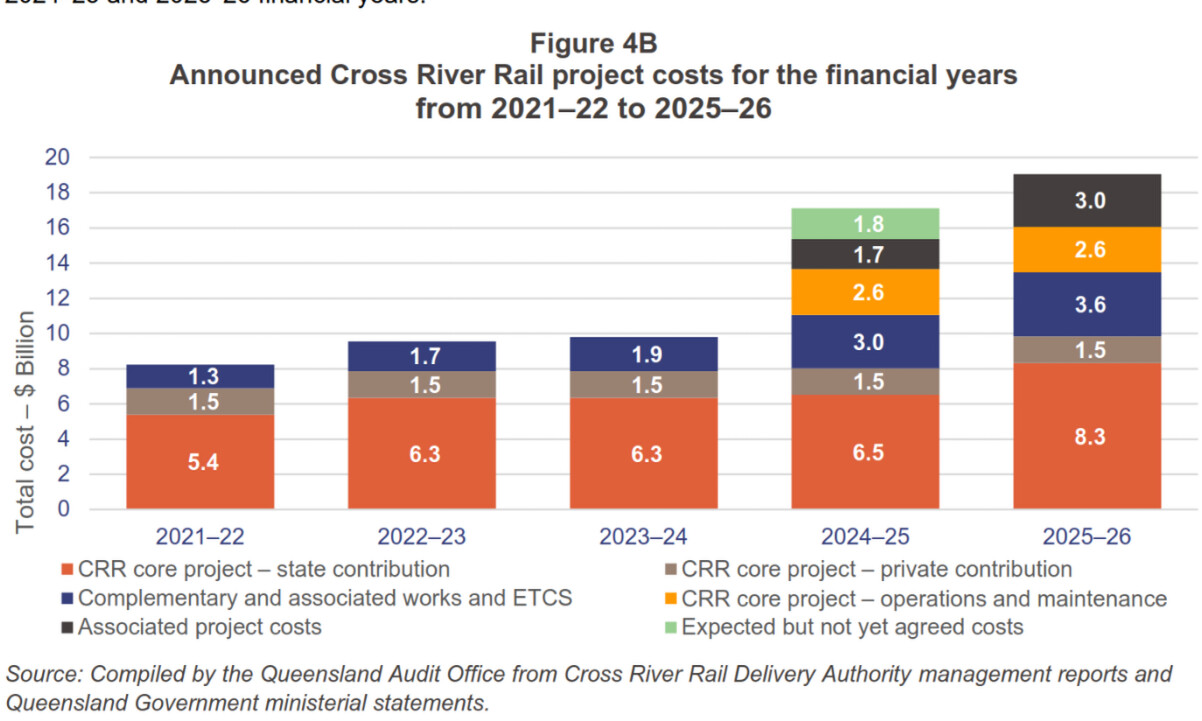
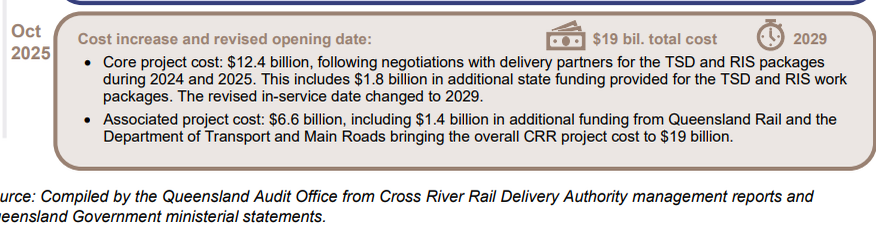
The Cross River Rail project continues to experience higher material and labour costs, workforce shortages, supply chain disruptions, and reduced productivity from industrial action. The project scope also includes associated works such as tunnel integration, train stabling facilities, signalling systems, and future operations and maintenance costs. Together, these factors have increased the overall project cost and extended the completion time frame. In 2024–25, the delivery authority renegotiated costs with its delivery partners for 2 major work packages, contributing to the project’s revised cost and schedule. In October 2025, the Queensland Government announced that the total project cost will now exceed $19 billion, with first passenger services expected in 2029.
(Bolding added)
Notes
Queensland Audit Office - Major projects 2025 Report 8: 2025–26
https://www.parliament.qld.gov.au/Work-of-the-Assembly/Tabled-Papers/docs/5825T2025/5825t2025.pdf
This $19 billion seems to be high. Does anyone have a break up into the various items that give rise to this total?
A ministerial statement from Dec 2024 breaks it down into:
Last cost estimate from the red team before departure was $6.3B spend, and that’s for construction only.
The link Metro posted above (probably the most reliable of the bunch) isn’t entirely clear, but does include this chart
Some personal thoughts:
it is dodgy! no need to mince words here.
also
and reduced productivity from industrial action.
god forbid workers be safe in their workplace
An alternative view is that this is the comprehensive cost. The Red Team figure is the cost for one component only. So it’s possible for both figures to be correct at the same time.
Total project cost = Capital cost + Operational costs + Financing costs
Red team have been citing only one component, which has been the traditional approach, but that doesn’t make it the right one.
And when you think about counting benefits, those benefits generally originate in the operations, not the capital works. The value comes from the existence of the service - reduced wait times, speed increase, reduced access times.
If one is going to include benefits from operations in BCR, then for consistency, then shouldn’t one also count any costs from operations too?
There is a very big difference in benefit from a new rail line that runs 1 train per hour to the exact same rail line that runs 4 trains per hour.
I do think there’s an argument for some components such as the QR-bourne costs, but others like the 25-year maintenance & QTMP costs are pushing it too far IMO. New trains & stabling are hardly part of the tunnel or needed as per the QR statement at budget estimates, and tunnel maintenance, while definitely a cost, isn’t factored into any other infrastructure project I’ve heard of and is thus pretty misleading. I do think there’s merit in knowing the total cost of the CRR project, any complementary works (such as additional ETCS upgrades), new rollingstock, etc that we’d need to do a network-wide upgrade, but I’d also argue that’s such a different thing to the original cost that it’s misleading to pretend this is simply a budget blowout rather than an entirely different number.
I hear you. But there is a difference between the tunnel and the project. For example, new stations on the Gold Coast logically don’t have a connection with the CRR tunnel, but seem to have been marketed and packaged with it.
New trains and QTMP probably don’t have a strong connection, however if the gradient of the tunnel or the spacing of the doors matching the platform doors precluded the use of existing trains, then there well could be a case for including the QTMP trains in the project.
Traditionally, only the construction cost was quoted, but i’m not seeing a defensible case for doing that. Operations cost money too. If we count benefits arising from operations, then we should count costs from operations IMHO.
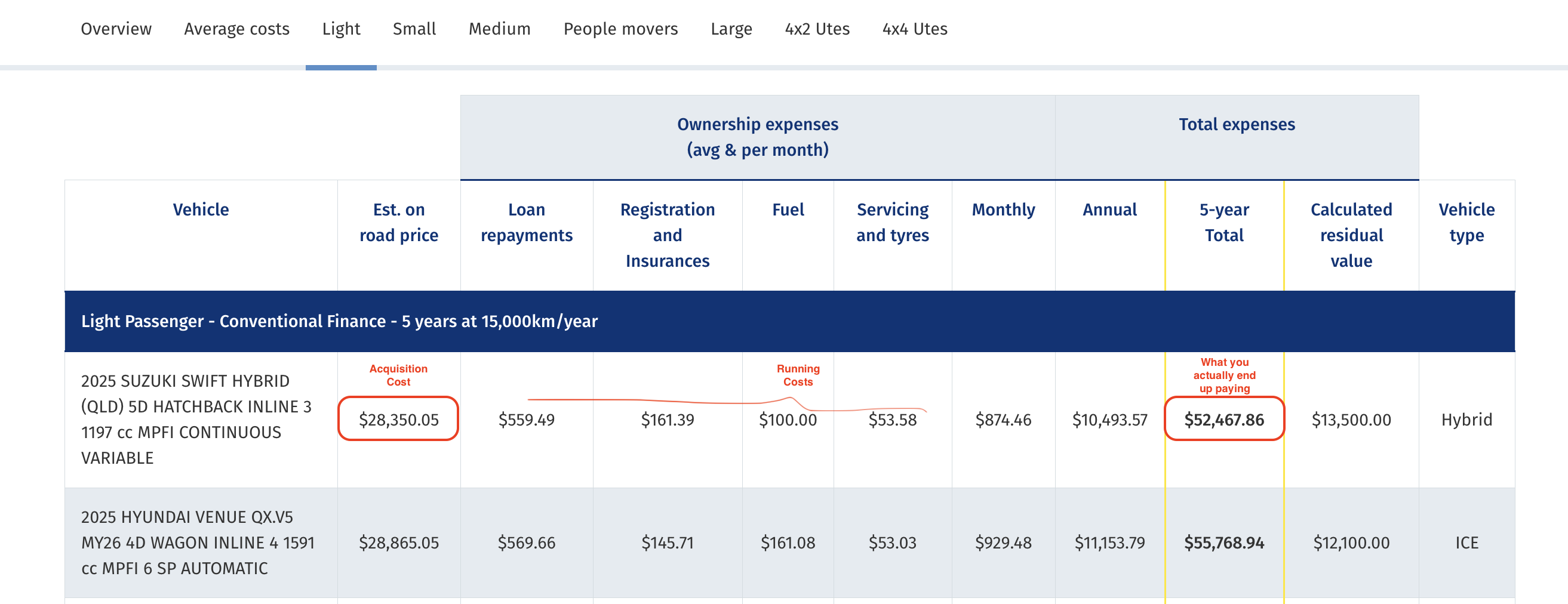
For example, if I were to buy a car, I wouldn’t only consider the purchase price as the total cost. I’d also consider the operating cost, maintenance, rego, etc over the life of the asset too.
We know for a fact that ALL trains have the same door spacing and the NGRs will be able to use the tunnel. I get playing devil’s advocate but this is being far too generous.
The defensible case is that this is how ALL projects in Australia are traditionally costed. Why change that now? Sure, you can make an argument that it shouldn’t be that way, but it makes NO sense to be so cagey about what makes up the figure UNLESS the reason is untoward.
Sure, you may consider it, but you don’t go into the dealership and see the TOTAL cost of the asset over its lifetime in bold on the vehicle.
Another question is, seeing as the QTMP will be required for the running of the line to Maroochydore due to the increased fleet requirements, why isn’t the QTMP being included in The Wave Stage 1 and 2 costs? Why isn’t Clapham Yard being included because it will hold the trains running on the line?
This is the reason why we don’t include these disparate projects in the costs. They are benefiting multiple separate projects and there is no sane or rational way to determine how you divvy up the cost. Are we going to start attributing 50% of the QTMP costs to CRR and 50% to The Wave to be fair?
The defensible case is that this is how ALL projects in Australia are traditionally costed.
Total Project Cost = Capital Cost + Operational Costs + Financing Costs
It makes sense to quote the Total Project Cost. Doing so won’t be misleading, provided that the three component costs - capital costs, operational costs, and financing costs are also quoted alongside.
Thinking about this, quoting only the construction cost is like buying a house and then failing to take into account the annual mortgage interest repayments, council rates and maintenance over the 25-year life of the home loan. These are all real cash outgoings.
It seems less transparent to only quote one and omit quoting the other two, even if based on ‘tradition’. Operations and maintenance cost money. One has to ask, what is the benefit of concealing / omitting those?
I’d recommend asking Translink or Queensland Treasury why the trains were included, and if they are operable outside of CRR and the GC/Beenleigh lines. This will settle the speculation.
Sure, you may consider it, but you don’t go into the dealership and see the TOTAL cost of the asset over its lifetime in bold on the vehicle.
Well, maybe they should start doing that. IMO it would be more honest and upfront, and people could make better more informed decisions.
Excerpt from RACQ website (annotations added)
We know it’s being designed for the existing QR loading guage. A possible ‘restriction’ to lines running through the tunnel are operational only.
You’re taking this too far. Of course they won’t do that because it depends on how it is used by the owner. You also don’t see the maintenance costs for a house on the sale price; and yes mortgage payments are different to maintenance costs.
Costs are costs, whether they are hidden, or variable, or difficult to estimate, or all of these.
It’s all going to come out of the bank account in the end.
If they are not zero, then they need to be disclosed.
I don’t disagree, but this pedantry is implicitly defending the current government for an obviously political decision to include these costs in the quoted figure without adequately disclosing it. You’d find the previous government did disclose these costs under different budget items which is completely fair, and actually far more transparent. We knew what each individual component costed. Now it’s far more opaque.
The upfront cost of construction is rarely included under the same budget item as the ongoing maintenance of the asset. The examples of a car and a house prove this. Sure, you should consider it, but there’s a reason it isn’t in the upfront price: because it is extremely dependent on individual factors which can not be foreseen. It’s also a very different life-stage of the asset. Why should it be included under the same budget item?
The upfront cost of construction is rarely included under the same budget item as the ongoing maintenance of the asset. The examples of a car and a house prove this. Sure, you should consider it, but there’s a reason it isn’t in the upfront price: because it is extremely dependent on individual factors which can not be foreseen. It’s also a very different life-stage of the asset. Why should it be included under the same budget item?
Cross River Rail is a PPP. The State of Queensland will pay “Project Co” (comprised of PULSE and others) tunnel availability payments (every quarter, in arrears) for 25 years to pay off the private consortia who are building and maintaining Cross River Rail.
The Pulse Consortium is comprised of CIMIC Group companies, Pacific Partnerships, CPB Contractors, and UGL with international partners DIF, BAM, and Ghella Investments & Partnerships.
Now, we can think about this stream of future availability payments as the operating cost of the CRR tunnel, from the Queensland Government perspective. Why? because it is drawing out cash from the State Budget for 25 years.
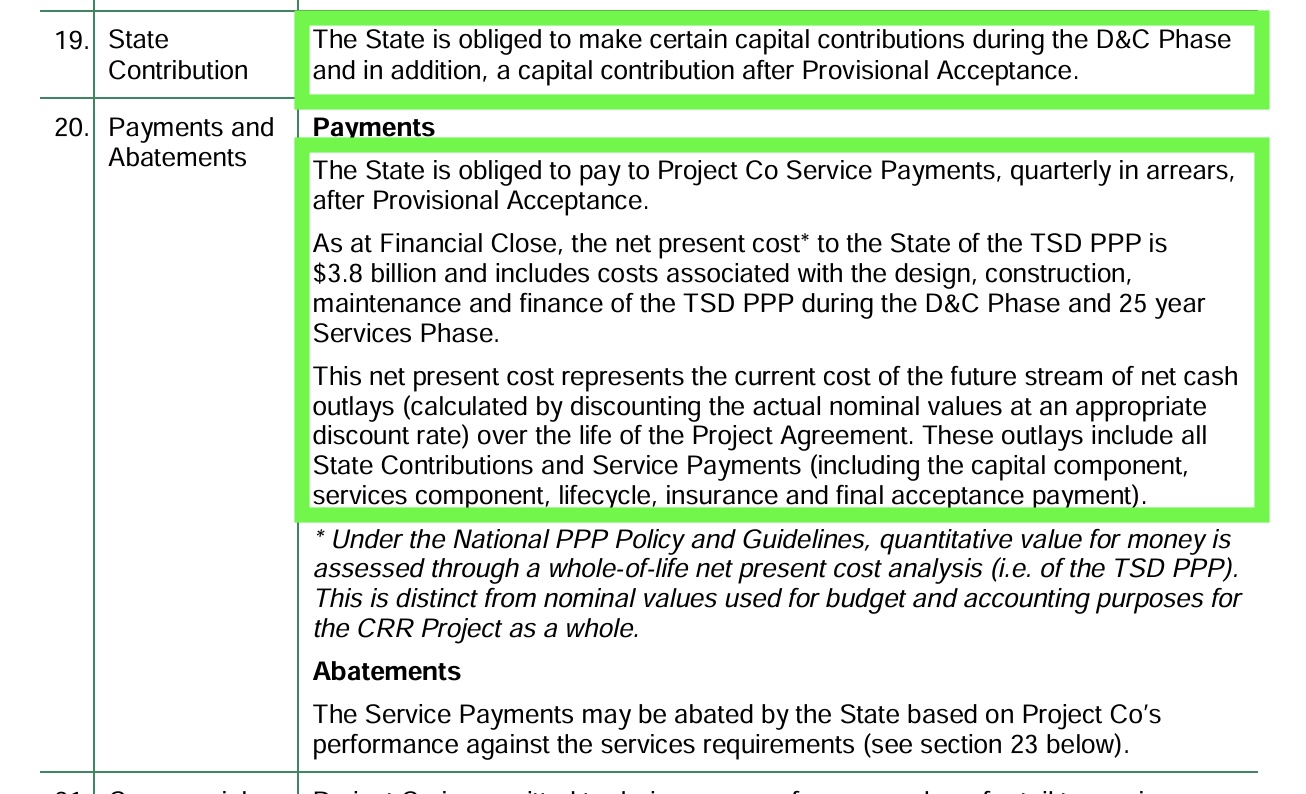
Excerpt - CRRDA Tunnel, Stations and Development Public Private Partnership Project Summary (p20, published March 2020)
The line “This net present cost represents the current cost of the future stream of net cash outlays…” means that the future costs over this 25 year period are foreseeable. At the time, this stream of payments was expected to sum up to around ~ $3.8b.
The cost is therefore not just the state-financed construction part of CRR (presumed to be Item 19 in the above image), but also the sum of these future availability payments to “Project Co”, adjusted to be in today’s dollars (Item 20). Annotations added.
Taking this information as a whole, IMO there is a good case for including maintenance/operations (e.g. the PPP availability payments to) as part of the cost of CRR. That is because (a) it is a PPP with availability payments the Queensland Government has promised to make, and (b) the stream of payments is reasonably certain.
Notes
The three major contracts, including the PPP, appear on the CRR Authority website:
Project Delivery
Cross River Rail is being delivered in partnership with the private sector through three major infrastructure packages of work: the Tunnel, Stations and Development (TSD) public-private partnership; the Rail, Integration and Systems (RIS) alliance; and the European Train Control System (ETCS) contract.
CRRDA Tunnel, Stations and Development Public Private Partnership Project Summary